What Is Depop? How Buying and Selling Works
Depop is an online marketplace where people buy and sell clothing, shoes, and accessories, with a strong focus on secondhand fashion. Sellers create individual listings, buyers choose what they want, and purchases go through the platform. The social side helps you discover styles and follow shops, but each order still needs the same care as any purchase from an independent seller.
If you’re asking what is Depop, the useful answer goes beyond “a clothing app.” You need to know who supplies the items, what buying and selling cost in your country, how delivery and payouts work, and what happens when something goes wrong. Those details differ across the United States, Canada, the United Kingdom, and Australia.
This guide explains the app and website, current fees, offers, shipping, returns, safety, and the company behind the name. You’ll also find practical examples to help you judge a purchase or decide whether listing your own clothes is worth the effort.
Worked examples are illustrations, not typical earnings or guaranteed outcomes.
What is Depop, and how does it work?
Depop connects independent buyers and sellers through a fashion marketplace. Sellers photograph items, describe their condition, choose prices, and arrange shipping after a purchase. Buyers browse or search listings, ask questions, and check out through Depop. The platform supplies the marketplace and payment tools; it generally isn’t the retailer supplying your clothing.
Think of a seller’s profile as a small shop. One person might list a jacket they no longer wear, while another runs a resale business. Their stock, prices, response times, and listing quality can be very different. Depop describes its service as a peer-to-peer fashion marketplace in its company overview.
Founded in 2011, the London-headquartered company developed from a social shopping idea connected with fashion magazine PIG. Its social features let you follow sellers and discover items through other people’s tastes. Buying an existing garment can extend its use, but a secondhand label alone doesn’t measure the environmental impact of a particular purchase.
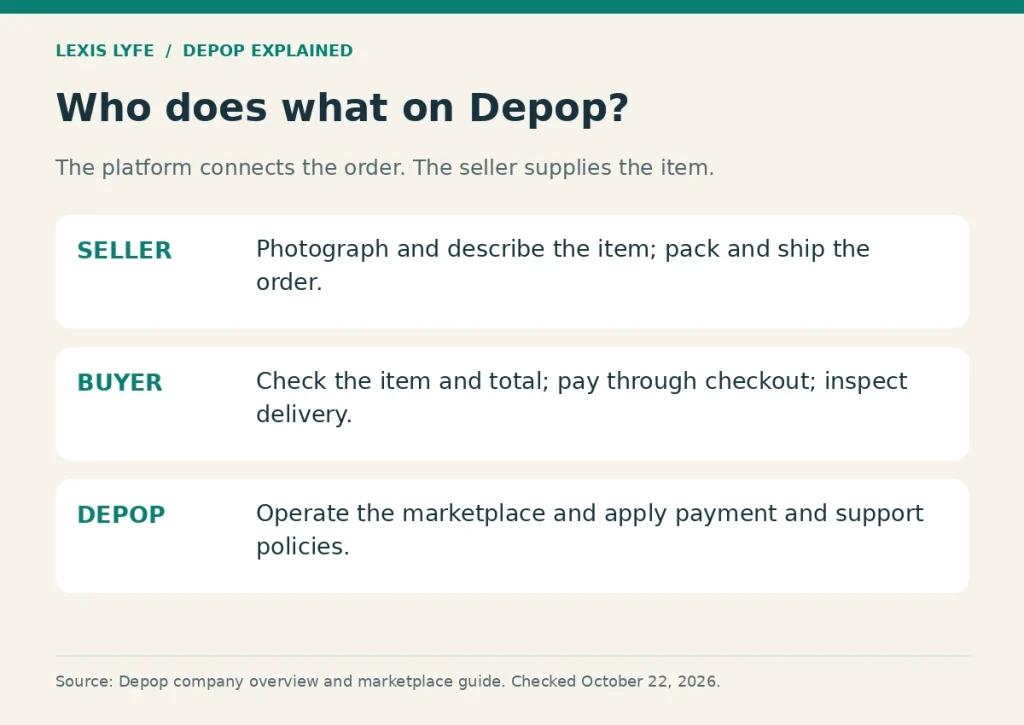
The basic responsibilities are:
- The seller explains the item and fulfills the order.
- The buyer checks the listing, pays through checkout, and reviews the delivery.
- Depop operates the platform and applies its transaction and support policies.
What is the Depop app, and what is the Depop website?
The Depop app is the mobile version of the marketplace. The Depop website is depop.com, its browser-based service. Both provide access to the same marketplace, although screen layouts and available tools can differ. The official getting started guide explains joining, buying, selling, and shipping.
Choose the app if taking listing photos and checking messages on your phone suits you. A computer can make comparing descriptions or organizing shop records easier. Before entering login details, check the domain rather than trusting a link in a message.
Useful terms you’ll see include: ListingThe page describing an individual item, its condition, price, and delivery details. OfferA proposed item price that still requires the purchase to be completed. Depop BalanceThe area showing sale funds and their payment status for Depop Payments sellers. RepopA tool for creating a resale listing from an item previously bought on Depop.
How do you buy on Depop?
To buy on Depop, find an item, inspect its description and photos, check the seller, and review the full price before paying through checkout. Ask about fit or condition before ordering. Save the transaction record, follow delivery updates, and inspect the item promptly when it arrives.
Start with the item, then check the seller
A low price tells you very little without condition and sizing information. A vintage label size may also differ from the fit you expect. Compare measurements with a similar garment you own rather than relying only on “small,” “medium,” or “large.”
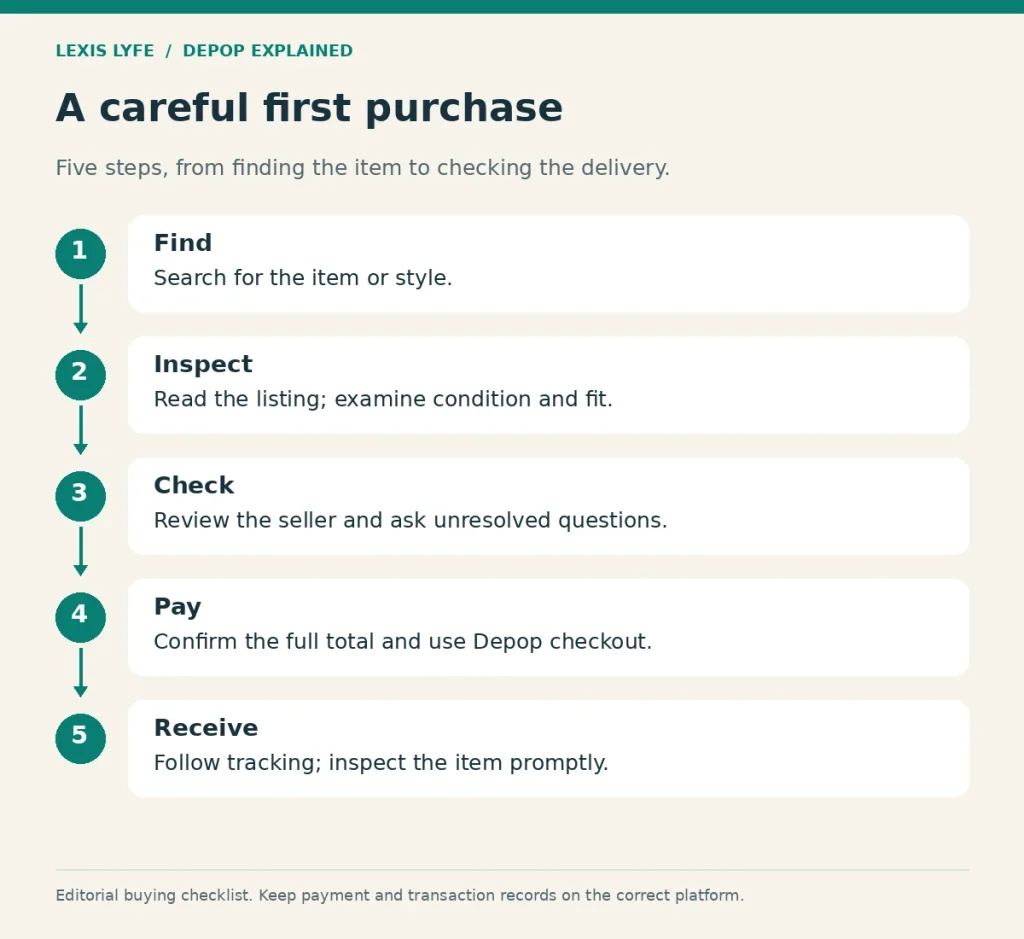
Use this buying sequence:
- Search for the item or style and narrow the results using the available filters.
- Read the full description and examine labels, seams, soles, hardware, and disclosed flaws.
- Review the seller’s recent feedback and ask any unresolved questions in Depop messages.
- Check the item price, delivery charge, buyer fee, and applicable taxes or duties.
- Complete checkout on Depop and monitor the order through your purchase record.
Before paying, look for:
- Measurements: actual garment dimensions where fit matters.
- Condition evidence: close-ups of wear, repairs, stains, or damage.
- Delivery details: the seller’s location and shipping arrangement.
- Consistent information: photos, description, brand, and size that agree.
For style inspiration, the kawaii outfit ideas and styling guide can help you decide which shapes, colors, and accessories you actually want before browsing.
Example: A sweater described as oversized may still have sleeves that are too short for you. Asking for sleeve and body measurements is more useful than asking whether it “fits normally.”
How do offers and bundles work?
An accepted offer isn’t a completed order. Under the current Make Offer policy, the seller has 14 days to respond, and the buyer has 14 days to purchase after acceptance. Shipping is separate, and another buyer can still buy before you complete checkout. The feature currently excludes offers on items outside your country.
When considering a bundle, check:
- Whether the combined price includes a genuine discount.
- Whether the shipping arrangement covers the combined parcel correctly.
- Whether you want every item enough to justify the total.
Depop’s bundle guidance explains available seller discounts. A bundle can reduce some transaction costs, but it doesn’t automatically make unwanted clothing a bargain.
How do you sell on Depop?
To sell on Depop, create an account, complete the required payment setup, and publish an accurate listing with original photos. Choose a price that covers your costs, set the shipping arrangement, and confirm an actual order before dispatch. Keep condition photos, tracking, and transaction records until the sale is resolved.
Set up your account and first listing
Start with clothing you already own so you can learn the process without committing money to stock. Choose an item you can describe confidently and package safely. Selling an existing possession is also a different decision from buying inventory to build a business.
Account preparation has three practical steps:
- Register with accurate personal details and set up your profile.
- Complete the payment and identity requirements shown for your location.
- Check the shipping choices and fee policies before publishing a listing.
Payment arrangements vary geographically. Depop’s parent and guardian guidance identifies Depop Payments for the US, UK, and Australia, with PayPal used elsewhere. Follow the setup shown in your account rather than assuming another country’s tutorial applies.
Build a useful listing in this order:
- Photograph the actual item in clear light, including labels and flaws.
- Identify its type, brand when known, size, color, and material when supported by the label.
- Explain its condition, measurements, alterations, and any missing parts.
- Set the price and shipping arrangement after calculating your likely proceeds.
- Review the listing as a buyer would, then publish it.
Depop’s first-time seller guidance calls for accurate descriptions and original photos. Avoid stock photography and copied descriptions that could misrepresent the garment.
Make the description useful without adding noise
A good listing answers the questions that would otherwise delay a purchase. Write the condition plainly, including anything a buyer would notice on opening the parcel. “Small hole near the left cuff, shown in the final photo” is more useful than “good condition for its age.”
Include:
- A clear identity: what the item is and which brand made it, if known.
- A usable fit description: label size plus measurements where relevant.
- Specific condition notes: the location and extent of wear or damage.
- Accurate style terms: descriptions that actually match the garment.
Listing example: “Blue denim jacket, labeled medium. Chest measured flat: 21 inches. Light fading at the collar and a small mark on the right cuff, both photographed.”
That example is a writing model, not a listing for an actual item. Don’t describe something as authentic, vintage, handmade, or a particular fabric unless you have evidence for the claim.
Manage the sale after someone buys
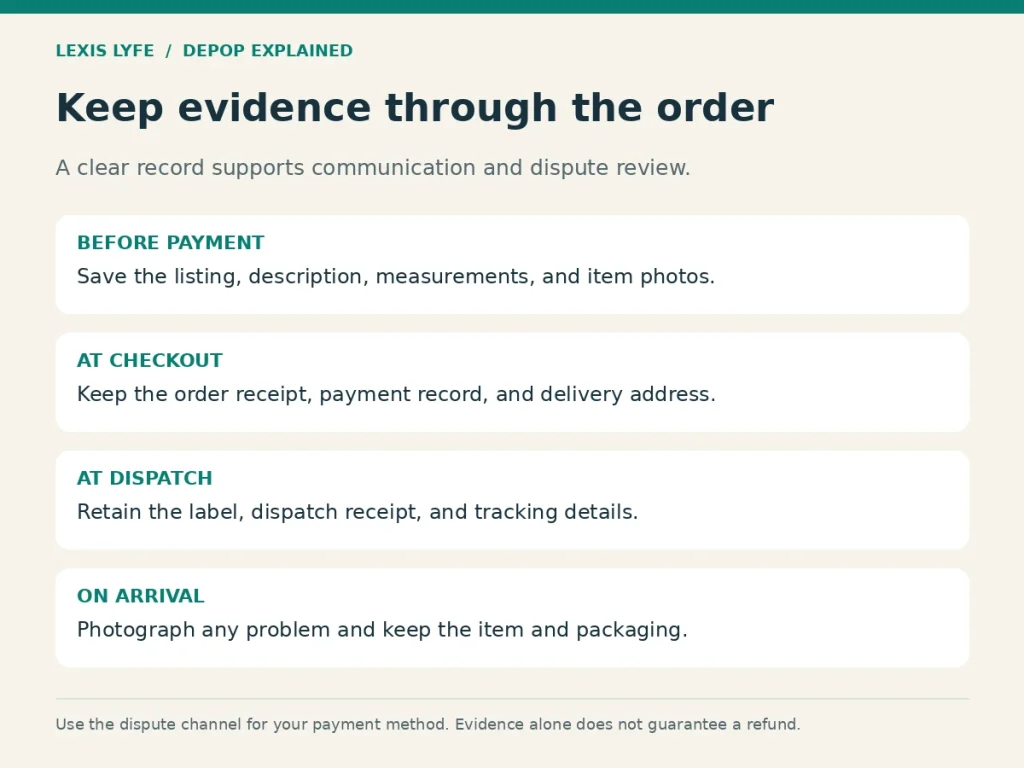
Confirm the order inside your account before shipping. A screenshot or email forwarded by a supposed buyer isn’t a substitute for the transaction record. Pack the correct item, use the agreed shipping method, and retain evidence of dispatch.
Keep a simple record of:
- Item cost and any cleaning or repair expense.
- Sale deductions, including processing and any applicable boosting fee.
- Delivery evidence, such as the label, receipt, and tracking number.
- Inventory status, especially if the same piece is listed elsewhere.
For a growing shop, the startup tools guide explains how to choose tools around a real operating problem. A simple stock record is useful before a larger software subscription.
What does Depop cost in the US, Canada, UK, and Australia?
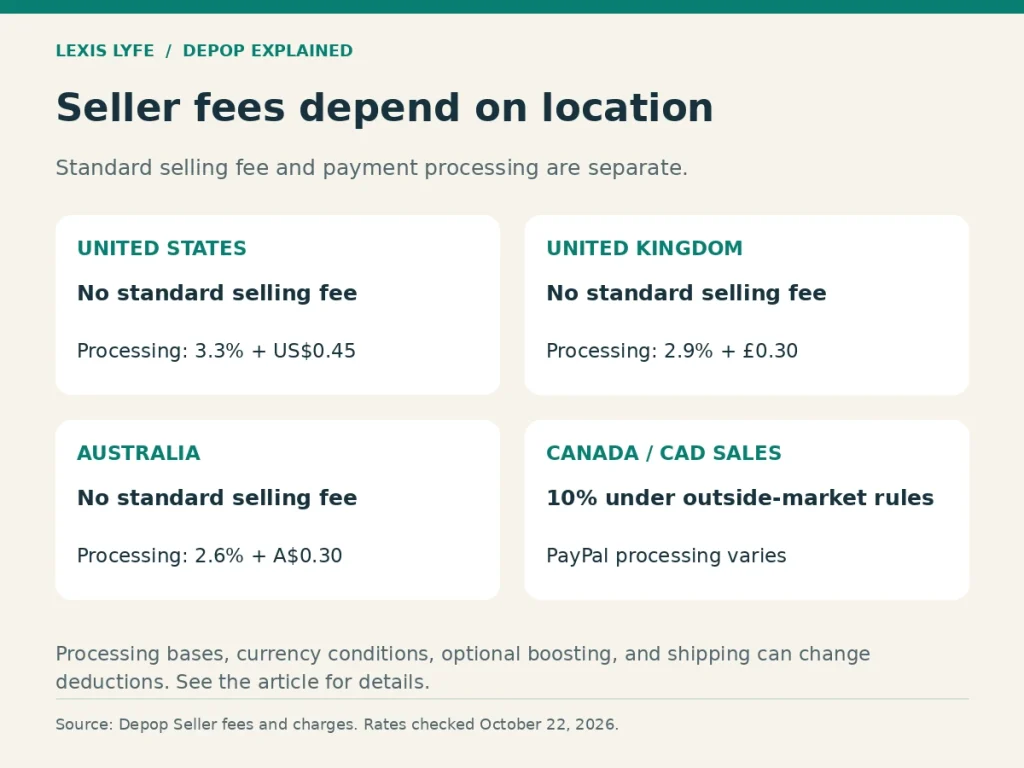
Depop costs depend on your country, payment method, and use of optional promotion. Sellers in the US, UK, and Australia currently have no standard Depop selling fee, but processing still applies. Canadian sellers fall under the separate rules for sellers outside those markets. Buyers should compare the complete checkout total.
Seller fees by country
The following rates come from Depop’s seller fees and charges, checked October 22, 2026.
| Seller location | Standard Depop selling fee | Payment processing |
|---|---|---|
| United States | No standard selling fee | 3.3% + US$0.45 |
| United Kingdom | No standard selling fee | 2.9% + £0.30 |
| Australia | No standard selling fee | 2.6% + A$0.30 |
| Canada | 10% under the outside-market rules for CAD sales | PayPal fee varies by account and location |
For Depop Payments, processing applies to the item price, shipping, and applicable taxes. The outside-market selling-fee policy includes currency conditions and charges on seller-arranged shipping. Check those details if selling across currencies.
No selling fee doesn’t mean no deductions. Your acquisition costs, packaging, delivery expense, and optional promotion still affect what you keep.
Buyer fees and the total price
The current UK and US Marketplace fee policy allows up to 5% of the item price plus up to £1 or US$1. The calculation excludes shipping and taxes; the actual amount is shown during checkout.
Australia’s Marketplace fee policy, effective July 22, 2026, allows up to 5% plus up to A$1. Its pricing explanation says the displayed listing price already includes that fee, with shipping separate. Don’t add the fee twice when comparing prices.
For a US illustration, assume:
- An item price of US$30.
- Shipping of US$6.
- A buyer fee at the stated maximum of US$2.50.
That produces US$38.50 before any applicable tax. It’s a worked maximum-fee example, not a quote for every US$30 purchase. Canadian buyers should use their actual checkout breakdown rather than applying the US or Australian schedule.
Boosting is optional and changes your margin
According to the Boosted Listings policy guidance, the current boosting rate is 12% in the UK and US and 8% in Australia. Its attribution window can charge a qualifying purchase within 28 days of a buyer’s interaction, including after you stop boosting. Shipping can enter the fee base when you arrange it yourself.
Before enabling promotion, check:
- The applicable rate for your location and listing.
- The sale amount on which the fee will be calculated.
- The minimum proceeds you need after every other expense.
Margin example: On a US$30 item with no shipping charge and no tax, US processing is US$1.44. That leaves US$28.56 before other costs. A qualifying 12% boost would deduct another US$3.60, leaving US$24.96.
If the item cost US$8 and packaging cost US$1, that leaves US$15.96 before labor and income tax, assuming no other expenses. This is arithmetic based on the stated assumptions, not a profit forecast.
How do shipping and seller payouts work?
Shipping is arranged by the seller using the options available for their location and account. Payment availability follows a separate schedule and can depend on delivery, verification, and holds. A purchase notification, a shipped parcel, an available balance, and money in your bank account are different stages of the sale.
Choose shipping before accepting a price
Weigh and measure the packed parcel rather than guessing from the garment alone. Packaging adds weight, and a coat needs a different arrangement from a thin T-shirt. Check the label and carrier terms shown in your account before promising a service.
Australian sellers should also check a current transition: the Australian Shipping Policy requires Depop Shipping through Australia Post from October 6, 2026 for users joining from that date, and October 26, 2026 for existing users. On this guide’s October 22 review date, those groups are at different stages of the rollout.
For a smooth dispatch:
- Use the receipt address rather than an alternative supplied in a message.
- Check the correct label and carrier requirements before handing over the parcel.
- Keep the receipt and update tracking through the appropriate order tools.
International orders add another layer. Confirm that the seller ships to your country and check the delivered cost before buying. Depop explains cross-border taxes in its customs fees and taxes guidance; obligations vary by destination and transaction.
Payout timing isn’t identical in every country
| Location | Current official guidance | What to check |
|---|---|---|
| US | Funds become available under a schedule of 2 business days after delivery or 10 business days after sale, whichever comes first | Available balance, withdrawal requirements, bank processing |
| UK | Depop Shipping: 2 business days after delivery or 10 business days after sale, whichever comes first; manual shipping follows a different schedule | Shipping method and any account-specific schedule |
| Australia | Depop Shipping or tracked AusPost can follow a 2–3 business day post-delivery schedule; a 10-business-day post-sale schedule also applies | The arrangement shown in your account |
| Canada | PayPal handles payments under its own availability and hold rules | Your PayPal transaction and account status |
Sources: Depop’s US payout guide, UK payout guide, Australian payout guide, and PayPal guidance.
A pending balance isn’t money you can spend yet. Check identity verification, bank details, and any unresolved order issue before treating a delay as a missing payment.
Is Depop legit, and how can you use it safely?
Depop is a legitimate marketplace, but individual listings and users still need checking. Its existence as a real business doesn’t establish that a particular item is authentic or that every seller is reliable. Use platform checkout, inspect evidence, and understand the protection rules that apply to your location and payment method.
Buyer protection has conditions
Depop’s buyer protection policy covers eligible Depop Payments purchases in the UK, US, and Australia for non-delivery, damage, or significant misdescription. Report qualifying problems within 30 days of purchase. Off-platform transfers and in-person transactions are excluded.
Canadian purchases routed through PayPal follow that provider’s applicable dispute process. Buying on the platform and sending money privately are different actions, even when the payment service has the same name.
Watch for these warning signs:
- Requests to pay through a separate link, bank transfer, or private payment.
- A supposed buyer asking for card details so you can “receive” a sale payment.
- Pressure to ship before the order appears in your account.
- Item photos or explanations that don’t answer reasonable questions.
Depop’s buying safety advice recommends staying within its payment system and using tracked returns. Don’t let a promised discount replace those checks.
Seller protection isn’t the same as tracking
The current seller protection policy requires qualifying sellers in the UK, US, and Australia to use a Depop Shipping label within five days, send to the receipt address, and meet the other conditions. Transaction limits, including shipping and taxes, are £250, US$300, and A$450 respectively. Bundles count as one transaction.
Protection isn’t available under that program to sellers outside those three countries. An independently purchased tracked service can provide delivery evidence without satisfying Depop’s own seller-protection rules.
Practical example: If a buyer messages a different delivery address after paying, don’t simply redirect the parcel. Resolve the order through the platform so the transaction record and shipping arrangement agree.
What happens if an item doesn’t arrive or you want a return?
If an order fails to arrive or differs significantly from its listing, use the dispute process for the payment method you used. A change of mind or an accurately described item that doesn’t fit is a different situation. Inspect the delivery promptly, preserve evidence, and follow the instructions for any agreed return.
Know the difference between a problem and a preference
Depop’s refund guidance distinguishes incorrect or seriously misdescribed items from fit disappointment and changed preferences. Business sellers may have additional obligations under applicable consumer law, so a shop’s wording doesn’t settle every legal question.
| Situation | Useful next step |
|---|---|
| Nothing arrives | Check tracking and raise the issue through the order or applicable PayPal dispute process |
| The label size differs from the listing | Photograph the label and compare it with the saved description |
| Major damage wasn’t disclosed | Photograph the problem and retain the item and packaging |
| The correctly described garment doesn’t suit you | Ask whether the seller accepts a voluntary return |
| You no longer want the purchase | Request a return; don’t assume automatic approval |
For an eligible Depop Payments problem:
- Open the order record and check delivery information.
- Explain the issue and include clear photos where relevant.
- Raise or escalate the issue through Depop within the applicable deadline.
- If a return is agreed, follow the supplied instructions and retain tracking.
The specific missing-order guide says you can raise an issue after more than five days without shipment and must act within 30 days of purchase for the relevant Depop Payments refund route. Don’t wait until the protection deadline has passed to ask for help.
For PayPal payments, consult the applicable PayPal dispute rules through the transaction. Don’t assume Depop’s deadline and PayPal’s deadline are interchangeable.
Can you resell an item that doesn’t fit?
Repop can help create a new listing using information from a previous purchase. Review that information and update the condition, measurements, photos, and price before publishing. A convenient relisting tool doesn’t establish that the original description is still accurate.
What can you sell, and what makes an item worth listing?
Depop is centered on fashion, including secondhand clothing, shoes, bags, and accessories. A useful listing decision considers the item’s condition, evidence, likely demand, and proceeds after costs. Being available to list doesn’t mean an item will sell quickly, at your preferred price, or with a worthwhile return for your time.
Vintage pieces, streetwear, everyday wardrobe items, and seller-designed fashion can all fit the marketplace. The official marketplace guide also discusses reworked and upcycled pieces. Those categories describe possibilities, not a verified ranking of the most profitable products.
Before listing, ask:
- Can I describe and photograph this item accurately?
- Is the condition acceptable at a realistic price?
- Can I pack and ship it within the required arrangement?
- Will the likely proceeds justify the time involved?
Follow product and dropshipping rules
Check the prohibited and restricted items policy before listing unfamiliar categories. Counterfeits and prohibited goods aren’t acceptable just because similar listings appear in search.
Depop’s dropshipping policy prohibits dropshipped catalogue goods while allowing specific seller-designed handmade or print-on-demand arrangements subject to requirements. Those include original photographs and production and delivery disclosures. It isn’t permission to copy a wholesaler’s catalogue into a shop.
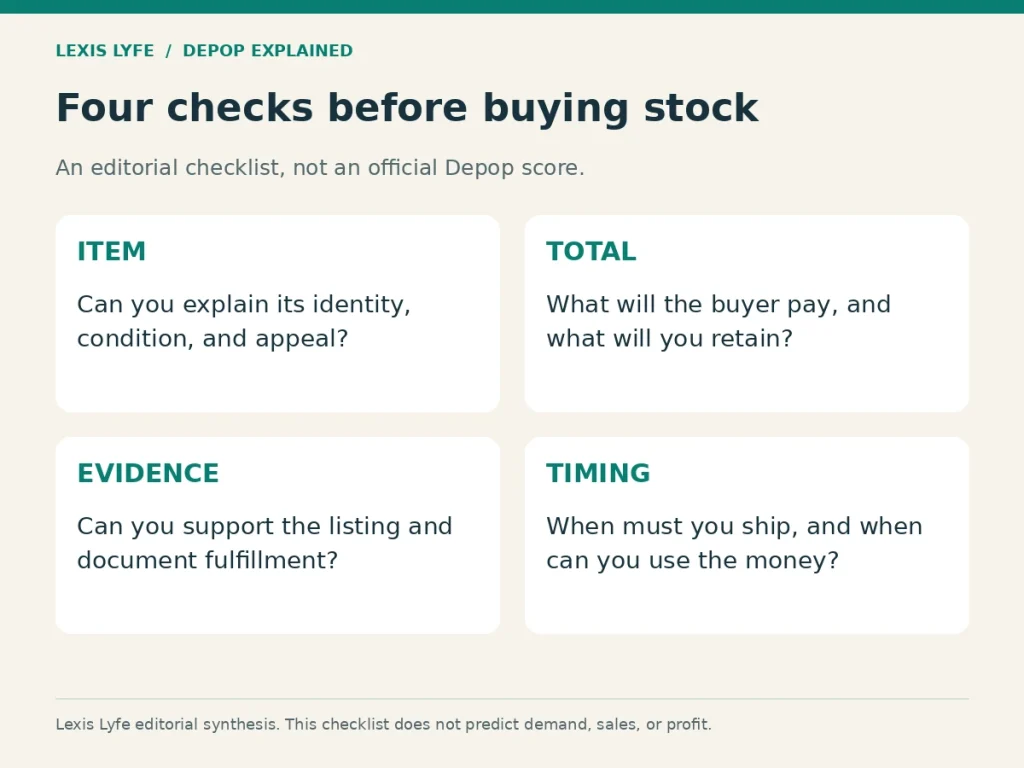
Use four checks before buying stock
This editorial checklist combines the practical decisions above. It isn’t an official Depop score or a prediction of sales:
- Item: Do I understand its identity, condition, and appeal?
- Total: What does the buyer pay, and what do I retain?
- Evidence: Can I support the listing and document fulfillment?
- Timing: When must I ship, and when can I access the money?
Decision example: A jacket can be attractive and fairly priced, yet still be a poor inventory purchase if you can’t verify its authenticity or afford to wait for payment.
For broader income planning, compare these costs and delays with the guide to earning money online without upfront investment. A sales total is different from money retained after the work and expenses.
How does Depop compare with other marketplaces?
Depop suits people who want fashion discovery alongside independent resale listings. Other marketplaces can overlap with that purpose but differ in their category focus and transaction tools. Compare the same item across services using its condition, complete price, delivery arrangement, and return terms rather than choosing from the app’s reputation alone.
| Marketplace | Broad focus | Useful question before choosing |
|---|---|---|
| Depop | Fashion discovery and independent resale | Does this item’s style and presentation suit the buyers I want to reach? |
| Vinted | Clothing, shoes, accessories, and other supported categories | Is the service available for this transaction in my market? |
| eBay | Fashion plus a broad range of goods | Would broader category search help buyers find this item? |
| Etsy | Handmade, vintage, and other goods allowed under its policies | Does the item meet Etsy’s specific marketplace rules? |
This is an editorial comparison of the services’ public positioning, not a fee ranking. Check Vinted, eBay, and Etsy for current local availability and rules before cross-listing.
Avoid assuming that an item receiving more attention on one platform will sell for the same price elsewhere. If you list a single garment on multiple services, update availability promptly after a sale.
Who is Depop for, and can teenagers use it?
Depop can suit buyers looking for individual fashion pieces and sellers willing to photograph, describe, and ship them carefully. Teenagers can create accounts from age 13 under its current rules, but payments have additional age and verification requirements. A younger user’s account therefore needs more preparation than simply downloading an app.
The official age requirements explain when a parent or guardian must help with payment details and identification. Account eligibility doesn’t mean someone under 18 can independently set up every payment service.
For a younger user, discuss:
- A spending limit that includes shipping and fees.
- Keeping conversations within the platform and reporting unwanted contact.
- Protecting personal information and seeking help with payment setup.
- Who will handle packing, disputes, and record keeping.
Depop may be less convenient if you need immediate cash, don’t want to manage delivery, or expect every purchase to have a shop-style change-of-mind return. Start with one low-complexity transaction and learn the process before increasing the amount at stake.
Common Depop mistakes to avoid
The most avoidable Depop problems come from assuming that every country has the same fees, every accepted offer is a sale, or every payment message proves an order exists. Read the transaction details, calculate the complete cost, and match your shipping and evidence to the rules for your account.
Using an old fee tutorial. The fee structure has changed, and the US, UK, Australia, and Canada don’t share one universal schedule. Check the current official page for your location.
Pricing from a suggested figure alone. Compare the actual garment, condition, and costs. A recommended price doesn’t establish demand or guarantee that your sale will be profitable.
Calling every older-looking piece vintage. Verify what you can and describe uncertainty honestly. A style inspired by an earlier decade doesn’t establish when it was made.
Treating likes as income. Interest can help you learn, but only completed purchases create sales. Track proceeds and time rather than relying on attention alone.
Assuming all tracked parcels qualify for protection. Check the separate requirements for Depop’s seller program before choosing a shipping method.
Frequently Asked Questions
The questions below cover the decisions that commonly come before a first purchase or listing: company identity, cost, payment, safety, and selling expectations. Use the country-specific sections above for the full fee and protection conditions. A short answer is a starting point, while the actual transaction record determines what applies to an order.
Conclusion
Depop brings independent fashion sellers and buyers together through an app and website. A good transaction starts with an accurate item description, a clear total price, and checkout through the proper channel. Check local fees, shipping conditions, and payment timing before deciding what to buy or list.
For your first purchase, choose an item with clear photos and measurements. For your first sale, pick something you already own and can describe confidently. Keep the order evidence and learn each stage before increasing your spending or inventory.