
Amazon Interview Experience: SDE 1 and SDE 2 Process, Questions, and Preparation Guide
An Amazon interview experience is rarely just a sequence of coding puzzles. Current official guidance and recent candidate reports show a combined evaluation of problem-solving, executable code, design judgment, communication, and evidence from past behavior. The exact path changes by role, location, university status, and hiring team, so a useful guide must separate Amazon’s published process from one person’s anecdote.
This guide explains the online assessment, phone screen, interview loop, coding, low-level and high-level design, Leadership Principles, STAR stories, and the Bar Raiser. It also compares the Amazon SDE 1 interview experience with the Amazon SDE 2 interview experience, gives representative questions from recent accounts, and provides a six-week plan for candidates in the United States, Canada, and India. You will leave with a repeatable method for every round and a way to measure readiness before interview day.
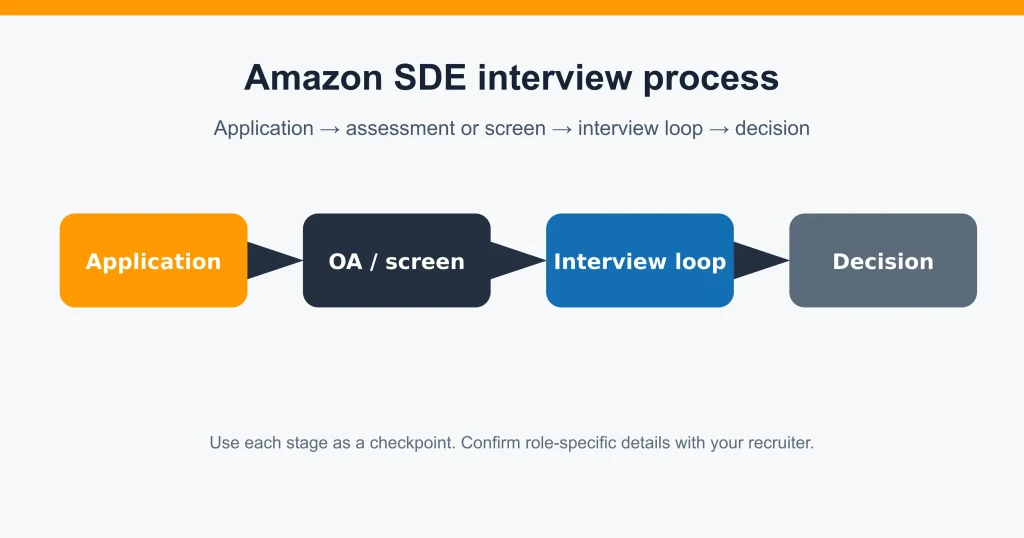
What the Amazon SDE Interview Process Looks Like
Amazon’s process commonly moves from an application to an assessment or technical screen, then to an interview loop and a decision. The exact sequence is role-specific. Amazon’s current SDE II page publishes an online assessment followed by four 55-minute interviews, while university SDE guidance describes different assessment components by country and candidate type. Confirm your own schedule with the recruiter.
Amazon’s official SDE II preparation page says its current OA includes 90 minutes for two technical questions, 20 minutes of system-design scenarios, and an 8-minute Work Style Survey. It describes the loop as four 55-minute interviews. Those numbers are reliable for the page’s SDE II path, but they should not be generalized to every SDE 1, internship, or team-specific opening.
The university SDE online-assessment guide says full-time and internship structures can differ by country. It lists an average 70-minute coding assessment, a 15-minute Workstyles Assessment, and, for some full-time processes, a 60-minute Work Simulation. Recent candidate reports in India also describe two coding problems plus work-style or work-simulation tasks. Treat the invitation email as the final specification.
A common end-to-end sequence is:
- Application and resume review. The team checks the role’s basic and preferred qualifications.
- Recruiter contact or assessment invitation. Some candidates speak to a recruiter before testing; others receive the OA first.
- Online assessment or technical phone screen. Coding, work-style, simulation, or design scenarios may appear.
- Interview loop. Interviewers collect independent evidence across technical and behavioral competencies.
- Debrief and decision. The team combines evidence after the loop; the recruiter communicates the outcome.
Before preparing, ask the recruiter:
- Which level and job ID is this loop evaluating?
- Is there an OA, phone screen, or both?
- How many interviews are scheduled, and how long is each?
- Which rounds cover coding, LLD/OOD, HLD, or domain knowledge?
- Which coding environment will be used?
- May the loop be split across days?
- When should accommodations be requested?
The invitation email and recruiter guidance override any public interview story. A report can show what happened once. It cannot promise what will happen to you.
SDE 1 vs. SDE 2: What Changes in the Interview
SDE 1 candidates are usually asked to demonstrate dependable fundamentals, clear problem solving, and the ability to learn. SDE 2 candidates must also show independent ownership, system-design judgment, operational awareness, and influence beyond a narrowly assigned task. Both levels can receive coding and behavioral questions; the expected depth and scope change.
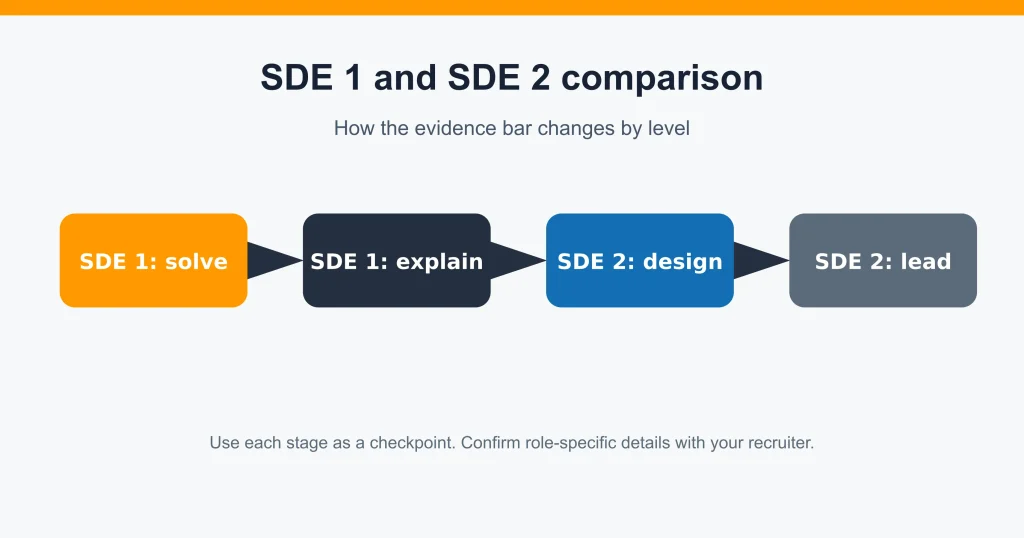
| Dimension | SDE 1 emphasis | SDE 2 emphasis |
|---|---|---|
| Primary signal | Sound fundamentals and growth | Independent delivery and technical judgment |
| Coding | Correct, explainable, tested solution | Correct, maintainable solution with trade-offs and follow-ups |
| Design | OOP/LLD basics or scoped design, depending on team | LLD and HLD depth; scaling, reliability, operations |
| Behavior | Projects, internships, teamwork, learning | Ownership, ambiguity, cross-team influence, measurable results |
| Scope | Well-defined component or task | Service or feature life cycle with limited oversight |
| Follow-ups | Complexity, edge cases, alternatives | Constraints, failure modes, evolution, migration, operations |
For SDE 1, strong evidence can come from internships, academic projects, open-source work, or an early-career role. The story still needs a real constraint, your individual action, and a result. Calling a class project “production scale” without evidence weakens trust. Explain the actual user count, latency, dataset size, deadline, or failure you faced.
For SDE 2, a correct diagram is only the start. Interviewers may probe why you selected a data model, where the bottleneck moves at ten times the traffic, how you deploy safely, what happens when a dependency fails, and how you would measure success. Your behavioral stories should show that you made and defended consequential choices while listening to others.
Level is an evidence problem. If a story shows that you completed a ticket exactly as specified, it supports delivery. If it shows that you found an ambiguous customer problem, aligned stakeholders, selected a reversible design, shipped it, monitored it, and corrected an unexpected effect, it supports broader ownership.
Online Assessment: Format, Strategy, and Common Traps
The OA tests more than the final number of passing cases. Depending on the role, it may combine coding with system-design scenarios, a Workstyles Assessment, or a Work Simulation. Use the timing and components in your invitation, practice in a plain editor, and reserve time to test boundary conditions instead of spending the entire session optimizing one solution.
A strong OA routine has four passes:
- Read both problems. Note constraints, input size, and the likely target complexity.
- Secure a correct baseline. Implement the clearer problem first unless the platform requires another order.
- Test adversarial cases. Include empty or minimal input, duplicates, extreme values, and state that persists across operations.
- Review the work-style portion calmly. Answer consistently with how you actually work and the behaviors described in Amazon’s Leadership Principles.
Use this coding checklist:
- Restate the goal in your own words.
- Extract constraints before choosing a data structure.
- Estimate complexity from the input limits.
- Name invariants for loops, windows, heaps, or dynamic programming states.
- Run a small example by hand.
- Test the smallest valid input.
- Check duplicates and ties.
- Avoid global mutable state between test cases.
- Return exactly the required format.
Recent accounts frequently mention two DSA problems. Topics include greedy methods, binary search, heaps, graphs, trees, dynamic programming, sliding windows, and strings. That does not make a list of recently tagged questions a prediction engine. Practice should produce transferable patterns and clean implementation habits.
Common OA mistakes include optimizing before the behavior is correct, ignoring integer overflow, treating sample cases as a full specification, copying a memorized pattern that violates a constraint, and leaving no time for the work-style or survey component. If a case fails, reduce it to the smallest counterexample and inspect the invariant.
Coding Interviews: The Method Interviewers Can Evaluate
A strong coding interview makes your reasoning observable. Clarify the input and output, propose a baseline, improve it using the constraints, write syntactically correct code, and test it aloud. Amazon’s official SDE II guidance explicitly says to expect real code rather than pseudocode and names scalable, robust, well-tested code as the main criteria.
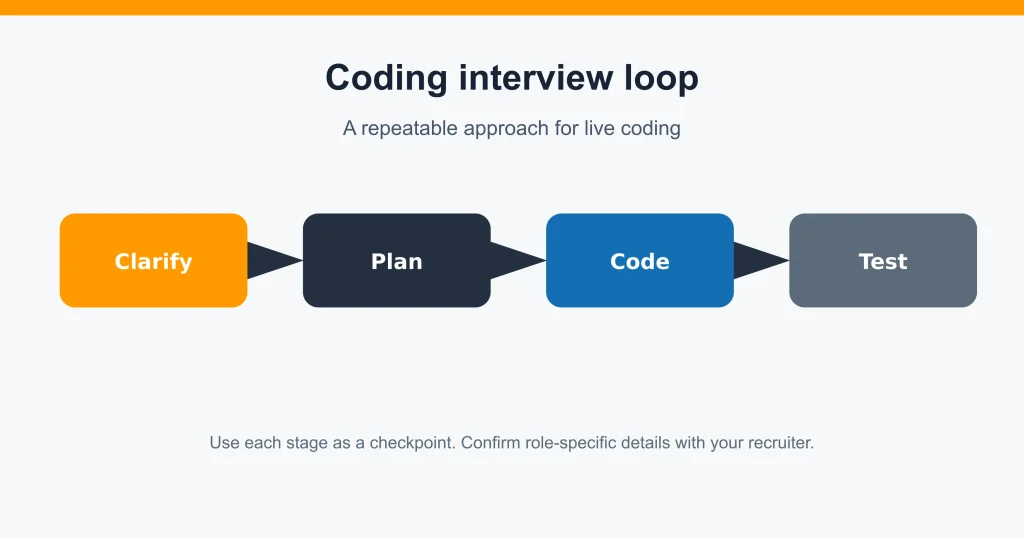
Use this seven-step sequence:
- Clarify. Ask about null input, duplicates, ordering, mutability, range, and expected output.
- Confirm scale. Input size often distinguishes a quadratic approach from an
O(n log n)orO(n)target. - Give a baseline. A short brute-force explanation proves that you understand correctness.
- Find the bottleneck. Identify repeated work, search, ordering, or state that a data structure can improve.
- State the invariant. Explain what remains true as the algorithm advances.
- Implement cleanly. Use meaningful names, small helpers, and explicit boundary handling.
- Test and analyze. Dry-run normal and adversarial cases, then state time and space complexity.
A useful opening sounds like this: “I’ll confirm two edge cases, outline a direct solution, then use the input bound to decide whether we need the optimized version.” That sentence tells the interviewer where you are going without pretending you already know the answer.
When stuck, do not disappear into silence. State the exact obstacle: “The expensive step is finding the next smallest element after every update. I’m considering a heap, but deletion may be stale, so I would store versioned entries and discard stale ones when popped.” Even if the solution is incomplete, the interviewer can evaluate technical judgment.
DSA Patterns That Matter Most
The best topic list is a set of reasoning tools, not a prediction of exact questions. Amazon’s official software-development topics include programming languages, data structures, algorithms, coding, object-oriented design, databases, distributed computing, operating systems, internet topics, and general machine learning or AI. Prioritize the patterns below, then cover the broader fundamentals relevant to your job description.
Arrays and hashing
Use it when: frequency maps, prefix information, and index relationships. The interview signal is not recognizing the label; it is converting constraints into the right structure and explaining correctness. For arrays and hashing, practice one direct problem, one variation with an added constraint, and one problem where the pattern is tempting but wrong. That contrast prevents mechanical matching.
- Core check: state what each key represents and test duplicate-heavy input.
- Complexity check: derive cost from operations, including hidden sorting, recursion depth, or auxiliary structures.
- Communication check: explain the invariant before typing and revisit it during the dry run.
Two pointers
Use it when: sorted input, opposite ends, or coordinated traversal. The interview signal is not recognizing the label; it is converting constraints into the right structure and explaining correctness. For two pointers, practice one direct problem, one variation with an added constraint, and one problem where the pattern is tempting but wrong. That contrast prevents mechanical matching.
- Core check: prove why moving one pointer cannot discard a valid answer.
- Complexity check: derive cost from operations, including hidden sorting, recursion depth, or auxiliary structures.
- Communication check: explain the invariant before typing and revisit it during the dry run.
Sliding windows
Use it when: contiguous ranges with a monotonic validity condition. The interview signal is not recognizing the label; it is converting constraints into the right structure and explaining correctness. For sliding windows, practice one direct problem, one variation with an added constraint, and one problem where the pattern is tempting but wrong. That contrast prevents mechanical matching.
- Core check: name when the left edge moves and what the window guarantees.
- Complexity check: derive cost from operations, including hidden sorting, recursion depth, or auxiliary structures.
- Communication check: explain the invariant before typing and revisit it during the dry run.
Stacks and monotonic stacks
Use it when: nearest greater/smaller relationships and deferred work. The interview signal is not recognizing the label; it is converting constraints into the right structure and explaining correctness. For stacks and monotonic stacks, practice one direct problem, one variation with an added constraint, and one problem where the pattern is tempting but wrong. That contrast prevents mechanical matching.
- Core check: explain what order the stack preserves.
- Complexity check: derive cost from operations, including hidden sorting, recursion depth, or auxiliary structures.
- Communication check: explain the invariant before typing and revisit it during the dry run.
Queues and deques
Use it when: BFS, scheduling, or maintaining candidates in order. The interview signal is not recognizing the label; it is converting constraints into the right structure and explaining correctness. For queues and deques, practice one direct problem, one variation with an added constraint, and one problem where the pattern is tempting but wrong. That contrast prevents mechanical matching.
- Core check: separate enqueue-time from dequeue-time invariants.
- Complexity check: derive cost from operations, including hidden sorting, recursion depth, or auxiliary structures.
- Communication check: explain the invariant before typing and revisit it during the dry run.
Linked lists
Use it when: pointer rewiring, cycles, merging, and in-place updates. The interview signal is not recognizing the label; it is converting constraints into the right structure and explaining correctness. For linked lists, practice one direct problem, one variation with an added constraint, and one problem where the pattern is tempting but wrong. That contrast prevents mechanical matching.
- Core check: draw three nodes and protect references before mutation.
- Complexity check: derive cost from operations, including hidden sorting, recursion depth, or auxiliary structures.
- Communication check: explain the invariant before typing and revisit it during the dry run.
Trees
Use it when: recursive structure, traversals, path state, and aggregation. The interview signal is not recognizing the label; it is converting constraints into the right structure and explaining correctness. For trees, practice one direct problem, one variation with an added constraint, and one problem where the pattern is tempting but wrong. That contrast prevents mechanical matching.
- Core check: define what each recursive call returns.
- Complexity check: derive cost from operations, including hidden sorting, recursion depth, or auxiliary structures.
- Communication check: explain the invariant before typing and revisit it during the dry run.
Graphs
Use it when: reachability, components, shortest paths, and dependency order. The interview signal is not recognizing the label; it is converting constraints into the right structure and explaining correctness. For graphs, practice one direct problem, one variation with an added constraint, and one problem where the pattern is tempting but wrong. That contrast prevents mechanical matching.
- Core check: state directedness, weights, and visited-state semantics.
- Complexity check: derive cost from operations, including hidden sorting, recursion depth, or auxiliary structures.
- Communication check: explain the invariant before typing and revisit it during the dry run.
Heaps
Use it when: top-k selection, event ordering, and streaming extrema. The interview signal is not recognizing the label; it is converting constraints into the right structure and explaining correctness. For heaps, practice one direct problem, one variation with an added constraint, and one problem where the pattern is tempting but wrong. That contrast prevents mechanical matching.
- Core check: handle stale entries and explain heap size.
- Complexity check: derive cost from operations, including hidden sorting, recursion depth, or auxiliary structures.
- Communication check: explain the invariant before typing and revisit it during the dry run.
Binary search
Use it when: ordered values or a monotonic answer predicate. The interview signal is not recognizing the label; it is converting constraints into the right structure and explaining correctness. For binary search, practice one direct problem, one variation with an added constraint, and one problem where the pattern is tempting but wrong. That contrast prevents mechanical matching.
- Core check: write the invariant for the search interval.
- Complexity check: derive cost from operations, including hidden sorting, recursion depth, or auxiliary structures.
- Communication check: explain the invariant before typing and revisit it during the dry run.
Sorting and intervals
Use it when: ordering that exposes mergeable or schedulable structure. The interview signal is not recognizing the label; it is converting constraints into the right structure and explaining correctness. For sorting and intervals, practice one direct problem, one variation with an added constraint, and one problem where the pattern is tempting but wrong. That contrast prevents mechanical matching.
- Core check: define tie-breaking before coding.
- Complexity check: derive cost from operations, including hidden sorting, recursion depth, or auxiliary structures.
- Communication check: explain the invariant before typing and revisit it during the dry run.
Backtracking
Use it when: search spaces with reversible choices. The interview signal is not recognizing the label; it is converting constraints into the right structure and explaining correctness. For backtracking, practice one direct problem, one variation with an added constraint, and one problem where the pattern is tempting but wrong. That contrast prevents mechanical matching.
- Core check: show the choice, recurse, and undo steps explicitly.
- Complexity check: derive cost from operations, including hidden sorting, recursion depth, or auxiliary structures.
- Communication check: explain the invariant before typing and revisit it during the dry run.
Dynamic programming
Use it when: overlapping subproblems and optimal substructure. The interview signal is not recognizing the label; it is converting constraints into the right structure and explaining correctness. For dynamic programming, practice one direct problem, one variation with an added constraint, and one problem where the pattern is tempting but wrong. That contrast prevents mechanical matching.
- Core check: define state, transition, base case, and evaluation order.
- Complexity check: derive cost from operations, including hidden sorting, recursion depth, or auxiliary structures.
- Communication check: explain the invariant before typing and revisit it during the dry run.
Greedy algorithms
Use it when: a locally safe choice supported by an exchange argument. The interview signal is not recognizing the label; it is converting constraints into the right structure and explaining correctness. For greedy algorithms, practice one direct problem, one variation with an added constraint, and one problem where the pattern is tempting but wrong. That contrast prevents mechanical matching.
- Core check: explain why delaying or reversing the choice cannot improve the result.
- Complexity check: derive cost from operations, including hidden sorting, recursion depth, or auxiliary structures.
- Communication check: explain the invariant before typing and revisit it during the dry run.
Strings and tries
Use it when: prefix operations, tokenization, or character counts. The interview signal is not recognizing the label; it is converting constraints into the right structure and explaining correctness. For strings and tries, practice one direct problem, one variation with an added constraint, and one problem where the pattern is tempting but wrong. That contrast prevents mechanical matching.
- Core check: clarify encoding, case, and normalization.
- Complexity check: derive cost from operations, including hidden sorting, recursion depth, or auxiliary structures.
- Communication check: explain the invariant before typing and revisit it during the dry run.
Union-find
Use it when: dynamic connectivity and component merging. The interview signal is not recognizing the label; it is converting constraints into the right structure and explaining correctness. For union-find, practice one direct problem, one variation with an added constraint, and one problem where the pattern is tempting but wrong. That contrast prevents mechanical matching.
- Core check: describe path compression and union policy.
- Complexity check: derive cost from operations, including hidden sorting, recursion depth, or auxiliary structures.
- Communication check: explain the invariant before typing and revisit it during the dry run.
Topological sorting
Use it when: prerequisites and cycle detection. The interview signal is not recognizing the label; it is converting constraints into the right structure and explaining correctness. For topological sorting, practice one direct problem, one variation with an added constraint, and one problem where the pattern is tempting but wrong. That contrast prevents mechanical matching.
- Core check: explain what indegree zero means at each step.
- Complexity check: derive cost from operations, including hidden sorting, recursion depth, or auxiliary structures.
- Communication check: explain the invariant before typing and revisit it during the dry run.
Dijkstra and weighted paths
Use it when: nonnegative edge weights and best-known distances. The interview signal is not recognizing the label; it is converting constraints into the right structure and explaining correctness. For dijkstra and weighted paths, practice one direct problem, one variation with an added constraint, and one problem where the pattern is tempting but wrong. That contrast prevents mechanical matching.
- Core check: state why a popped finalized distance is safe.
- Complexity check: derive cost from operations, including hidden sorting, recursion depth, or auxiliary structures.
- Communication check: explain the invariant before typing and revisit it during the dry run.
What Production-Ready Code Means in a Live Interview
Production-ready interview code is readable, defensible, and tested within the time available. It does not require a framework or exhaustive validation. It uses a suitable algorithm, meaningful names, controlled mutation, correct boundaries, and explicit handling of the inputs the interviewer says matter. The candidate can explain how the code would evolve in a real service.
Use this quality checklist:
- Correctness: the algorithm matches the clarified contract.
- Readability: names reveal roles such as
left,frequency, orbest_distance. - Maintainability: helpers separate distinct operations without fragmenting trivial logic.
- Robustness: edge cases are handled deliberately.
- Efficiency: time and memory fit the constraints.
- Testability: examples cover success, boundaries, and failure-prone transitions.
- Portability: avoid relying on obscure library behavior unless you explain it.
A common misconception is that talking makes coding slower. Unstructured narration does. Structured narration saves time because the interviewer can correct a misunderstood requirement before you build on it. Speak at decision points, then focus while typing.
Low-Level Design and Object-Oriented Design
Low-level design evaluates how you turn requirements into objects, interfaces, state transitions, and extensible behavior. Start with use cases, identify changing behavior, establish ownership of state, and expose a small API. Avoid beginning with design-pattern names. A pattern is useful only when it solves a stated source of change.
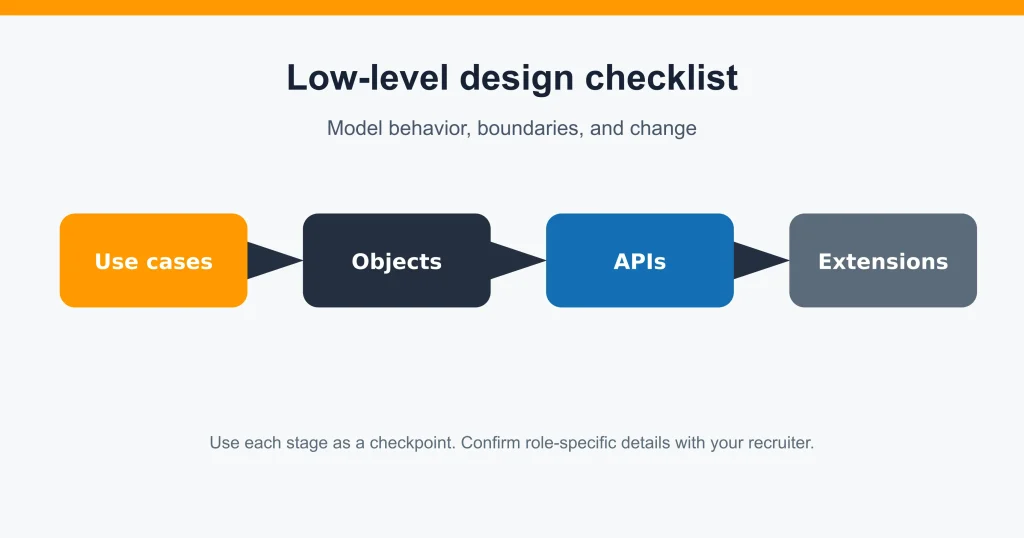
A repeatable LLD sequence is:
- List primary use cases and actors.
- Define invariants and state transitions.
- Identify entities, values, services, and repositories.
- Assign responsibilities and avoid a single “god” class.
- Sketch public methods and error behavior.
- Walk through one use case, then add a new requirement.
Representative prompts in recent accounts include a calculator, ATM, bookstore, file library, chatbot service, and Stack Overflow-like product. The nouns suggest entities, but the verbs reveal behavior. In an ATM, “withdraw” raises authorization, balance, cash inventory, denomination selection, idempotency, and failure recovery. Listing User, Account, and ATM is not enough.
For SDE 1, interviewers may accept a scoped model with clean abstractions and clear trade-offs. For SDE 2, expect follow-ups about concurrency, extension, persistence, test seams, failure handling, and boundaries between objects and services. If a prompt says “make it extensible,” ask which variation is expected first.
High-Level System Design for SDE 2
High-level design tests how you convert an ambiguous product into a scalable and operable system. Clarify functional requirements, quantify scale, define APIs and data, draw major components, then analyze bottlenecks and failure modes. A good answer makes trade-offs explicit and spends depth where the interviewer signals interest.
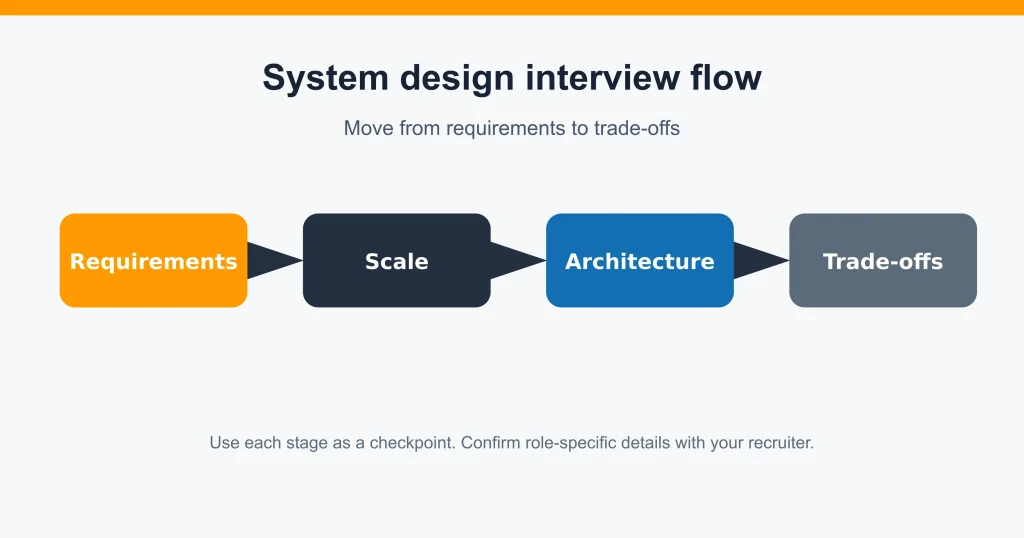
| Stage | Questions to answer | Strong behavior |
|---|---|---|
| Requirements | Users, actions, consistency, latency, availability | Do not design every possible feature |
| Scale | Traffic, storage, read/write ratio, growth | Use rough numbers to expose bottlenecks |
| Interface | APIs, events, idempotency, errors | Tie endpoints to stated use cases |
| Data | Entities, access patterns, indexes, retention | Choose storage from access patterns |
| Architecture | Services, caches, queues, workers | Explain synchronous and asynchronous paths |
| Reliability | Replication, retries, timeouts, backpressure | Name duplicate and partial-failure behavior |
| Operations | Metrics, logs, traces, deployment, rollback | Connect signals to user impact |
Use this design order:
- Clarify the product. Identify core and optional requirements.
- Estimate the workload. Rough calculations are decision tools, not trivia.
- Define contracts. Specify request, response, identity, pagination, and error semantics.
- Model data from access patterns. Discuss keys, indexes, consistency, and retention.
- Draw the main path. Client, edge, service, storage, cache, and asynchronous work.
- Stress the design. Hot keys, celebrity traffic, dependency failure, retries, and regional loss.
- Close with trade-offs. State what you optimized and what you intentionally deferred.
Recent SDE 2 accounts mention URL shorteners, Twitter-like feeds, parking systems, ad servers, meeting-room booking, load balancing, and grocery-store parking. Do not memorize one diagram per product. Practice primitives: partitioning, replication, caching, queues, fan-out, rate limiting, search, object storage, idempotency, and observability.
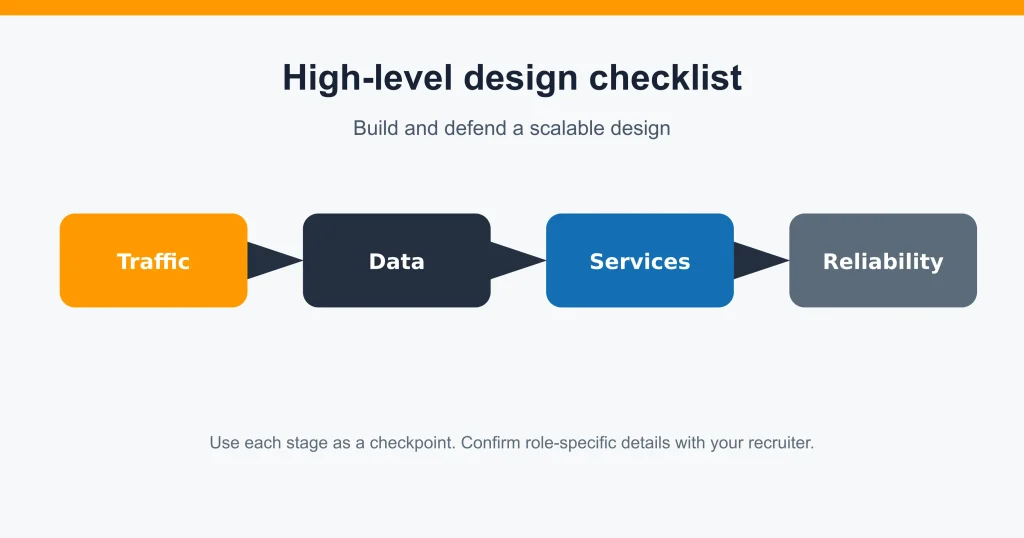
Capacity estimates
Focus: derive requests per second, peak factor, object size, and retention. A strong answer provides a rough estimate that changes a design choice. Explain the default choice, one plausible alternative, and the condition that would make you switch. Trade-offs become credible when they are attached to a workload or failure mode.
- Ask: What requirement makes capacity estimates important here?
- Decide: Which option best fits the stated scale and consistency needs?
- Verify: Which metric or test would show that the decision is failing?
API design
Focus: define identities, pagination, idempotency keys, and failure responses. A strong answer provides contracts that support retries safely. Explain the default choice, one plausible alternative, and the condition that would make you switch. Trade-offs become credible when they are attached to a workload or failure mode.
- Ask: What requirement makes api design important here?
- Decide: Which option best fits the stated scale and consistency needs?
- Verify: Which metric or test would show that the decision is failing?
Data modeling
Focus: start from reads and writes, then choose keys and indexes. A strong answer provides a reasoned SQL, NoSQL, or hybrid choice. Explain the default choice, one plausible alternative, and the condition that would make you switch. Trade-offs become credible when they are attached to a workload or failure mode.
- Ask: What requirement makes data modeling important here?
- Decide: Which option best fits the stated scale and consistency needs?
- Verify: Which metric or test would show that the decision is failing?
Caching
Focus: name the key, value, TTL, invalidation, and miss path. A strong answer provides awareness of staleness and hot keys. Explain the default choice, one plausible alternative, and the condition that would make you switch. Trade-offs become credible when they are attached to a workload or failure mode.
- Ask: What requirement makes caching important here?
- Decide: Which option best fits the stated scale and consistency needs?
- Verify: Which metric or test would show that the decision is failing?
Partitioning
Focus: choose a partition key and discuss skew and rebalancing. A strong answer provides a plan for uneven traffic. Explain the default choice, one plausible alternative, and the condition that would make you switch. Trade-offs become credible when they are attached to a workload or failure mode.
- Ask: What requirement makes partitioning important here?
- Decide: Which option best fits the stated scale and consistency needs?
- Verify: Which metric or test would show that the decision is failing?
Replication
Focus: state consistency and failover expectations. A strong answer provides read/write behavior during failure. Explain the default choice, one plausible alternative, and the condition that would make you switch. Trade-offs become credible when they are attached to a workload or failure mode.
- Ask: What requirement makes replication important here?
- Decide: Which option best fits the stated scale and consistency needs?
- Verify: Which metric or test would show that the decision is failing?
Queues and streams
Focus: separate producers, consumers, ordering, and retry semantics. A strong answer provides handling duplicates and poison messages. Explain the default choice, one plausible alternative, and the condition that would make you switch. Trade-offs become credible when they are attached to a workload or failure mode.
- Ask: What requirement makes queues and streams important here?
- Decide: Which option best fits the stated scale and consistency needs?
- Verify: Which metric or test would show that the decision is failing?
Rate limiting
Focus: identify scope, algorithm, storage, and user response. A strong answer provides fairness plus overload protection. Explain the default choice, one plausible alternative, and the condition that would make you switch. Trade-offs become credible when they are attached to a workload or failure mode.
- Ask: What requirement makes rate limiting important here?
- Decide: Which option best fits the stated scale and consistency needs?
- Verify: Which metric or test would show that the decision is failing?
Search
Focus: distinguish source of truth from an index. A strong answer provides freshness, reindexing, and query needs. Explain the default choice, one plausible alternative, and the condition that would make you switch. Trade-offs become credible when they are attached to a workload or failure mode.
- Ask: What requirement makes search important here?
- Decide: Which option best fits the stated scale and consistency needs?
- Verify: Which metric or test would show that the decision is failing?
Reliability
Focus: use timeouts, retries with jitter, circuit breaking, and backpressure. A strong answer provides avoid retry storms and cascading failure. Explain the default choice, one plausible alternative, and the condition that would make you switch. Trade-offs become credible when they are attached to a workload or failure mode.
- Ask: What requirement makes reliability important here?
- Decide: Which option best fits the stated scale and consistency needs?
- Verify: Which metric or test would show that the decision is failing?
Observability
Focus: tie metrics, logs, and traces to service-level symptoms. A strong answer provides signals that lead to a diagnosis. Explain the default choice, one plausible alternative, and the condition that would make you switch. Trade-offs become credible when they are attached to a workload or failure mode.
- Ask: What requirement makes observability important here?
- Decide: Which option best fits the stated scale and consistency needs?
- Verify: Which metric or test would show that the decision is failing?
Deployment
Focus: describe compatibility, canaries, rollback, and migration. A strong answer provides a safe path from old to new. Explain the default choice, one plausible alternative, and the condition that would make you switch. Trade-offs become credible when they are attached to a workload or failure mode.
- Ask: What requirement makes deployment important here?
- Decide: Which option best fits the stated scale and consistency needs?
- Verify: Which metric or test would show that the decision is failing?
Leadership Principles and the STAR Method
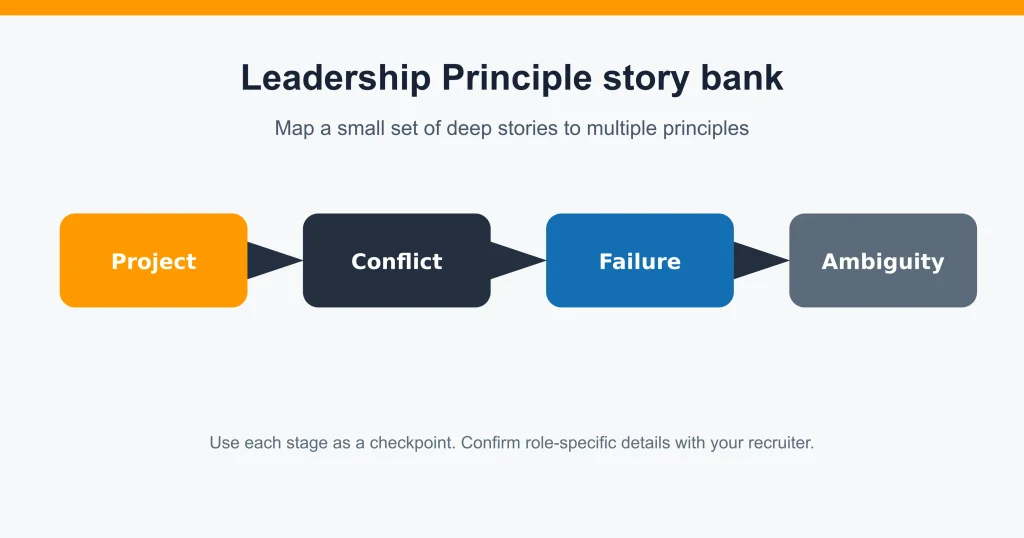
Behavioral evaluation is part of the technical loop, not an HR formality. Amazon’s official SDE II guide says each interviewer typically asks two or three behavioral questions about successes or challenges and recommends answers with metrics where applicable. Prepare a small bank of deep, truthful stories, then map each story to several relevant Leadership Principles.
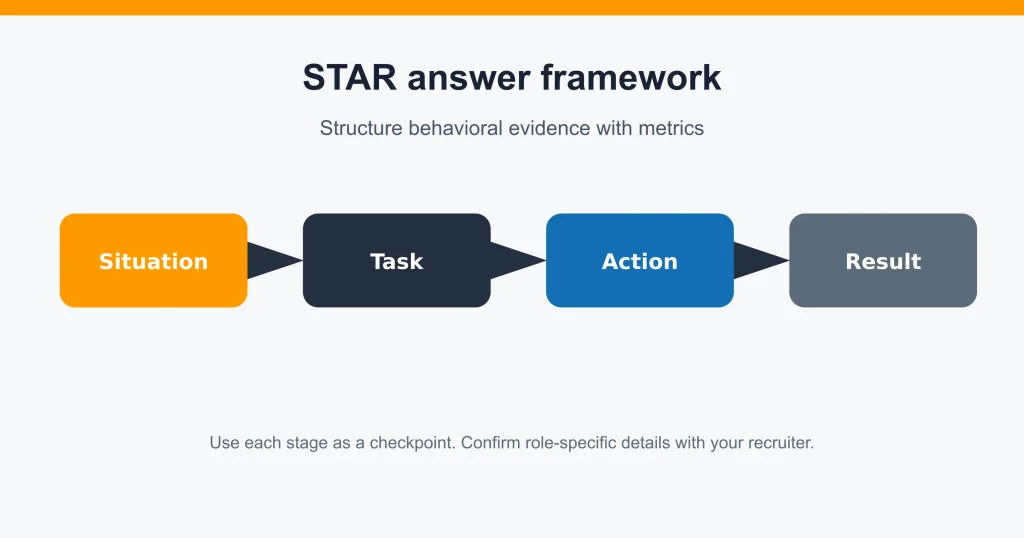
A compact STAR answer uses:
- Situation: one or two sentences on context, scale, and stakes.
- Task: your responsibility, decision, or goal.
- Action: the choices you personally made, alternatives considered, and collaboration involved.
- Result: measurable outcome, customer effect, learning, and what you would change.
Avoid turning STAR into a script. Interviewers probe. Know the technical detail, timeline, stakeholders, objections, data, and consequences behind every story. Replace “we decided” with the specific part you owned while still crediting the team. Replace “it improved performance” with the measurement method and actual change.
Customer Obsession
Evidence to prepare: you started from a customer problem or protected long-term trust. Do not recite the principle’s wording. Tell a concrete story with a decision, resistance or uncertainty, and a result. A polished claim without verifiable detail is weaker than an imperfect result with honest learning.
- Likely probe: How did you learn what the customer actually needed?
- Metric: choose a customer, quality, time, cost, reliability, or adoption measure that actually existed.
- Reflection: say what you would repeat and what you would change now.
Ownership
Evidence to prepare: you acted beyond a narrow assignment and considered long-term effects. Do not recite the principle’s wording. Tell a concrete story with a decision, resistance or uncertainty, and a result. A polished claim without verifiable detail is weaker than an imperfect result with honest learning.
- Likely probe: What would have happened if you had done nothing?
- Metric: choose a customer, quality, time, cost, reliability, or adoption measure that actually existed.
- Reflection: say what you would repeat and what you would change now.
Invent and Simplify
Evidence to prepare: you removed complexity or created a better mechanism. Do not recite the principle’s wording. Tell a concrete story with a decision, resistance or uncertainty, and a result. A polished claim without verifiable detail is weaker than an imperfect result with honest learning.
- Likely probe: What was simpler for the customer or operator afterward?
- Metric: choose a customer, quality, time, cost, reliability, or adoption measure that actually existed.
- Reflection: say what you would repeat and what you would change now.
Are Right, A Lot
Evidence to prepare: you used evidence, sought dissent, and changed course when needed. Do not recite the principle’s wording. Tell a concrete story with a decision, resistance or uncertainty, and a result. A polished claim without verifiable detail is weaker than an imperfect result with honest learning.
- Likely probe: Which assumption proved wrong?
- Metric: choose a customer, quality, time, cost, reliability, or adoption measure that actually existed.
- Reflection: say what you would repeat and what you would change now.
Learn and Be Curious
Evidence to prepare: you acquired knowledge and applied it to a real result. Do not recite the principle’s wording. Tell a concrete story with a decision, resistance or uncertainty, and a result. A polished claim without verifiable detail is weaker than an imperfect result with honest learning.
- Likely probe: How did you test that your learning was correct?
- Metric: choose a customer, quality, time, cost, reliability, or adoption measure that actually existed.
- Reflection: say what you would repeat and what you would change now.
Hire and Develop the Best
Evidence to prepare: you raised another person’s capability through specific support. Do not recite the principle’s wording. Tell a concrete story with a decision, resistance or uncertainty, and a result. A polished claim without verifiable detail is weaker than an imperfect result with honest learning.
- Likely probe: What changed for that person or team?
- Metric: choose a customer, quality, time, cost, reliability, or adoption measure that actually existed.
- Reflection: say what you would repeat and what you would change now.
Insist on the Highest Standards
Evidence to prepare: you found a hidden quality gap and created a durable fix. Do not recite the principle’s wording. Tell a concrete story with a decision, resistance or uncertainty, and a result. A polished claim without verifiable detail is weaker than an imperfect result with honest learning.
- Likely probe: How did you prevent recurrence?
- Metric: choose a customer, quality, time, cost, reliability, or adoption measure that actually existed.
- Reflection: say what you would repeat and what you would change now.
Think Big
Evidence to prepare: you connected immediate work to a larger customer or business opportunity. Do not recite the principle’s wording. Tell a concrete story with a decision, resistance or uncertainty, and a result. A polished claim without verifiable detail is weaker than an imperfect result with honest learning.
- Likely probe: How did you make the vision actionable?
- Metric: choose a customer, quality, time, cost, reliability, or adoption measure that actually existed.
- Reflection: say what you would repeat and what you would change now.
Bias for Action
Evidence to prepare: you made a calculated, reversible decision under time pressure. Do not recite the principle’s wording. Tell a concrete story with a decision, resistance or uncertainty, and a result. A polished claim without verifiable detail is weaker than an imperfect result with honest learning.
- Likely probe: What risk did you accept and contain?
- Metric: choose a customer, quality, time, cost, reliability, or adoption measure that actually existed.
- Reflection: say what you would repeat and what you would change now.
Frugality
Evidence to prepare: you achieved the goal with constrained time, money, or people. Do not recite the principle’s wording. Tell a concrete story with a decision, resistance or uncertainty, and a result. A polished claim without verifiable detail is weaker than an imperfect result with honest learning.
- Likely probe: Which constraint improved the solution?
- Metric: choose a customer, quality, time, cost, reliability, or adoption measure that actually existed.
- Reflection: say what you would repeat and what you would change now.
Earn Trust
Evidence to prepare: you listened, communicated candidly, and repaired confidence. Do not recite the principle’s wording. Tell a concrete story with a decision, resistance or uncertainty, and a result. A polished claim without verifiable detail is weaker than an imperfect result with honest learning.
- Likely probe: What uncomfortable fact did you surface?
- Metric: choose a customer, quality, time, cost, reliability, or adoption measure that actually existed.
- Reflection: say what you would repeat and what you would change now.
Dive Deep
Evidence to prepare: you traced a symptom to evidence and a root cause. Do not recite the principle’s wording. Tell a concrete story with a decision, resistance or uncertainty, and a result. A polished claim without verifiable detail is weaker than an imperfect result with honest learning.
- Likely probe: Which data changed the diagnosis?
- Metric: choose a customer, quality, time, cost, reliability, or adoption measure that actually existed.
- Reflection: say what you would repeat and what you would change now.
Have Backbone; Disagree and Commit
Evidence to prepare: you challenged a decision respectfully, then supported the final direction. Do not recite the principle’s wording. Tell a concrete story with a decision, resistance or uncertainty, and a result. A polished claim without verifiable detail is weaker than an imperfect result with honest learning.
- Likely probe: What evidence did you present, and how did you commit?
- Metric: choose a customer, quality, time, cost, reliability, or adoption measure that actually existed.
- Reflection: say what you would repeat and what you would change now.
Deliver Results
Evidence to prepare: you protected the critical outcome despite setbacks. Do not recite the principle’s wording. Tell a concrete story with a decision, resistance or uncertainty, and a result. A polished claim without verifiable detail is weaker than an imperfect result with honest learning.
- Likely probe: What trade-off preserved the goal?
- Metric: choose a customer, quality, time, cost, reliability, or adoption measure that actually existed.
- Reflection: say what you would repeat and what you would change now.
Strive to be Earth’s Best Employer
Evidence to prepare: you improved safety, inclusion, growth, or team health. Do not recite the principle’s wording. Tell a concrete story with a decision, resistance or uncertainty, and a result. A polished claim without verifiable detail is weaker than an imperfect result with honest learning.
- Likely probe: Whose experience changed and how did you know?
- Metric: choose a customer, quality, time, cost, reliability, or adoption measure that actually existed.
- Reflection: say what you would repeat and what you would change now.
Success and Scale Bring Broad Responsibility
Evidence to prepare: you considered wider social, operational, or environmental effects. Do not recite the principle’s wording. Tell a concrete story with a decision, resistance or uncertainty, and a result. A polished claim without verifiable detail is weaker than an imperfect result with honest learning.
- Likely probe: Which downstream impact changed your decision?
- Metric: choose a customer, quality, time, cost, reliability, or adoption measure that actually existed.
- Reflection: say what you would repeat and what you would change now.
What the Bar Raiser Does
The Bar Raiser is a trained interviewer who helps maintain a consistent hiring standard beyond one team’s immediate need. Candidates should not try to identify or “beat” that person. Prepare for every interviewer to probe technical decisions and Leadership Principle evidence, and answer with the same clarity, ownership, and honesty throughout the loop.
Recent accounts place behavioral, coding, design, or project discussion in a round candidates believed was the Bar Raiser. That variety is the lesson: the title does not predict a single question format. The useful preparation is deep evidence. Know why you chose an approach, what you measured, what failed, which alternative you rejected, and what you learned.
Use this Bar Raiser checklist:
- Do not guess the interviewer’s role. Treat every round as decision-quality evidence.
- Keep stories consistent. Details should remain stable across follow-ups.
- Own failures without theater. Explain the miss, correction, and mechanism added.
- Defend decisions with data. Confidence is not evidence.
- Change your mind when facts change. Good judgment includes updating.
- Ask thoughtful questions. Explore customer problems, technical challenges, and the team’s operating model.
A Round-by-Round Composite Amazon Interview Experience
No single story represents every candidate, but recent SDE 1 and SDE 2 reports support a useful composite. The sequence below synthesizes recurring patterns while avoiding the claim that your loop will match it. Use it to rehearse transitions between technical and behavioral evidence.
Composite SDE 1 experience
The candidate receives an OA with two coding problems and a work-style component. In the first live round, the interviewer asks a tree or graph problem, then probes complexity and an edge case. A second round combines another coding problem with project questions. A later manager or Bar Raiser conversation explores two Leadership Principles in depth, with repeated “why,” “what did you do,” and “what would you change” follow-ups.
- What goes well: the candidate clarifies, writes correct code, dry-runs it, and uses specific project evidence.
- What creates risk: memorized answers, vague team-level claims, and no measurable result.
- Best preparation: coding under observation plus six deep stories drawn from real work.
Composite SDE 2 experience
The candidate completes coding and work-style/design scenarios, then enters a four-interview loop. One interview emphasizes DSA and Leadership Principles. Another covers LLD or object modeling. A third asks for HLD and presses on hot keys, failure, and operations. The final interview combines a project deep dive or behavioral questions with technical follow-ups.
- What goes well: the candidate makes scope explicit, quantifies scale, and links design choices to customer and operational outcomes.
- What creates risk: drawing a standard architecture without requirements, weak failure handling, or stories that show execution without independent judgment.
- Best preparation: full 55-minute mocks that combine design and behavioral probing.
How to recover when a round goes off track
A wrong first assumption is recoverable if you notice it, say what changed, and update the solution. Stop, restate the corrected constraint, identify which part of the approach is invalid, and preserve any work that still applies. In coding, reduce the failing case. In design, revisit requirements or workload. In behavioral answers, correct the timeline plainly instead of defending an inaccurate detail.
- Coding reset: “This counterexample breaks my invariant. I’ll return to the point where I assumed uniqueness.”
- Design reset: “The celebrity-traffic case makes fan-out on write too expensive for some accounts, so I’d use a hybrid.”
- Behavioral reset: “I described that as my decision, but the manager owned the final call. My contribution was the experiment and recommendation.”
Six-Week Preparation Plan
A balanced plan alternates coding, design, and behavioral practice from the first week. Waiting until the final days to prepare Leadership Principle stories is risky because deep follow-up exposes thin examples. Use timed mocks as measurements, review errors by category, and spend the next week on the weakest signal rather than repeating comfortable problems.
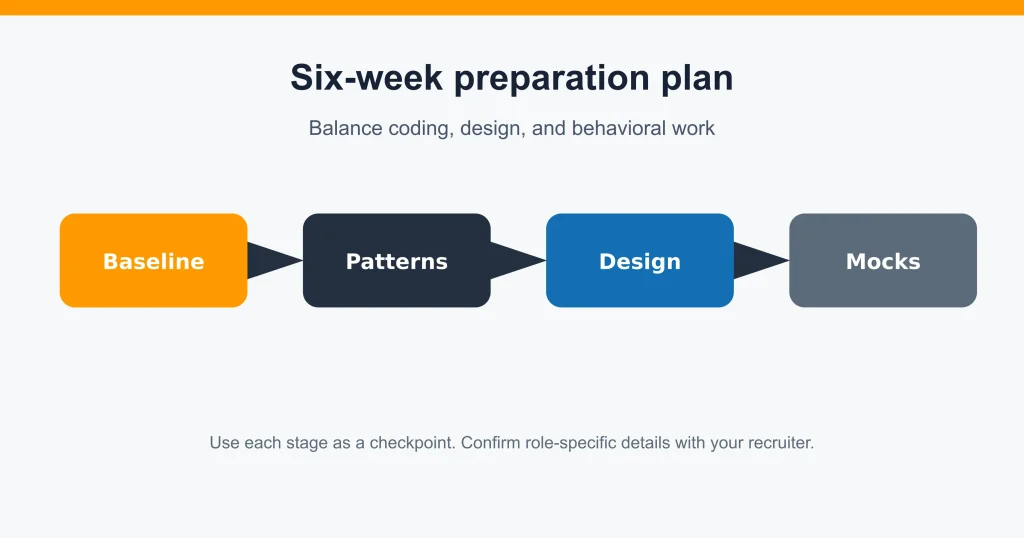
| Week | Focus | Evidence produced |
|---|---|---|
| 1 | Baseline and role calibration | Timed coding set; job-description map; first four stories |
| 2 | Core DSA patterns | Arrays, hashing, trees, graphs; complexity explanations |
| 3 | Advanced patterns and OOD | DP, heaps, binary search; one LLD prompt; six stories |
| 4 | System design and operations | Two HLD prompts for SDE 2; reliability and data trade-offs |
| 5 | Integrated mocks | Coding plus LP; design plus LP; targeted correction |
| 6 | Full simulation and taper | Two realistic loops; light review; logistics and sleep |
Week 1: establish the baseline
- Run two timed coding problems without an IDE and record correctness, time, tests, and explanation gaps.
- Read the job description line by line and map each qualification to evidence.
- Ask the recruiter for the exact loop and platform.
- Draft four STAR stories with real numbers and technical detail.
- For SDE 2, run one system design prompt to expose missing fundamentals.
Week 2: make common patterns automatic
- Practice arrays, hashing, windows, trees, and graphs with variations.
- Say the invariant aloud before coding each solution.
- Test from a fixed checklist instead of improvising.
- Review one computer-science topic relevant to the role each day.
- Refine stories after a partner asks five layers of “why.”
Week 3: add depth and object design
- Practice heaps, binary search, intervals, DP, and greedy reasoning.
- Complete one LLD prompt from requirements through an extension.
- Write code with small helpers and no autocomplete.
- Expand the story bank to six or eight stories.
- Record one mock and remove rambling context.
Week 4: design for load and failure
- SDE 2 candidates complete two HLD prompts with estimates and failure analysis.
- SDE 1 candidates learn core design vocabulary and focus on scoped OOD unless the recruiter confirms HLD.
- Practice data-model explanations from access patterns.
- Add operational signals to project stories: alarms, incidents, latency, cost, or deployment.
- Run a behavioral-only mock with aggressive follow-ups.
Week 5: combine the signals
- Run a coding interview that starts with two LP questions.
- Run a design interview with a 15-minute behavioral segment.
- Track mistakes by cause: knowledge, pattern selection, implementation, testing, communication, or time.
- Repeat only the failure category, then use a fresh problem to verify improvement.
- Prepare questions for the team about customers, architecture, on-call, and growth.
Week 6: simulate and taper
- Complete two full-length simulations using the actual tool where possible.
- Stop collecting new resources three days before the loop.
- Review concise notes on invariants, design primitives, and story facts.
- Check camera, audio, power, internet, and a backup contact method.
- Protect sleep and meal timing so the practice converts to performance.
The Evidence-First Readiness Matrix
Readiness is not the number of problems solved. It is the ability to produce consistent evidence under interview conditions. Score four dimensions after each mock: correctness, explanation, design judgment, and behavioral depth. A candidate is ready when the result is repeatable across fresh prompts and different interview partners.
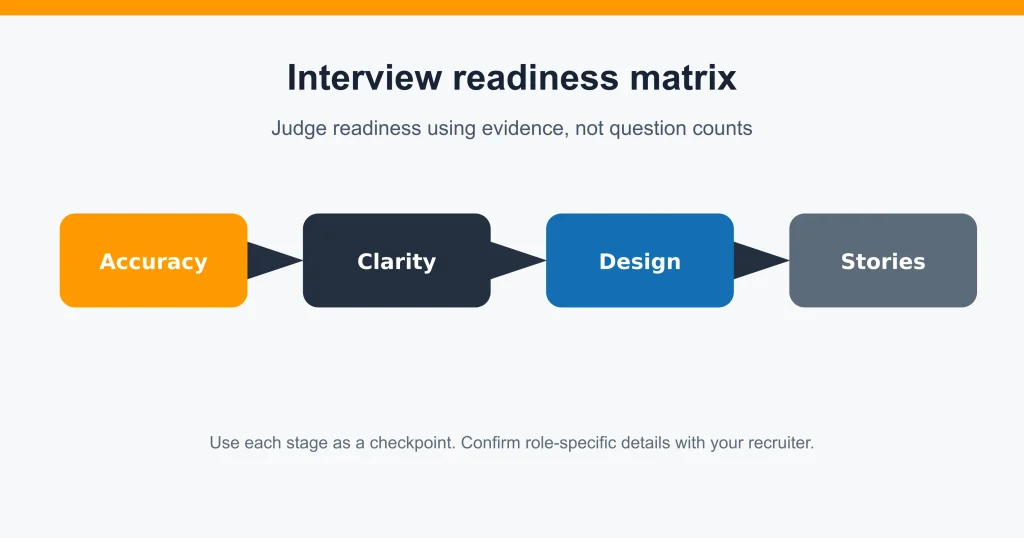
| Signal | Ready evidence | Needs work |
|---|---|---|
| Coding correctness | Complete solution; adversarial tests pass | Works only after hints or misses boundaries |
| Communication | Clear plan, invariant, and complexity | Silent implementation or constant narration |
| Design judgment | Requirements drive trade-offs and failure handling | Generic diagram with no workload |
| Behavioral depth | Specific actions, data, conflict, result, reflection | Memorized summary with vague “we” claims |
| Recovery | Detects error, explains impact, updates calmly | Defends a broken assumption |
| Consistency | Similar quality across fresh mocks | Performance depends on seeing a known problem |
After each mock, record:
- Prompt and constraints without copying proprietary interview content.
- First failed assumption and how quickly you noticed it.
- Time to a correct baseline and time to the optimized solution.
- Tests you chose and the bug each could reveal.
- Hints received and whether they changed the core idea.
- Behavioral follow-ups that exposed missing detail.
- One mechanism for the next session, such as stating the invariant before code.
Common Mistakes and Misconceptions
Most failed loops are not explained by one hard question. The recurring problems are unverified assumptions, brittle memorization, weak testing, generic design, and shallow behavioral evidence. Correcting those habits improves performance across unfamiliar prompts, which is more useful than chasing a list of recently reported questions.
Mistake: treating anecdotes as policy
One candidate’s four rounds do not establish a global four-round process. Role, level, team, location, and hiring channel matter. Use official pages for published structure, recent stories for examples, and your recruiter for the exact schedule.
- Correction: create a one-page loop specification from the invitation and recruiter answers.
- Warning sign: saying “Amazon always asks” based on a single post.
Mistake: memorizing answers instead of building evidence
A memorized coding solution breaks when a constraint changes. A memorized STAR story breaks when the interviewer asks who disagreed, what metric moved, or what you would do differently. Learn the invariant and know the facts behind the story.
- Correction: practice variations and adversarial follow-ups.
- Warning sign: your answer sounds identical regardless of the question.
Mistake: skipping tests after reaching code
Interviewers need evidence that you can validate software. Reserve time for a normal case, smallest valid case, duplicate or tie case, and a transition that stresses the invariant. Name what each test proves.
- Correction: budget the final five minutes for dry runs and complexity.
- Warning sign: “It should work” replaces a trace.
Mistake: drawing architecture before requirements
Starting with a load balancer, cache, and database creates a generic picture. Clarify users, critical actions, consistency, scale, and latency first. Every component should answer a requirement or failure mode.
- Correction: write three functional and three nonfunctional requirements before boxes.
- Warning sign: you cannot explain why a queue exists.
Mistake: underpreparing behavioral rounds
Recent accepted and rejected reports repeatedly describe deep Leadership Principle follow-ups. Coding success does not erase weak ownership or unclear judgment. Prepare stories with the same rigor as algorithms.
- Correction: rehearse with a skeptical partner who asks for dates, data, alternatives, and individual action.
- Warning sign: most of the answer describes the team and little describes your choice.
Mistake: overstating scale or impact
Interviewers can probe architecture and metrics. If a student project had 40 users, say 40. The value may be the learning, reliability improvement, or product insight. Honest scope plus strong reasoning beats invented scale.
- Correction: use exact known numbers and label estimates.
- Warning sign: metrics change between tellings.
Regional and Role Differences: US, Canada, and India
The core evaluation themes are consistent, but the path can differ across the United States, Canada, India, university hiring, and team-specific pipelines. Recent India reports often mention an OA followed by DSA, LLD, HLD, and Leadership Principle interviews. North American reports also show phone screens and loops that may be scheduled in one or more days.
Do not infer visa, relocation, compensation, or location policy from an interview-experience post. Ask the recruiter about the specific job ID. For accessibility needs, Amazon’s hiring pages direct candidates to request accommodations through recruiting or the applicant accommodation channel. Make the request early enough for the interview format to be adjusted.
Use this regional verification list:
- Local time and date for every round.
- Virtual or in-person format and the meeting platform.
- Assessment components listed in the invitation.
- Permitted resources and proctoring rules.
- Programming languages available in the environment.
- Split-day options for the loop, if offered.
- Role location and team match if the original opening changes.
- Accommodation contact and required lead time.
Questions to Ask Amazon Interviewers
Good questions help you evaluate the role and show that you think beyond getting an offer. Ask about customers, near-term technical problems, ownership boundaries, operating practices, and how success is measured. Avoid questions whose answers are obvious on the job page, and do not use the final minutes to pitch another rehearsed story.
Choose two or three:
- Which customer problem is the team trying hardest to solve this year?
- What technical constraint most shapes the architecture today?
- How does the team balance feature work with operational health?
- What would strong performance look like in the first six months?
- Which decisions can an SDE at this level make independently?
- How does design review work across teams?
- What recent incident changed the way the team builds or operates software?
- How do engineers receive feedback and grow here?
For company context, Lexis Lyfe’s article on Amazon revenue versus profit explains the difference between business scale and earnings. Use company research to understand the environment, then keep your interview questions focused on the team and its customers.
Interview-Day Checklist
Interview-day preparation should remove avoidable friction. Review concise notes, not a new problem set. Join early, keep water and power available, and know the recovery path if the connection fails. During the interview, treat clarification, communication, testing, and reflection as part of the evaluated work.
Before the first round:
- Verify the time zone and calendar link.
- Test the platform, microphone, camera, and coding tool.
- Close notifications and resource-heavy applications.
- Keep recruiter contact information available.
- Prepare paper only if the rules permit it.
- Review story facts and design checklists, not scripts.
During each round:
- Write down the goal and constraints.
- Clarify before committing to an approach.
- Share decisions at useful checkpoints.
- Accept hints as new information, not as failure.
- Test before declaring completion.
- Ask one or two role-relevant questions.
After each round:
- Reset mentally instead of scoring yourself.
- Record only general lessons, respecting interview confidentiality.
- Report a technical interruption promptly.
- Preserve energy for the next interviewer.
Frequently Asked Questions
Conclusion
The strongest Amazon interview preparation connects three kinds of evidence: correct and tested code, design choices tied to requirements and failure modes, and truthful stories that show judgment through Amazon’s Leadership Principles. SDE 1 emphasizes fundamentals and growth; SDE 2 adds independent ownership, system depth, and broader influence.
Start by confirming the exact process for your job ID. Build a repeatable coding method, practice LLD and HLD at the level the role requires, and prepare a small story bank that survives detailed follow-up. Use fresh mocks to identify the weakest signal, fix that mechanism, and test again. That approach remains useful even when the actual questions differ from every public interview experience you read.