Growth Navigate Funding: Resources and Options Explained
Searching for growth navigate funding can lead you to a business advisory website, a similarly named fundraising consultancy, or articles about raising money. Those results can sound connected even when their ownership, services, and funding models have not been established as the same. For a founder, the first task is identifying exactly who is offering what.
This guide separates the names, explains what funding advisers can provide, and compares the capital options available to businesses in the United States and Canada. You’ll find current public program limits, published advisory prices, a practical funding-readiness checklist, and examples showing how repayment, dilution, and fundraising expenses change your decision. It also explains how to assess an adviser, prepare documents, approach suitable funders, and manage the money after closing. The aim is straightforward: help you choose a financing route you can defend with evidence, rather than buy a promise that your business will get funded.
What does growth navigate funding mean?
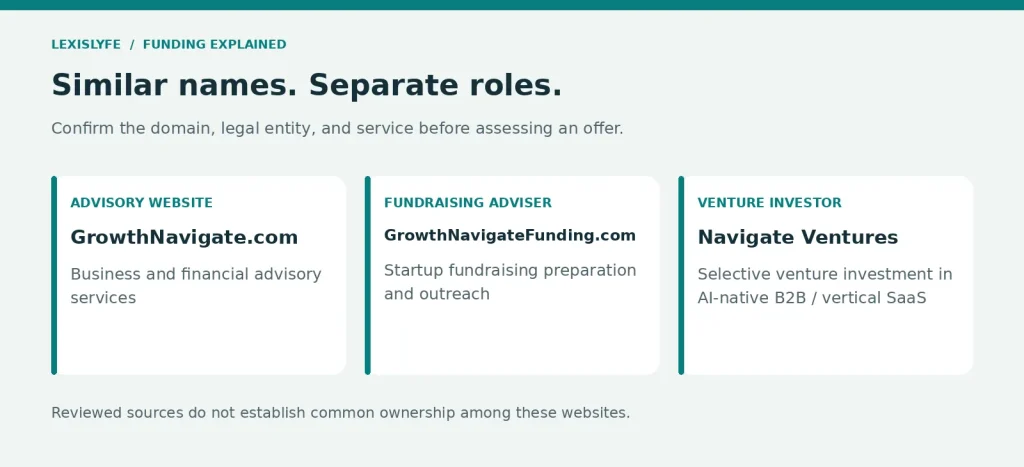
Growth navigate funding is an ambiguous search phrase, rather than the name of a single verified government grant or standardized loan. Public results include GrowthNavigate.com’s financial advisory services, a separate website branded Growth Navigate Funding, and general financing guides. Check the exact domain, legal entity, and proposed service before treating any result as a funding offer.
Separate the websites before comparing their claims
GrowthNavigate.com’s funding service page markets help with capital acquisition, investor connections, pitch preparation, and financial strategy. Its homepage presents a broader advisory business covering financial planning, coaching, investment strategy, and technology. Those descriptions establish what the website advertises; they do not establish that a visitor qualifies for financing.
GrowthNavigateFunding.com presents itself as a startup fundraising adviser. Its advertised services include fundraising strategy, financial modeling, pitch decks, investor outreach, and due-diligence preparation. Treat its testimonials and performance figures as company-reported claims, unless independently substantiated. A statement that an adviser has helped clients raise money is different from a lender committing money to your company.
Navigate Ventures is a venture capital firm with a specific investment thesis. Its current homepage describes a focus on AI-native B2B and vertical SaaS companies, with product-market fit, repeatable sales, and roughly $3 million or more in annual recurring revenue. That is an investor profile, not a general small-business funding program.
| Name or result | What the reviewed website describes | What you still need to establish |
|---|---|---|
| GrowthNavigate.com | Broad financial and business advisory support | Contracting entity, scope, fees, actual capital providers |
| GrowthNavigateFunding.com | Startup fundraising advisory services | Team credentials, engagement terms, claim substantiation |
| Navigate Ventures | Selective venture investment | Current investment fit and interest in your company |
| General funding guides | Educational explanations of business finance | Accuracy, sources, and relevance to your jurisdiction |
The reviewed public material does not establish common ownership among these websites. Do not transfer one site’s results, prices, or eligibility claims to another. If a salesperson says two names represent the same business, ask for documentation identifying the contracting entities and their relationship.
For the related software topic, see Lexislyfe’s Growth Navigate overview and startup tools guide.
Where can US and Canadian businesses actually get funding?
Businesses obtain capital from customers, owners, lenders, investors, or specific support programs. An adviser can help prepare or introduce you, but the funding decision belongs to the organization supplying the money. Start with your business location, spending purpose, repayment capacity, and ownership preferences, then compare eligible sources through their official application channels.
The most useful distinction is between capital providers and service providers. A bank evaluates a loan application. An equity investor evaluates ownership and return potential. An advisory business sells work intended to improve preparation or access. Paying for that work does not turn an uncertain financing decision into an approval.
Use these starting points:
- United States: the SBA’s 7(a) program, microloan program, and local business counseling resources.
- Canada: the Canada Small Business Financing Program, your financial institution, and NRC support for technology innovation.
- Private capital: investors whose published stage, sector, geography, and investment size match your business.
- Internal capital: retained earnings, founder contributions, or customer deposits supported by realistic delivery commitments.
A US company buying machinery and a Canadian software startup conducting research need different applications. Even within one country, a business can fit one funding product and fail another’s requirements. There is no universal eligibility checklist attached to the search phrase.
Start a shortlist with the official program name, exact provider, permissible uses, required evidence, and application route. Save the date you checked each item. This makes it easier to reject unrelated offers and revisit changing requirements before submitting an application.
Which funding option fits your growth plan?
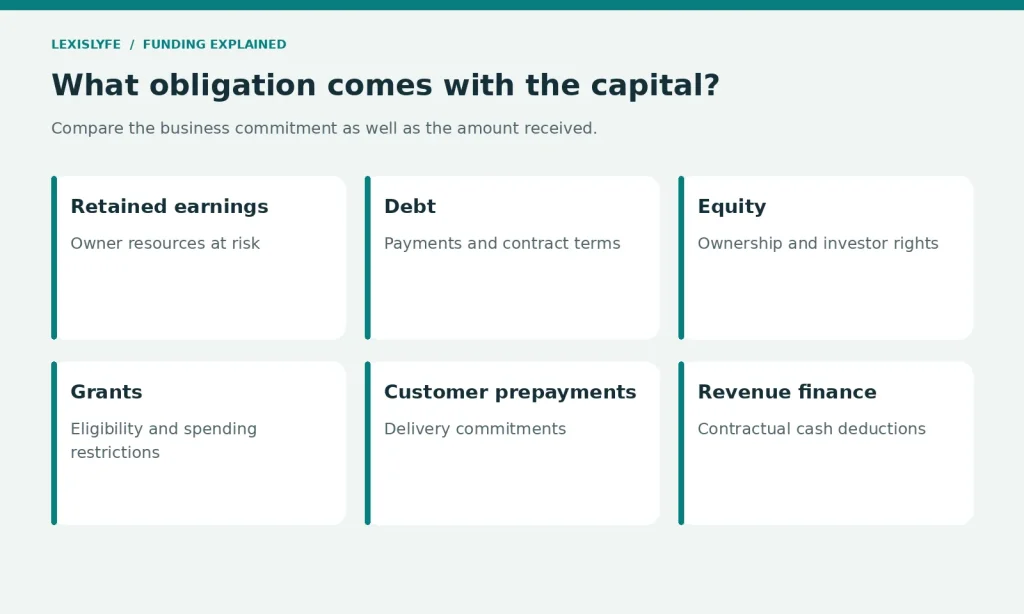
Match financing to the cash flow it will support. Predictable, near-term receipts can support repayment; uncertain product development requires more financial flexibility. Ownership capital can absorb a longer development period but changes the ownership structure. Grants can support eligible projects, while customer financing and retained earnings depend on delivery capacity and available cash.
| Funding route | Best question to ask | Main obligation or tradeoff | Evidence to prepare |
|---|---|---|---|
| Retained earnings or founder cash | Can we fund the next test without exhausting reserves? | Concentrates risk in existing owners | Cash budget and personal exposure limit |
| Term loan | Can operating cash cover payments under a weaker forecast? | Interest, repayment, and possible security or guarantees | Financial statements, forecast, credit and asset details |
| Line of credit | Is this a temporary working-capital gap? | Interest and facility conditions | Receivables, inventory, collections history |
| Angel investment | Does the investor accept our stage and risk? | Ownership dilution and negotiated rights | Team, market evidence, milestones, cap table |
| Venture capital | Could this business fit the fund’s return model? | Dilution, governance, and growth expectations | Repeatable demand, economics, defensibility |
| Revenue-based financing | What happens to cash when revenue rises or falls? | Contractual revenue payments, fees, or other charges | Revenue history, margins, full payment schedule |
| Grant or innovation support | Is the project and expenditure eligible? | Application, reporting, and spending restrictions | Project plan, budget, milestones, eligibility evidence |
| Customer prepayments | Can we reliably deliver what customers purchase? | Delivery and potential refund obligations | Contracts, production capacity, fulfillment budget |
Three terms make these comparisons easier: Repayment capacityThe cash the business can reliably allocate to financing payments after essential operating commitments. DilutionThe reduction in an existing owner’s percentage ownership when additional equity is issued. Restricted fundsMoney whose use is limited by a contract, award condition, or other applicable obligation.
Bootstrapping and customer-funded growth
Bootstrapping works when a small investment can answer the next important question. An agency might finance a specialist hire from retained profit after confirming signed customer work. A product team might sell a paid pilot before committing to a large development budget.
The limit is not simply how much cash sits in the bank. Some of that money may be needed for payroll, taxes, refunds, or existing commitments. Define a minimum operating reserve before allocating founder cash to expansion. A business can show a positive balance while having little money available for a new project.
Family-and-friends funding also needs a clear structure. Record whether the contribution is a gift, loan, or ownership investment, and document the agreed terms. A personal relationship should not substitute for knowing what repayment or ownership rights have been promised.
Debt, equity, and alternative structures
Debt can preserve ownership, but scheduled payments reduce room for error. Financing equipment with a known operational use is a different proposition from borrowing to test an unproven advertising channel. Compare the asset’s useful life and expected cash contribution with the payment schedule.
Equity can support work that lacks immediate repayment capacity. It also brings negotiation about valuation, investor rights, board arrangements, and future financing. A good investor fit includes agreement about growth pace, reporting, and potential exits, not just agreement on the amount invested.
Private equity and strategic corporate investment may fit some established businesses. A strategic investor’s commercial connections can help, but exclusivity or other negotiated restrictions may limit future partnerships. Ask how the relationship affects competitors, customers, suppliers, and a future sale.
Crowdfunding requires its own distinction. Reward campaigns involve product or reward delivery, while equity crowdfunding involves securities and an applicable regulatory framework. Neither route removes preparation, platform costs, or the need to understand the agreement.
Write a decision memo before approaching providers
A short financing decision memo can expose disagreements before they become expensive. State the milestone, amount required, spending dates, acceptable ownership change, and maximum payment the downside forecast can support. Add the evidence that would make management revise the plan. This turns a general wish to raise money into a decision the team can review.
Consider a hypothetical product business deciding between buying inventory immediately and first securing customer deposits. An inventory loan could make sense if orders, margins, delivery costs, and collection dates support its payments. Customer deposits could reduce the borrowing need, but only if the company can fulfill those orders and meet the agreed terms. Neither option is automatically cheaper once production risk and cash timing are included.
The memo should distinguish necessary spending from spending that can wait. Buying a machine needed for a signed production commitment may deserve a different priority from launching a second product line with little demand evidence. If the second project can be delayed without losing the first opportunity, the business may need a smaller financing package.
Record the chosen route and the strongest reason against it. For a loan, that might be concentration in one customer’s payments. For equity, it might be ownership terms that complicate a later round. Naming the weakness makes it easier to negotiate protections, select a fallback, and recognize when the original decision no longer fits the business. Keep the memo alongside the forecast so both change together.
What official US funding resources should you check?
US founders should verify program details directly with the SBA and participating providers. The 7(a) program supports eligible business borrowing through lenders; microloans serve smaller financing needs through intermediaries. Grants have specific purposes and eligibility. A website advertising funding advice is not an official application channel merely because it discusses these resources.
SBA 7(a) loans
The SBA’s official page, checked October 18, 2026, lists a maximum individual 7(a) loan of US$5 million. Listed uses include working capital, equipment, real estate, and certain ownership changes. Applicants must satisfy eligibility and credit requirements, including a reasonable ability to repay. Applications go through participating lenders rather than an adviser granting approval on the SBA’s behalf.
A published maximum is a program ceiling, not a suggested borrowing amount. Ask the lender which costs qualify, what equity contribution or security applies to your case, and how much cash remains after all closing costs. Keep the borrowing request tied to a documented use of proceeds.
Before contacting a lender, assemble:
- The business’s operating history and ownership information.
- Current financial statements and a cash-flow forecast.
- A specific explanation of the requested financing and spending schedule.
- Existing debt details and the documents the lender requests for underwriting.
SBA microloans and business support
The SBA microloan program provides loans of up to US$50,000 through intermediary lenders. Confirm that the intermediary serves your area and that your proposed spending fits its requirements. This can be a more relevant starting point than pursuing venture capital for a modest operating investment.
The SBA grants page states that SBA does not provide grants for starting or expanding a business. It identifies narrower grant-related activities, including research and development support. Do not turn a general reference to government grants into an assumption that ordinary expansion costs qualify.
Use counseling to clarify the financing need before purchasing extensive fundraising help. The SBA business planning resources include planning guidance and access to counseling. A useful first conversation should help you identify missing evidence, not simply produce a longer list of places to apply.
What official Canadian funding resources should you check?
Canadian businesses should start with their financial institution and the official program rules. The Canada Small Business Financing Program shares lending risk with participating institutions, which still decide whether to approve financing. Technology businesses can also investigate NRC support. Each route has distinct eligibility, eligible spending, documentation, and timing requirements.
Canada Small Business Financing Program
As checked October 18, 2026, ISED’s CSBFP borrower guidance describes eligible small businesses or startups operating in Canada with gross annual revenue of C$10 million or less, excluding farming businesses. Financing can total up to C$1.15 million, comprising a term-loan maximum of C$1 million and a line-of-credit maximum of C$150,000.
Those totals have important limits within them. Of the term-loan amount, no more than C$500,000 can cover equipment and leasehold improvements; within that amount, up to C$150,000 can cover intangible assets and working capital. A company seeking software and operating funds cannot assume that the entire C$1 million term-loan ceiling is available for those uses.
ISED’s borrower FAQ states a 2% registration fee. Floating term-loan rates are capped at the lender’s prime rate plus 3%; line-of-credit rates are capped at prime plus 5%. Fixed term-loan pricing follows a different stated benchmark. These are program limits, not a personalized rate quote, and should be reconfirmed before applying.
Ask the institution to explain:
- Which spending category covers each proposed purchase.
- Whether its current offering includes the facility you need.
- The exact interest rate, fees, payment schedule, and security requirements.
- How the financing changes under a slower-revenue forecast.
Innovation support and regional opportunities
NRC’s technology innovation support is a relevant starting point for businesses investigating innovation assistance. Check the specific program page and contact process instead of assuming that every software purchase or research idea qualifies for funding.
Build a separate calendar for project applications, approvals, eligible expenditure dates, and reimbursements. If a program reimburses qualifying spending, your business may still need cash to pay bills before reimbursement. Keep loan approvals, grant decisions, and project support discussions separate in the forecast until their conditions are clear.
Cross-border founders should track US dollars and Canadian dollars separately. Add the operating entity, expense location, and funding currency to every application record. A US customer base alone does not establish eligibility for a US program, and a Canadian founder’s nationality alone does not establish a Canadian business’s eligibility.
What services can a funding adviser provide, and what do they cost?
An adviser can sell preparation, analysis, and outreach services. Useful work might include a financing strategy, pitch deck, financial model, investor shortlist, or organized data room. Compare the deliverables and contract terms before comparing headline prices. Published package fees do not establish funding approval, total engagement cost, or the quality of the work.
Current published prices on the fundraising advisory website
The GrowthNavigateFunding.com services page, checked October 18, 2026, advertises these packages. They belong to that domain; they should not be presented as prices from GrowthNavigate.com or Navigate Ventures.
| Advertised package | Displayed monthly price | Selected advertised inclusions |
|---|---|---|
| Launchpad | $4,500 | Strategy session, deck review, 50-contact investor list, model health check |
| Navigator | $9,500 | Deck and model development, 200-contact list, 10 warm introductions per month, data-room setup |
| Ascent | Custom | Fundraising retainer, senior adviser, due-diligence support, post-close advice |
The reviewed pricing section uses a dollar symbol without explicitly identifying the currency. Confirm currency in writing, along with minimum duration, taxes, expenses, success fees, cancellation rights, and any additional compensation. These are advertised prices, not independently verified transaction prices or an endorsement.
A three-month engagement at a displayed $4,500 monthly rate totals $13,500 before other charges, assuming that rate applies throughout. At $9,500, the same arithmetic gives $28,500. These examples illustrate retainer accumulation; they are not claims about the website’s minimum contract term.
Translate a package into work you can inspect
Ask for a statement of work that specifies:
- Financial model: editable files, underlying assumptions, scenarios, and a reconciliation to source records.
- Pitch deck: research responsibilities, revision rounds, design rights, and final editable output.
- Investor targeting: selection criteria, current relevance, relationship quality, and ownership of outreach records.
- Introductions: what counts as an introduction and whether a meeting is promised.
- Due diligence: document organization, responsibility for accuracy, access control, and review scope.
Then ask how acceptance works. If the model contains broken calculations or an investor list includes firms outside your geography, what will the adviser correct, and when? A measurable deliverable makes the engagement easier to evaluate than a broad promise of fundraising support.
References should match your business’s stage and sector. Ask a reference what the adviser actually delivered, how much founder time the engagement required, and what happened when investor interest was weaker than expected. A successful client story may be informative without representing a typical outcome.
How much capital should you raise?
Raise enough to reach a defined milestone while preserving a realistic cash buffer. Calculate operating needs, one-time growth spending, financing costs, and downside exposure, then subtract cash genuinely available for that plan. A round size should come from the spending and evidence required, rather than an attractive valuation or a provider’s maximum offer.
Build a milestone-based capital budget
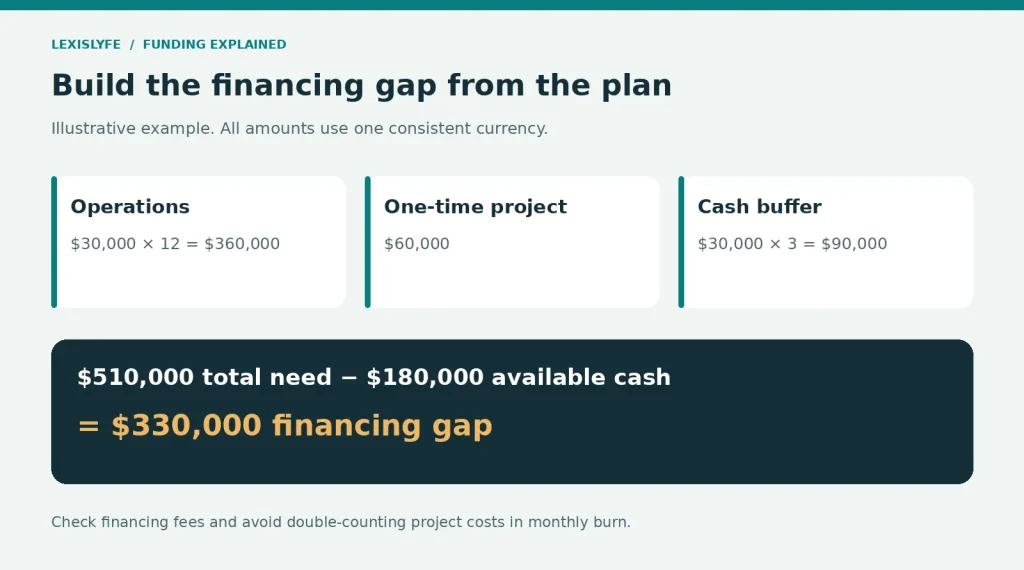
Consider a hypothetical company using one currency throughout its forecast. It expects net cash outflow of $30,000 a month while improving retention and testing a repeatable sales process. It wants 12 months to run the plan, plus a three-month buffer at the same assumed burn rate.
| Budget component | Calculation | Amount |
|---|---|---|
| Operating cash for the plan | $30,000 × 12 months | $360,000 |
| One-time growth project | Budgeted separately | $60,000 |
| Buffer | $30,000 × 3 months | $90,000 |
| Total planned cash requirement | Sum of the above | $510,000 |
| Available unrestricted cash | After other commitments | ($180,000) |
| Illustrative financing gap | $510,000 less $180,000 | $330,000 |
This is an illustrative budget, not a recommended funding amount. Financing fees, changes in working capital, or additional restrictions could increase the gap. Avoid counting a project cost twice if it already sits inside monthly burn.
Runway equals available cash divided by monthly net cash burn, when burn is reasonably stable. Before the new project or financing, $180,000 divided by $30,000 implies six months. Actual runway changes as receipts, hiring, capital purchases, debt payments, and other commitments change.
Test uncertainty before selecting the funding amount
Run at least a base case and a downside case. Change assumptions that could genuinely alter cash timing, rather than reducing every forecast line by an arbitrary percentage. A delayed customer payment and a permanent revenue loss can create different financing needs.
Check these sensitivities:
- Revenue arrives later than the sales forecast assumes.
- Hiring or implementation takes longer than planned.
- Inventory or customer acquisition requires more cash upfront.
- A grant decision or financing close slips beyond the spending date.
Set an action trigger before cash becomes urgent. For example, management could pause a discretionary hiring plan if the next quarter’s signed work fails to meet its agreed threshold. Define the threshold using your own commitments and risk tolerance, not a generic readiness score.
Revenue also differs from profit and cash receipts. Lexislyfe’s explanation of Amazon’s revenue versus profit provides a related example of why those measures should not be treated as interchangeable.
How should you compare total financing cost and dilution?
Compare offers using the money available to spend and the obligations created. For borrowing, examine the timing and total amount of payments, fees, security, and guarantees. For equity, model ownership and negotiated rights. A headline interest rate, valuation, or funding amount cannot show the entire economic effect on your business.
Calculate net usable proceeds
Imagine a financing agreement that provides $200,000 but deducts a hypothetical $6,000 origination fee and $4,000 of other closing costs. Your business initially receives $190,000 of usable cash, while repayment may still be calculated using the $200,000 principal. Read the actual contract to establish how its fees work.
A second offer with a higher stated interest rate could produce more usable cash or require less frequent payments. It could also cost more overall. Put the actual payment dates into your forecast and compare both total cost and the lowest cash balance reached during the borrowing period.
Ask for:
- A complete payment schedule, including any final balloon payment.
- A list of upfront, ongoing, late-payment, and early-repayment charges.
- An explanation of variable rates, required reserves, and lender consent rights.
- The precise assets and guarantees supporting the obligation.
A factor-rate multiple is not automatically an annual percentage rate. Frequency and timing matter. If a provider describes pricing in unfamiliar terms, obtain a cash-flow schedule and an explanation you can independently check before comparing offers.
Model ownership under a simple equity round
Suppose new investors put $1 million into a company at a $4 million pre-money valuation. In a simplified priced round, post-money value is $5 million, and the new investors hold 20% immediately after that investment. Existing owners collectively retain 80%, before considering other changes.
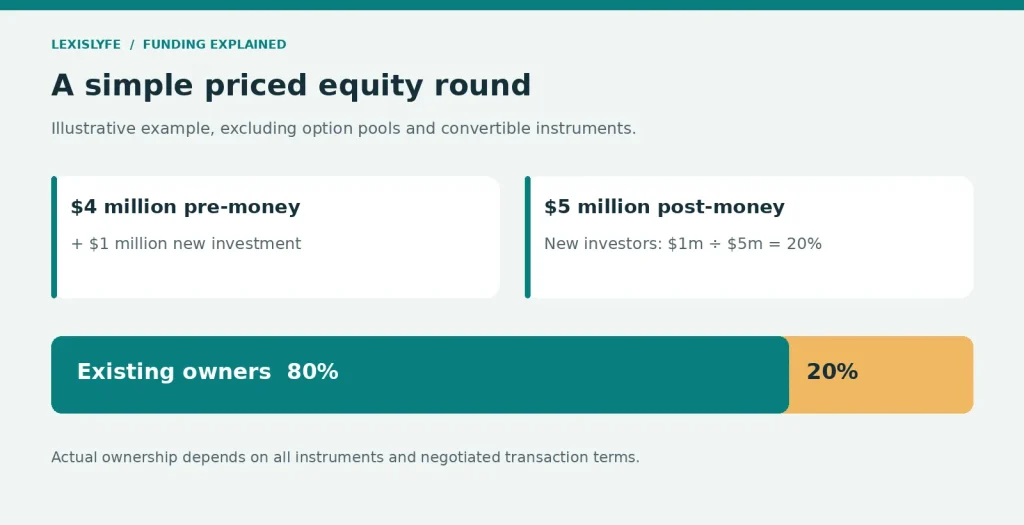
A SAFE, convertible note, option-pool expansion, or earlier investor right can change the result. Request a fully diluted cap table reflecting the proposed transaction. Also examine liquidation preferences, board rights, protective provisions, and follow-on rights with appropriate professional help.
For the broader corporate-finance concept, Lexislyfe’s WACC formula and worked example explains how debt and equity costs can be combined. WACC is not a substitute for a startup cash-flow forecast or a direct comparison of the contracts actually available to you.
How can you check a provider before paying or sharing documents?
Verify identity, scope, evidence, and commercial terms before committing. Confirm the legal business name and responsible people, distinguish advisory work from lending or investment, and obtain written deliverables. Independently check relevant registration claims and references. Share sensitive records gradually through controlled channels once you understand who will access them and why.
Use an evidence ladder for marketing claims
A provider’s statement is a starting point for questions. It becomes more useful when supported by specific, independently checkable information. A percentage without a denominator, time period, or definition does not tell you the likelihood that your own company will secure funding.
Use this original claim-to-evidence framework:
- Identify the claim. Record the exact result, metric, or relationship being advertised.
- Request its definition. Ask which clients, dates, outcomes, and exclusions are included.
- Ask for supporting evidence. Seek permitted references or records that substantiate the statement.
- Check it independently. Confirm relevant details through sources outside the sales conversation.
- Translate it into contract terms. Establish which deliverables, if any, the provider commits to producing for you.
A “success rate,” for example, could refer to all paying clients, screened clients, or only clients that reached a certain stage. Those denominators produce very different interpretations. Treat an unsupported statistic as unverified instead of turning it into your business’s forecast probability.
Examine compensation and registration claims
The SEC’s small-business guidance on broker-dealers explains that finding investors and receiving transaction-related compensation can raise registration questions. The assessment depends on the actual activities and applicable circumstances. Ask a securities professional to review a proposed success-fee arrangement rather than assuming that the label “consultant” settles the issue.
For a Canadian transaction, confirm the applicable provincial or territorial requirements and check any claimed registration with the relevant regulator. US registration information alone does not establish authorization for every Canadian activity. Keep the review specific to the service being proposed.
Identity and contract checks should cover:
- The legal entity named on the agreement and invoice.
- The people responsible for the work and their relevant experience.
- Refund, termination, exclusivity, and post-termination fee provisions.
- Any compensation received from lenders, investors, or other parties.
- Who controls confidential files and how access ends after the engagement.
The FTC’s advance-fee loan guidance identifies guaranteed credit offered in exchange for an upfront fee as a warning sign. That does not mean every upfront advisory fee is improper. Distinguish a transparent payment for defined work from payment demanded in exchange for guaranteed financing. Verify the contracting entity before sending money or sensitive records.
How do you prepare a funding-ready application?
Prepare a consistent business story supported by records. Explain the customer problem, demand, economics, team, financing need, and milestone the money will support. Reconcile the pitch with the forecast and underlying documents. The exact requirements vary by lender, investor, and program, so use the recipient’s current checklist before submitting.
Build a practical data room
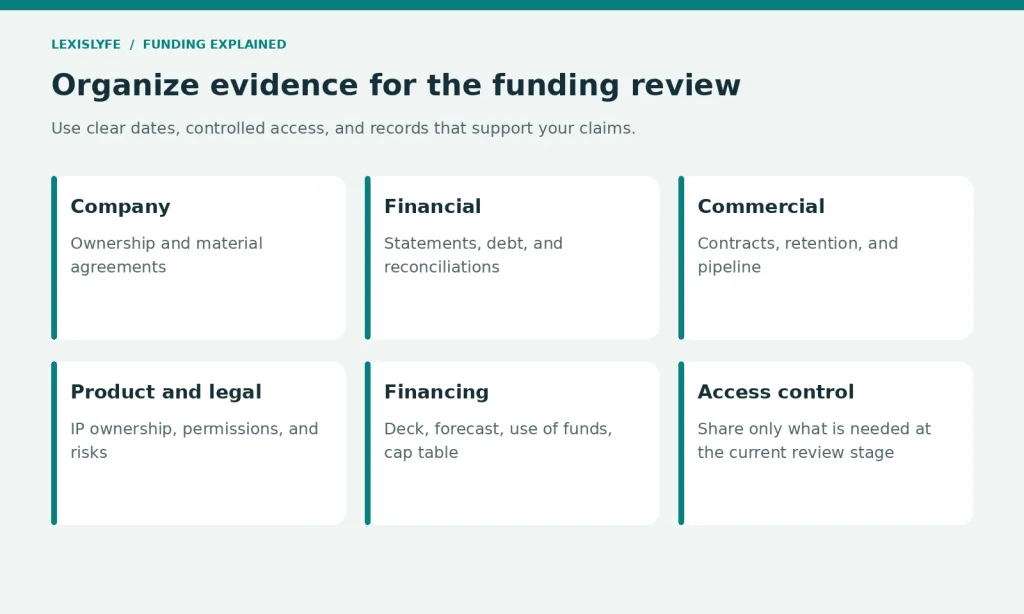
A data room should let a reviewer verify important claims without hunting through unrelated files. Give documents clear names and dates, remove duplicates, and distinguish signed agreements from drafts. Limit access according to the stage of the conversation and the sensitivity of the information.
Include the following where relevant:
- Company records: incorporation documents, ownership records, approvals, and material agreements.
- Financial records: statements, tax records when requested, bank information, debt schedules, and reconciliations.
- Commercial evidence: customer contracts, pipeline definitions, retention data, and concentration analysis.
- Product and legal evidence: intellectual property ownership, required permissions, key risks, and employment agreements.
- Financing materials: pitch deck, use-of-funds plan, forecast assumptions, and fully diluted cap table.
A founder should be able to explain discrepancies before a reviewer finds them. If the deck counts signed subscriptions but the accounting records show collected revenue, label the measures clearly. Neither number is automatically wrong, but presenting them as identical damages trust.
Show the metrics that fit your business model
SaaS businesses should define recurring revenue, retention, gross margin, customer acquisition costs, and concentration. State which expenses enter a calculation. A metric that excludes implementation labor may give a different picture from one that includes it.
Retail and product businesses should explain inventory turns, contribution margin, returns, fulfillment, and cash collection. A growing order book can consume cash if inventory must be purchased long before customers pay. A services business needs capacity planning, project margins, customer concentration, and payment timing.
Use a short readiness review:
- Can we reconcile each material claim to an identifiable record?
- Can we explain the assumptions behind the cash forecast?
- Can we show what the requested money will accomplish and when?
- Can we describe the downside and the action we would take?
- Can we identify the appropriate decision-maker and application route?
This review is a planning tool, not an approval score. If an answer is weak, use it to prioritize preparation before paying for a broad outreach campaign.
What is the process from preparation to funding close?
A practical process moves from business readiness to provider fit, evidence review, negotiation, and disbursement. Advisory discovery calls, lender underwriting, investor due diligence, and grant decisions are different processes. Track each separately, confirm who can approve the money, and avoid treating meetings or preliminary interest as cash available for spending.
Approach a small, relevant shortlist first
Build a target list using current investment or lending criteria. Record sector, geography, company stage, financing size, decision-maker, and evidence of current activity. For an investor, check whether the business fits the published thesis. For a lender, establish whether the product supports the proposed use.
A useful opening message states the business, evidence, funding request, and purpose clearly. For example: “We supply maintenance software to regional operators, have documented recurring contracts, and are raising capital to complete a defined sales-expansion plan.” Support any metrics with accurate definitions and records.
Do not confuse a large contact database with a large relevant market. A shorter list of suitable providers can produce more informative feedback. Record reasons for rejection so management can distinguish a fit problem from a weak forecast or an unclear proposal.
Track decisions and conditions through closing
Use this sequence as an operating checklist:
- Prepare: confirm the need, forecast, documents, and decision authority.
- Qualify: establish fit with the actual lender, investor, or program.
- Submit: provide the requested evidence through the correct channel.
- Review: answer questions and reconcile updated information.
- Negotiate: compare economics, conditions, rights, and obligations.
- Close: complete approvals and documents, then confirm disbursement.
A term sheet may leave significant conditions unresolved. A preliminary loan offer may still depend on underwriting, security, or other requirements. Keep your forecast conservative about receipt timing until the relevant conditions are satisfied.
There is no reliable universal fundraising timeline for this search phrase. Ask each provider for its actual stages, expected information needs, and conditions that can delay a decision. Build an alternative operating plan for a late close rather than promising suppliers or employees money that has not arrived.
When does a bridge round make sense?
A bridge round can buy time to reach a credible financing or operating milestone. It is useful only when the additional capital supports a plausible plan and its terms are acceptable. Extending an unresolved business problem without evidence of improvement can leave the company needing another round with fewer options.
Navigate Ventures’ March 23, 2025 article about the growth-capital gap describes a Series A extension approach for SaaS businesses seeking more time before a growth round. That is a historical explanation of one firm’s strategy. Its current website should be checked for today’s investment focus rather than treating the older article as a current commitment.
For a hypothetical company, a bridge might support completion of an enterprise implementation and evidence that customers renew. The proposal needs to explain how that evidence changes the next financing decision. “We need more runway” describes a cash shortage; it does not establish what the additional time will achieve.
Ask three questions before pursuing a bridge:
- Milestone: what specific evidence can realistically be produced before cash runs low again?
- Support: which existing or new capital providers have a reason to participate?
- Fallback: what operating change follows if the expected next round does not happen?
Founders should also model how the new instrument affects future ownership or repayment. If a bridge uses convertible terms, the headline amount does not reveal its ultimate dilution. Include the proposed bridge in the fully diluted scenario analysis before agreeing to it.
How should you manage growth after receiving funding?
Convert the funding plan into a spending and reporting system. Assign owners to milestones, release discretionary spending as evidence improves, and compare actual cash with the forecast. Keep covenant, investor, and program reporting obligations visible. A successful close creates financial capacity, but management still has to demonstrate that spending produces useful results.
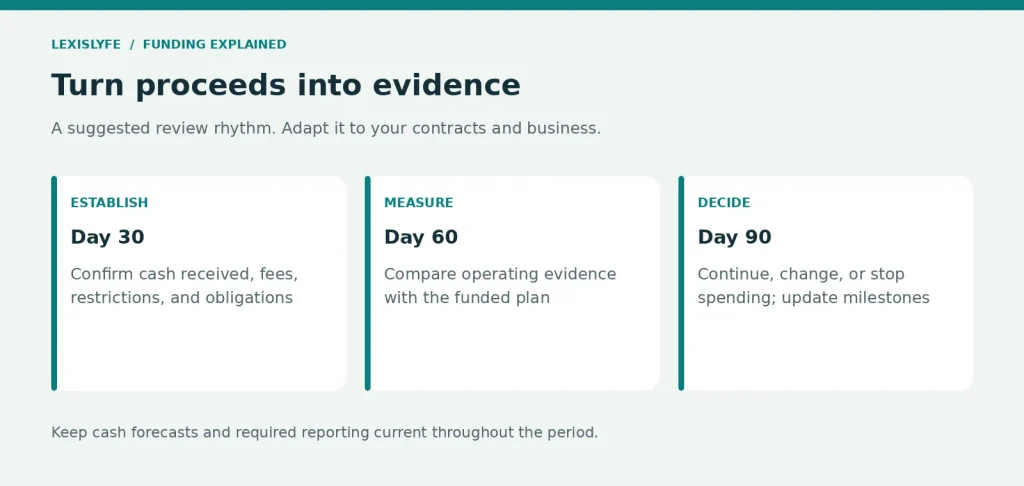
Use a 30-, 60-, and 90-day review
During the first 30 days, reconcile received proceeds, record fees, confirm restrictions, and update the forecast. Make sure the team knows which expenses are approved and which require additional evidence. Establish one reliable source for financial reporting.
By day 60, compare the early indicators with the plan. For a sales investment, measure qualified opportunities, conversion, acquisition cost, and implementation capacity. If demand grows but delivery capacity cannot keep up, additional advertising may worsen the cash problem instead of improving it.
At day 90, decide which spending should continue, change, or stop. Document the reason and update the next milestone. The goal is to learn early enough that the company still has alternatives.
Buy tools to solve a measured operating problem
Financing can make software purchases feel affordable before the business needs them. Identify the bottleneck, responsible owner, measurable outcome, and full cost before adding a subscription. Include implementation, training, integrations, and renewal costs in the cash forecast.
A simple reporting system should track:
- Cash available, upcoming commitments, and forecast runway.
- Progress against the milestone funded by the round.
- Business-model metrics with consistent definitions.
- Variances requiring a decision and the person responsible.
Automation and AI can assist forecasting, document organization, and report drafting. Reconcile their outputs with source records and review confidential-data handling before adoption. A polished forecast cannot compensate for incorrect inputs or an unsupported revenue assumption.
What common funding mistakes should you avoid?
The most costly mistakes usually break the connection between the financing and the business need. Founders may confuse advisory services with capital, borrow against uncertain receipts, overlook fees or dilution, or spend ahead of evidence. Prevent these errors by documenting assumptions, checking terms, and preserving choices if the plan takes longer than expected.
Misreading offers and measuring the wrong result
An introduction, meeting, term sheet, approval, and disbursement are different events. Record them separately. An outreach report should not count every contact as an investor conversation, and a cash forecast should not count conditional interest as money received.
Watch for these avoidable errors:
- Assuming affiliation: combining claims from websites with similar names.
- Buying a guarantee: treating a sales promise as a financing commitment.
- Ignoring net proceeds: budgeting the advertised amount before fees and restrictions.
- Borrowing for uncertain growth: accepting payments the downside forecast cannot support.
- Overvaluing valuation: accepting restrictive rights because the headline valuation looks attractive.
- Overbuilding the tool stack: increasing fixed costs before proving demand or operational benefit.
Confusing growth with financial resilience
A business can grow revenue while weakening its cash position. Longer collection cycles, higher inventory, delivery costs, or customer-acquisition spending can absorb the benefit of new sales. Review contribution margin and collection timing alongside top-line growth.
Raising too little can leave a milestone unfinished; raising more than the business can productively deploy can create unnecessary dilution or cost. The appropriate amount depends on the plan and available terms. Keep the financing decision tied to the milestone and downside forecast.
Avoid presenting hypothetical examples as client results. A worked calculation helps explain a decision; it does not prove that a provider has achieved that outcome. When reviewing case studies, look for the original company, date, financing type, and evidence supporting the claim.
Frequently Asked Questions
The most useful answers depend on identifying the specific provider and funding route. No universal grant, approval process, fee schedule, or eligibility rule follows from this search phrase. Use the questions below to distinguish advisory services from capital, check program fit, and decide what to verify before taking the next step.
Conclusion
Start by identifying the provider, then match capital to a documented business need. Verify the entity and its role, compare actual financing obligations, and prepare evidence before paying for broad outreach. A useful funding plan explains the milestone, cash requirement, acceptable terms, and response if revenue or financing arrives later than expected.
Keep three decisions separate: which capital type fits the business, which provider can supply it, and whether paid advisory help addresses a specific preparation gap. That order makes the search more useful. It also gives you a practical basis for saying yes to an appropriate offer, asking for better terms, or postponing a raise until the evidence is stronger.