What Is an RFI? Meaning, Process, and Examples
An unanswered question can hold up a purchase or a construction crew. Perhaps your company needs new software but doesn’t know which suppliers can meet its requirements. Perhaps a contractor finds that two drawings show different dimensions. Both situations can call for an RFI, although the documents serve different purposes.
RFI stands for request for information. In procurement, it gathers information about suppliers and possible solutions. In construction, it asks for clarification about project requirements. Understanding that distinction helps you send the right questions to the right people and avoid treating an information request as an approval to buy or build.
This guide explains RFI meaning, when to use one, how the procurement and construction processes work, and how RFIs differ from RFPs, RFQs, submittals and change orders. You’ll also find completed examples, response guidance, an evaluation method, and practical advice on deadlines, records and software for US and Canadian teams.
What is an RFI, and what does it do?
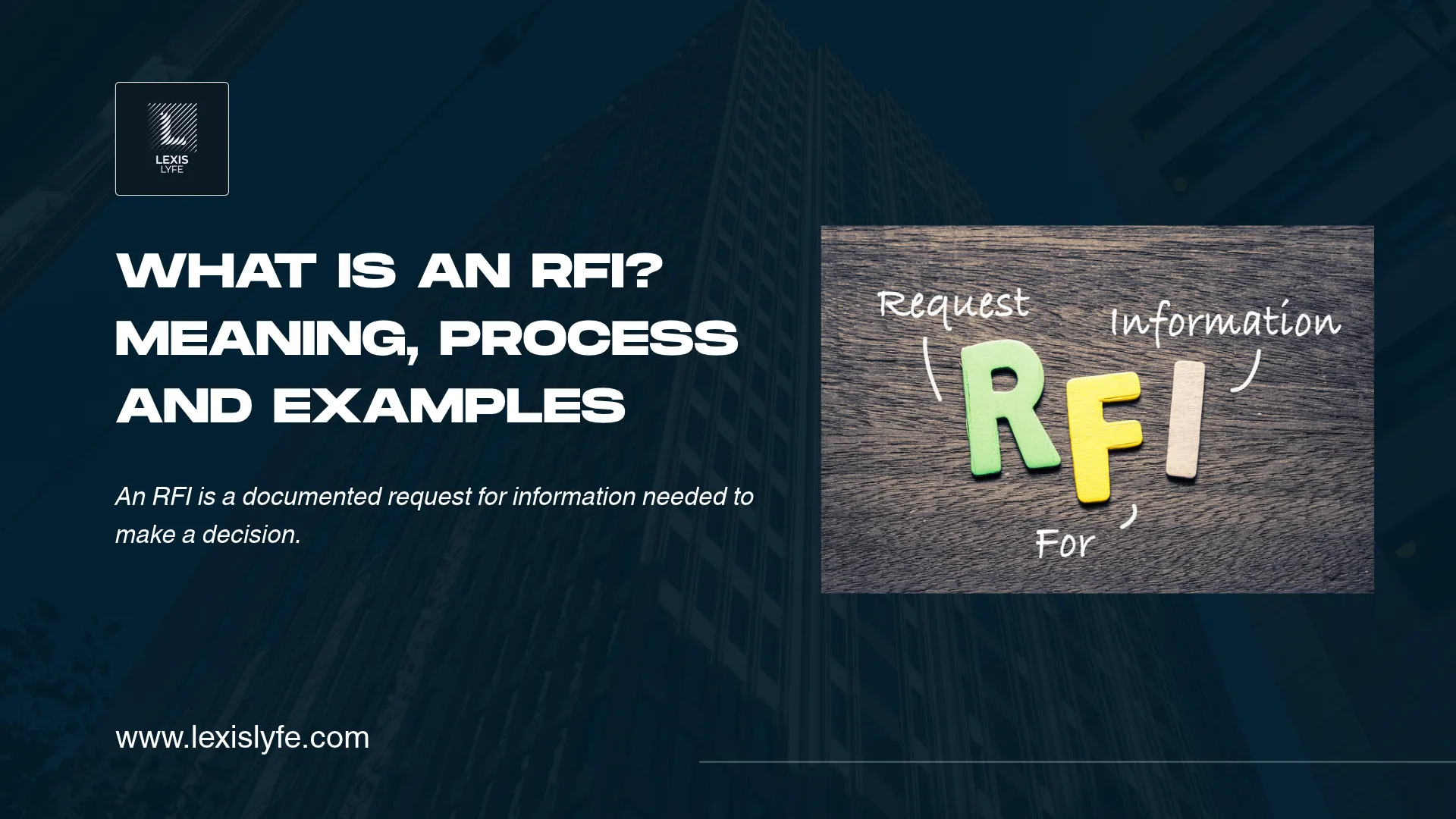
An RFI is a documented request for information needed to make a decision. A buyer may use one to research suppliers before a purchase. A construction team may use one to clarify drawings or specifications. The purpose, recipient and next step should be clear before the request is issued.
The acronym describes an information exchange, not a single universal form. A procurement questionnaire can contain several related questions. A construction RFI should normally focus on one issue that can receive a clear, traceable answer.
Consider these two questions:
- Procurement: Can your platform support our approval workflow and accounting integration?
- Construction: Which of the conflicting ceiling heights applies in Room 204?
The first question helps a buyer understand available options. The second helps a project team interpret an existing requirement. Neither question, by itself, establishes a price agreement or authorizes a contract change.
The useful output is a decision supported by evidence. A supplier list is useful only if the answers show which options deserve further investigation. A construction response is useful only if the responsible team can understand and apply the clarification through the project’s procedures. Procurement RFI A structured inquiry used to learn about supplier capabilities, market options and potential requirements. Construction RFI A formal question used to clarify incomplete, ambiguous or conflicting project information. RFI response The information returned by the supplier, designer or other designated respondent. RFI log A register that tracks requests, ownership, dates, responses and follow-up.
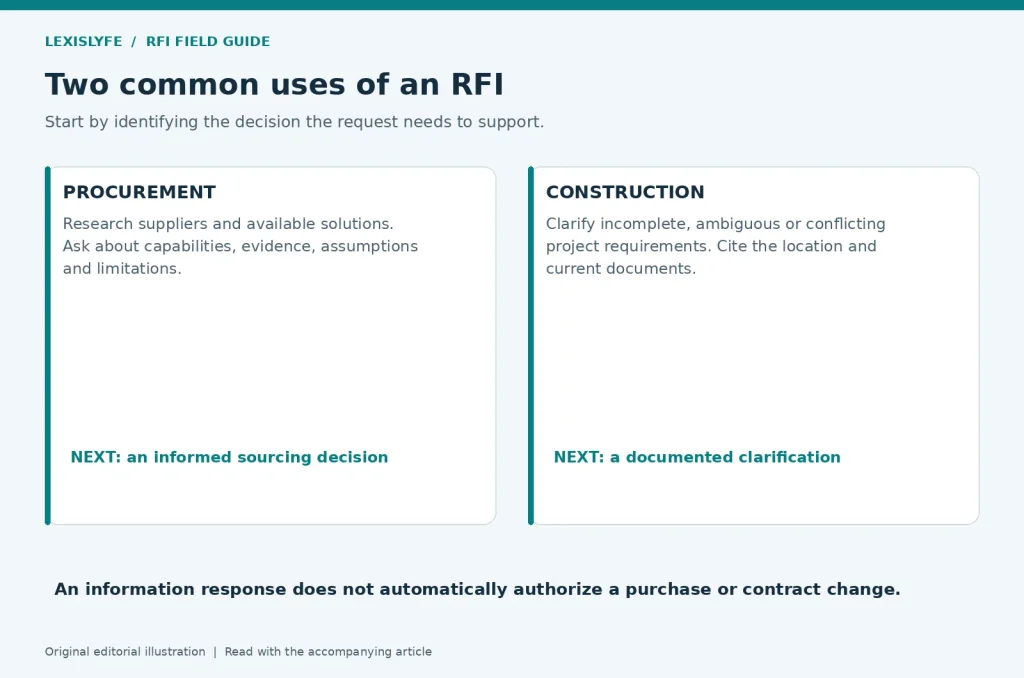
Two contexts, different decisions: supplier research and project clarification.
What is an RFI in construction?
An RFI in construction is a formal request to clarify a project requirement when information is missing, ambiguous or conflicting. It creates a record of the question and response. The project contract determines communication routes, decision authority and any separate procedure needed to change scope, price or time.
Procore’s construction guide describes RFIs as a way to resolve information gaps in construction documents. Typical issues include conflicting drawings, unclear specifications and conditions that differ from the documented design.
Common construction RFI types
A request can concern several disciplines, but its subject should identify one resolvable issue.
- Design clarification: A detail omits a dimension needed for installation.
- Material specification: A drawing and specification identify different finishes.
- Site condition: A measured opening differs from the opening shown.
- Coordination: Mechanical services and structural elements occupy the same space.
- Sequence or access: Conflicting requirements prevent the planned installation sequence.
- Compliance clarification: The design team needs to clarify how the specified work satisfies an applicable requirement.
An RFI about code compliance does not replace a required permit, inspection or decision by the authority having jurisdiction. Similarly, asking a designer about an installation does not transfer the contractor’s responsibilities automatically.
Who writes and answers construction RFIs?
A subcontractor may discover the issue, while the general contractor or designated RFI manager prepares and routes the formal request. The architect, engineer or other authorized respondent provides the clarification within their assigned responsibilities.
Before sending it, confirm:
- The originator, who identified and documented the problem.
- The coordinator, who checks completeness and routes the request.
- The respondent, who has authority to address the technical question.
- The distribution group, who needs the issued answer.
For example, an electrical subcontractor might identify a conflict, the general contractor might submit the RFI, and the electrical engineer might supply the technical clarification. The owner may also need to consider a related commercial decision. Those roles should follow the project arrangements, rather than whoever happens to answer an email first.
What is the difference between an RFI, RFP and RFQ?
An RFI gathers information, an RFP requests a proposed solution, and an RFQ commonly requests a quotation for a defined requirement. Choose the document that matches the decision you need to make. These documents are not a mandatory sequence, and RFQ can also mean request for qualifications.
| Document | Main question | Useful when | Expected response |
|---|---|---|---|
| RFI: request for information | What options and capabilities exist? | Requirements or supplier options need research | Capability information, evidence and assumptions |
| RFP: request for proposal | How would you deliver this outcome? | A buyer needs to compare proposed approaches | Technical approach, implementation plan and commercial proposal |
| RFQ: request for quotation | What would this defined purchase cost? | Scope, quantities and delivery requirements are sufficiently clear | Quote, exclusions, terms and delivery information |
| RFQ: request for qualifications | Who has the experience and capacity? | A process screens teams before a later selection stage | Qualifications, personnel, experience and credentials |
| RFT: request for tender | What offer will you submit against these tender requirements? | The buyer is using a formal tender process | A tender prepared under the stated instructions |
The GSA’s federal contracting guide distinguishes market research, quotation requests and full proposals. Its examples are useful for understanding purpose, although the specific solicitation controls an actual response.
Read the expanded term every time. The City of San Rafael’s procurement FAQ uses RFQ for request for qualifications, demonstrating why the acronym alone can be misleading.
Two practical choices illustrate the difference:
- Researching unfamiliar inventory software may justify an RFI, followed by an RFP if competing implementation approaches need evaluation.
- Buying a known product with fixed quantities and delivery requirements may justify moving directly to a quotation request.
Avoid assuming that a quote is automatically a contract. In US federal simplified acquisitions, FAR 13.004 specifically addresses the legal effect of quotations. Private and Canadian procurement arrangements require attention to their own wording and applicable rules.
When should you use an RFI or skip it?
Use an RFI when an information gap prevents a sensible next decision and a structured response will help resolve it. Skip it when the requirement is already clear, the answer is available in existing records, or another established process is the appropriate way to obtain approval or pricing.
For procurement, useful triggers include:
- You don’t know which suppliers can serve your operating locations.
- Different technologies could solve the problem, and you need to understand tradeoffs.
- Implementation dependencies could make your planned timetable unrealistic.
- You need market feedback before finalizing a formal solicitation.
An RFI can also refresh supplier information for recurring purchases. Record when the information was supplied, because a previous answer about availability, staffing or integration support may no longer apply.
For construction, review the current documents and previously answered questions before issuing a request. If the answer is already clear, a new RFI adds review work without resolving a new uncertainty.
Use a decision test before drafting
This article’s suggested decision, evidence, action test is an editorial framework, not an industry standard. It asks you to identify the decision being blocked, the evidence needed to resolve it, and the action that will follow the answer.
For a software purchase, the decision might be whether a supplier belongs on the shortlist. Evidence could include an integration guide and a relevant implementation example. The action could be an invitation to demonstrate the workflow.
A construction example might involve choosing the correct detail before fabrication. Evidence could be a written clarification with an attached sketch. The action could be a coordinated drawing update, subject to any required change authorization.
Skip or redirect the request when:
- You only need information already available in an approved record.
- You are actually requesting a substitution, contract modification or other separate approval.
- The question is so broad that no respondent could give an actionable answer.
How does the procurement RFI process work?
A procurement RFI process starts with a research question, gives suppliers a consistent way to respond, and ends with documented findings. The buyer uses those findings to refine requirements, identify potential suppliers or decide against proceeding. Issuing an RFI does not require the buyer to make a purchase.
The following six-step workflow is a suggested operating method. Adapt it to your organization’s procurement policies and the instructions governing the particular exercise.
- Define the decision. Write down what the team needs to learn and how the answer will affect the next step.
- Agree on the scope. Ask users, procurement and relevant technical reviewers to identify required capabilities, constraints and open questions.
- Prepare a common questionnaire. Use numbered questions, response instructions and a clear deadline, including the time zone.
- Issue and manage clarifications. Give respondents an appropriate route for questions and maintain an identifiable version of the request.
- Review the responses. Separate supported capabilities from assumptions, marketing statements and unanswered questions.
- Record the outcome. Document the requirements you changed, the suppliers you will investigate further and the reasons for your decision.
Keep the research proportionate. Asking every supplier for a custom implementation design can turn an early inquiry into substantial unpaid proposal work. If you need that level of detail, consider whether the exercise should move to a more appropriate stage.
For an internal shortlist, define the evaluation approach before reading responses. A company that cannot meet a genuine required condition should not receive a higher ranking merely because its presentation is polished.
Communicate what happens next. Suppliers should understand whether responses will inform a later competition, a product demonstration or a decision to stop. Avoid suggesting that a research response guarantees an invitation or award.
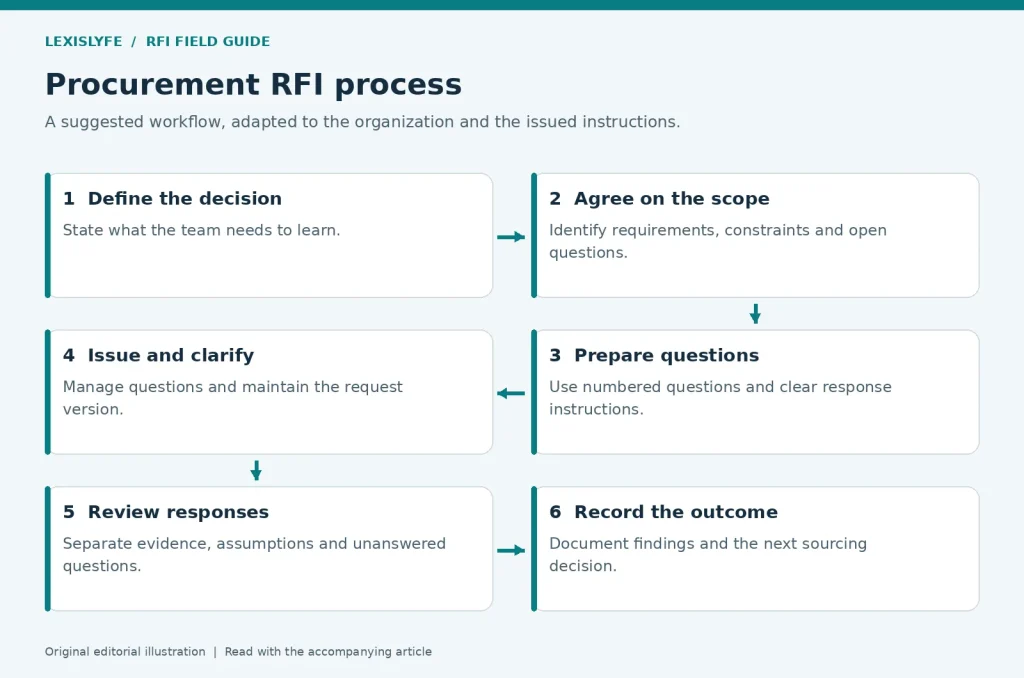
The procurement workflow ends in a documented next decision.
What information should an RFI include?
A useful RFI identifies the request, explains the decision or issue, asks answerable questions and states how to respond. Procurement RFIs need supplier and capability information. Construction RFIs need precise project references and the clarification requested. Both benefit from clear ownership, relevant attachments and a traceable response record.
| Information | Procurement RFI | Construction RFI |
|---|---|---|
| Identification | Buyer, request number and subject | Project, RFI number and subject |
| Context | Business need and research objective | Location and specific information gap |
| References | Existing systems and known constraints | Drawing numbers, revisions, details and specification sections |
| Questions | Numbered capability and evidence questions | One focused issue with any necessary related parts |
| Timing | Questions deadline and response deadline | Requested answer date and affected activity |
| Respondent | Supplier contact or response owner | Assigned technical respondent through the agreed route |
| Attachments | Relevant background or response worksheet | Markups, photographs or supporting records |
| Follow-up | Intended evaluation and next stage | Distribution, impact review and closure records |
Make response instructions unambiguous
Tell respondents what to submit, where to submit it and what will happen if they need clarification. A deadline such as Friday afternoon leaves room for disagreement. An explicit date, time and time zone is easier to administer.
A submission checklist can cover:
- Format: The required file type or response form.
- Identification: The request number and supplier or project contact.
- Limits: Any stated page, attachment or file-size limit.
- Questions: The contact and cutoff for clarification requests.
- Evidence: What documentation supports an answer.
- Handling: How confidential material should be identified under the stated process.
Ask for evidence that answers the question
Replace Do you offer excellent support? with Which support hours apply to this service, and how are incidents escalated? Replace Can you integrate with accounting software? with a question naming the actual system, version or interface relevant to the purchase.
For construction, a marked photograph needs a location, orientation and description of the conflict. An image captioned Please advise rarely gives a reviewer enough context.
Use the latest reference. Record document revisions explicitly. An accurate answer to an outdated drawing can still send the field team in the wrong direction.
What does a procurement RFI example look like?
A procurement RFI example should show a real decision, a defined business context and questions that produce comparable answers. The completed illustration below concerns inventory software. Its company, quantities and dates are fictional and demonstrate how to structure an inquiry rather than report a supplier’s actual capabilities or prices.
Completed example: inventory software research
Request: INV-RFI-001, inventory platform capability research.
Buyer: Example Distribution Company, a fictional business evaluating software for two warehouses in the United States and Canada.
Purpose: Determine which providers merit a demonstration before the company finalizes its purchasing requirements.
Planning assumptions: The business has 25 anticipated users, an existing accounting application and a requirement to preserve product, supplier and transaction records. These are illustrative requirements, not recommendations for every buyer.
Response arrangements: Questions are due November 6, 2026, at 3 p.m. Eastern Time. Responses are due November 13, 2026, at 3 p.m. Eastern Time through the designated purchasing channel. These are fictional example dates, not an open opportunity.
| ID | Question | Requested evidence |
|---|---|---|
| Q1 | Which multi-warehouse receiving, transfer and stock-count workflows are supported? | A workflow description and current product documentation |
| Q2 | How does the proposed accounting integration work? | Supported interface, limitations and responsibility for setup |
| Q3 | What data can be imported and exported? | Supported formats, example fields and known restrictions |
| Q4 | Where would our data be stored, and who could access it? | A description of relevant hosting and access arrangements |
| Q5 | What determines subscription, implementation and support charges? | Pricing units, included services, exclusions and assumptions |
| Q6 | What would a demonstration need to establish? | A proposed test using receiving, transfer and reporting tasks |
The buyer can state: This inquiry is for information gathering. It does not promise a purchase or a later invitation. Actual process wording should follow the organization’s approved approach.
Questions worth adapting for other purchases
A service provider, manufacturer or healthcare organization can adapt the structure without copying the software questions. Ask about the work you need performed and the constraints that determine feasibility.
- For retail supply, ask about order quantities, lead-time assumptions and handling returns.
- For professional services, ask about relevant experience, available capacity and the proposed responsibility split.
- For equipment, ask about installation dependencies, maintenance support and compatible operating conditions.
For a small team selecting business applications, LexisLyfe’s startup tools guide provides broader context for assessing a software stack. An RFI then helps test specific supplier claims against the workflows your business actually needs.
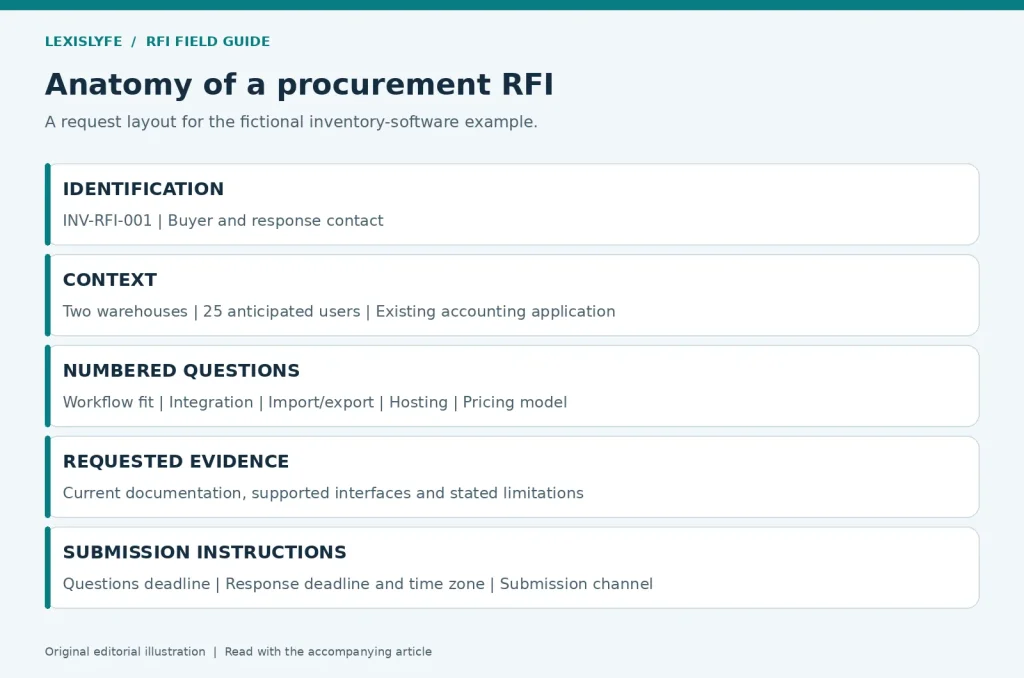
Organize the request so a supplier can find the question, evidence requirement and deadline.
How does the construction RFI process work?
A construction RFI process documents an information gap, routes it to the designated respondent and records the clarification. Before affected work proceeds, the team also checks whether separate instructions or change procedures apply. Distribution and field follow-through matter because an answer in a register does not ensure correct implementation.
This suggested workflow separates the technical question from any commercial follow-up:
- Check the records. Review current drawings, specifications, prior RFIs and relevant field information.
- Describe one issue. Identify the location, references, conflict and specific clarification needed.
- Route the request. Submit it through the project’s agreed communication process.
- Review the response. Check that the answer resolves the question and identifies any supporting documents.
- Assess impacts and authority. Identify possible scope, cost or schedule effects and follow the applicable procedure.
- Distribute the issued information. Notify affected trades and update the controlled project records as appropriate.
- Confirm follow-through. Record the resolution, remaining actions and closure under the project’s process.
A technical answer and an authorization are different records. AIA’s G716 instructions explain the form’s use and the need for an appropriate document when a response requires a change to the contract documents.
An RFI, submittal and change order serve different jobs
A submittal presents information such as shop drawings, product data or samples for the review required by the contract. An RFI asks for clarification. A change order documents an agreed contract modification under the applicable arrangement. The CSI discussion of submittal types explains why different submittals also need different handling.
Watch for three situations:
- Clarification only: The response explains an existing requirement.
- Potential change: The issue needs review through the contract’s change process.
- Further information needed: The respondent cannot resolve the question from the material supplied.
An RFI response should not be treated as an automatic allowance for extra work. Likewise, the absence of a final agreed change order does not justify a universal instruction to stop every affected activity. The contract may provide other authorized mechanisms, including directives. AIA’s comparison of change directives and change orders explains that distinction.
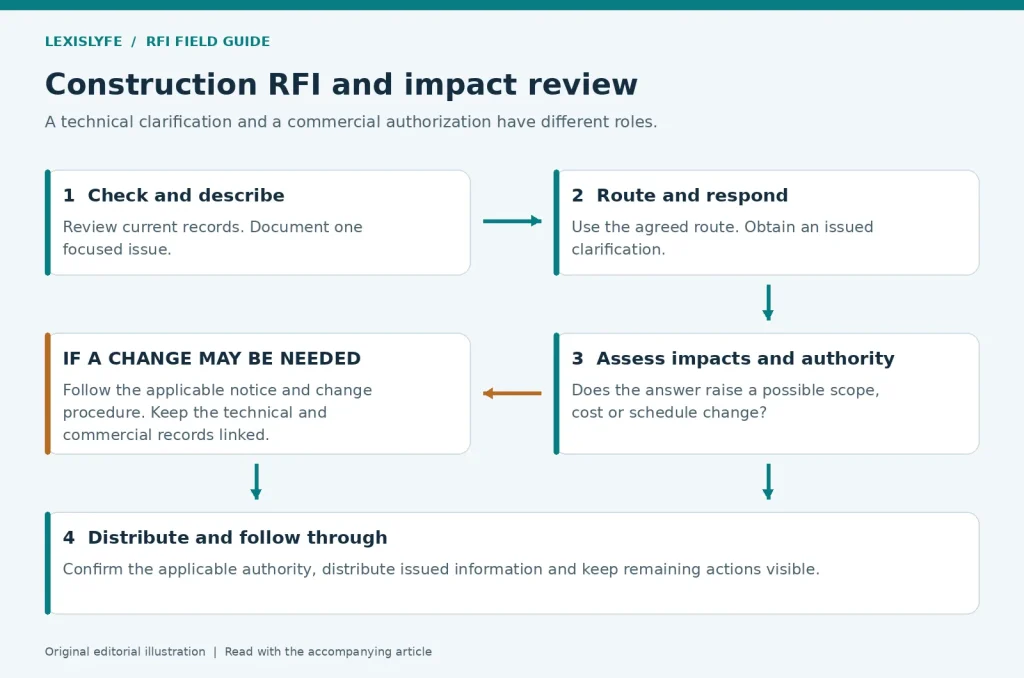
Resolve the question, check the applicable authorization, then distribute and follow through.
What does a completed construction RFI look like?
A completed construction RFI identifies the exact location and conflicting information, asks a focused question and records the issued response. The fictional example below shows the wording and follow-up. Its dimensions and dates are illustrative; they are not design instructions or a substitute for project-specific professional review.
Completed example: conflicting ceiling heights
Project: Example Office Renovation.
RFI: RFI-017, Room 204 ceiling height clarification.
Issued: November 2, 2026.
Requested response: November 5, 2026, to support coordination before the planned ceiling framing activity on November 9, 2026. These are example planning dates.
References: Architectural reflected ceiling plan A-602, Revision 2, and section 3/A-401, Revision 2. Both references are fictional drawing identifiers.
Question: The reflected ceiling plan indicates a finished ceiling height of 9 feet in Room 204. Section 3/A-401 indicates 8 feet 6 inches at the same location. Please confirm the required finished ceiling height and identify any related coordination requirements.
Attachments: A highlighted copy of each conflicting reference and a location-marked photograph. The illustration accompanying this example explains the discrepancy without presenting a buildable detail.
Suggested resolution: Use the height confirmed by the architect and coordinate the affected services before release. This is a request for direction, not the contractor selecting a design answer.
Potential impacts: Cost and schedule effects remain to be determined. The contractor identifies the affected activity so the team can assess the issue without treating a possible impact as an established claim.
Illustrative response and follow-up
The designated respondent might issue: “The required finished ceiling height for Room 204 is 9 feet. Refer to the accompanying clarification sketch and coordinate the affected services. Raise any unresolved conflicts through the project process.” This is a fictional response, not professional advice for an actual installation.
Before release, the coordinator should:
- Confirm that the issued response and attachment resolve the question.
- Review possible commercial and coordination effects through the appropriate process.
- Distribute the information and record the required field follow-up.
Keep the original question, answer and supporting attachments together. If a later response supersedes the first, preserve the history and clearly identify the current instruction. A reader should not have to infer which email is authoritative.
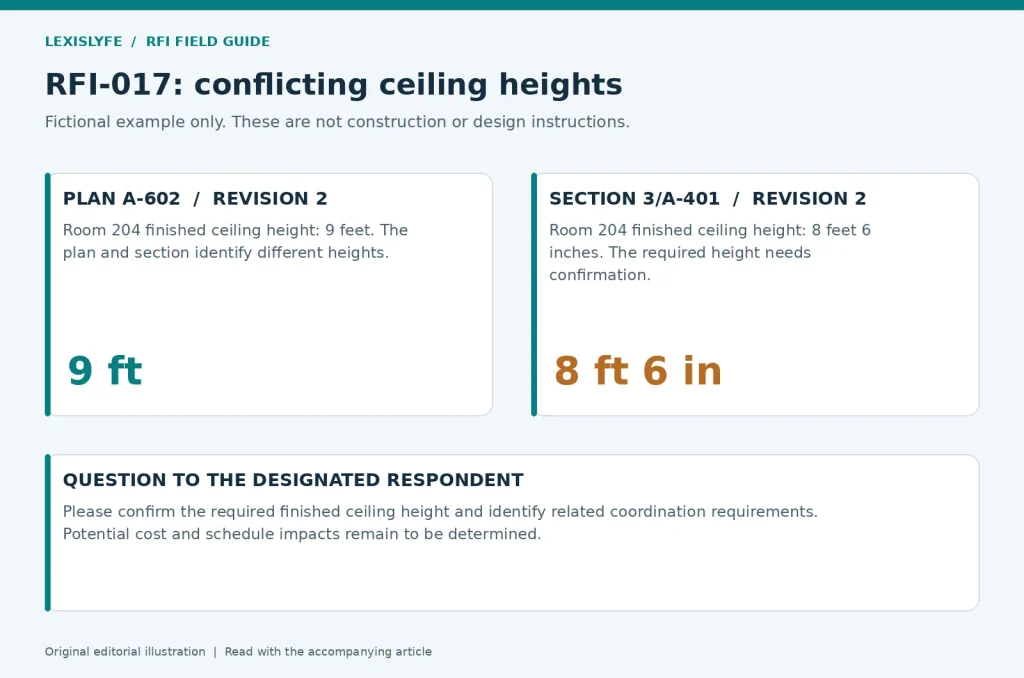
An illustrative discrepancy, not a construction detail: the respondent must confirm the requirement.
How should you respond to an RFI?
Respond to an RFI by answering the stated question, supplying relevant evidence and following the submission instructions. Suppliers should distinguish current capabilities from planned features and assumptions. Construction respondents should provide a clear, authorized clarification and identify any separate documents needed for the team to act on the response.
A supplier response that is easy to evaluate
Use the question numbering supplied by the buyer. Give a direct answer before adding background. A buyer should be able to tell whether your response means supported now, available with conditions, planned or not supported.
For the inventory example, a useful fictional answer might be: “Warehouse transfers are supported in the proposed service. The standard workflow records dispatch and receipt separately. The attached documentation describes user permissions. Integration with your accounting application requires a separate compatibility review.”
That answer states a capability, supplies evidence and identifies an unresolved dependency. It is more useful than our platform handles every business need.
A practical response sequence is:
- Check fit and instructions. Confirm the topic, eligibility information requested, deadline and submission route.
- Assign answers to owners. Route technical, commercial and security questions to people who can verify the facts.
- Resolve inconsistencies. Check that different sections describe the same service, assumptions and availability.
- Submit and retain the record. Keep the exact response, attachments and submission confirmation where available.
Useful supporting material includes:
- Current documentation that directly supports the answer.
- A relevant example whose scope is explained accurately.
- Stated limitations and dependencies.
- A contact for clarification through the requested channel.
A construction response that closes the information gap
Identify the request being answered and address the particular conflict. Reference an attached sketch or revised document precisely. If the question remains incomplete, identify what additional information is required and who needs to supply it.
Avoid ambiguous closure language. A reply such as coordinate as required may leave the original decision unresolved. If a response introduces another conflict, log the follow-up instead of recording the issue as fully resolved.
A reusable response library can reduce repeated drafting, but each reused answer needs a current owner and review date. AI-assisted drafts need the same factual review. A tool should not turn an old answer or an inferred capability into an unsupported commitment.
How do you evaluate RFI responses fairly?
Evaluate RFI responses against the decision the inquiry was designed to support. Check genuinely required conditions first, then compare relevant evidence using consistent criteria. Record uncertainties separately from confirmed capabilities. A procurement shortlist is a research outcome; it should not be presented as a contract award or proof of performance.
The following model is an original illustrative scoring method. It is not a prescribed procurement standard, and its weights should not be copied into a public process without checking the applicable requirements.
- Define any genuine screening conditions before reviewing responses.
- Score each relevant criterion using the same evidence scale.
- Record unresolved questions and the evidence needed to answer them.
- Document the next decision and its reasons.
Worked scoring example
Suppose a fictional buyer uses four criteria totaling 100%. Each criterion receives a score from 0 to 5. For this example, 0 means no useful evidence, 3 means relevant support with unresolved limitations, and 5 means strong relevant support for this research stage.
| Criterion | Weight | Supplier A score | A weighted points | Supplier B score | B weighted points |
|---|---|---|---|---|---|
| Required workflow fit | 40% | 4 | 32 | 3 | 24 |
| Integration evidence | 25% | 3 | 15 | 4 | 20 |
| Implementation feasibility | 20% | 4 | 16 | 3 | 12 |
| Support fit | 15% | 3 | 9 | 4 | 12 |
| Total | 100% | 72/100 | 68/100 |
For Supplier A’s first row, the arithmetic is 4 ÷ 5 × 40 = 32 points. The total is 32 + 15 + 16 + 9 = 72. Supplier B’s total is 24 + 20 + 12 + 12 = 68.
A four-point lead does not remove uncertainty. If accounting integration is decisive, the buyer should test it before making a purchasing decision. The scores identify where to investigate, not what a supplier has already proved in operation.
Look for warning signs such as:
- Unsupported statements presented as verified capabilities.
- Different answers to the same requirement in separate sections.
- A proposed approach that depends on an unidentified partner or unconfirmed feature.
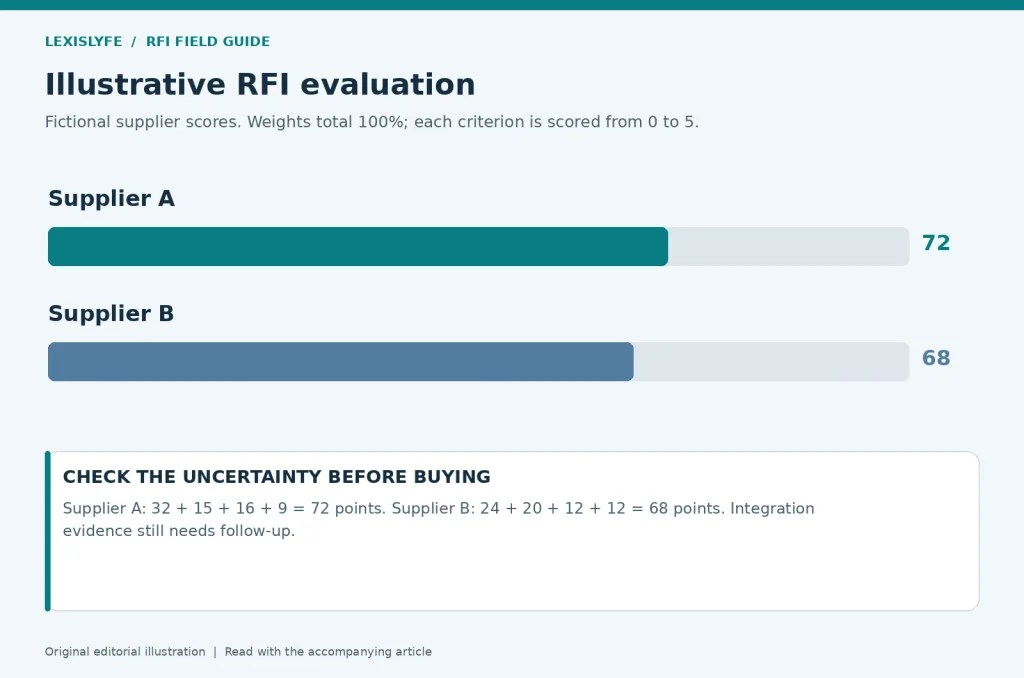
Fictional scores show the arithmetic. They are not supplier ratings or market data.
How long does an RFI take, and what does it cost?
An RFI’s timing and cost depend on its scope, the evidence needed and the review process. There is no universal response deadline or per-RFI fee. Use the stated procurement instructions or construction contract, then plan for the work needed to prepare, review, clarify and implement the resulting decision.
For construction, CSI’s discussion of interpretations and clarifications explains that commonly used US standard conditions refer to agreed time limits or reasonable promptness rather than one fixed number of days for every request.
Distinguish a requested answer date from an agreed contractual deadline. A date entered in software can be a useful planning field without creating a new contractual obligation.
Estimate effort using your own assumptions
Use a simple planning calculation rather than an unsupported industry average:
- Estimate preparation, review and follow-up hours.
- Apply the relevant internal labor assumptions.
- Add separately identified software or administration costs if applicable.
For example, 2 hours of preparation, 1 hour of specialist review and 0.5 hour of coordination total 3.5 hours. At an illustrative internal rate of $60 per hour, the arithmetic is 3.5 × $60 = $210. This is a fictional workload example, not a typical RFI price or vendor fee.
In procurement, preliminary price information can be appropriate. FAR 15.201(e) expressly allows US federal RFIs to seek price, delivery and other market information for planning. Label a requested figure as budgetary information and state its assumptions rather than treating it as a final quote.
How are RFIs used in US and Canadian government work?
Government RFIs can support supplier research, procurement planning or public policy development. The notice explains which purpose applies and how information will be used. US and Canadian readers should follow the relevant authority’s instructions rather than assuming that every RFI is a tender, funding opportunity or invitation to bid.
US federal FAR 15.201 explains that responses to these planning notices are not offers capable of acceptance to form a binding contract. FAR 52.215-3 also sets out planning-purpose language concerning awards and payment for information.
The current CanadaBuys RFI guidance describes gathering supplier feedback to shape requirements and procurement strategy. It states that RFIs or letters of interest must make clear that they are not solicitations and do not commit the buyer to future purchases or contracts.
A government RFI may seek public input rather than suppliers. NIH’s 2025 AI strategy RFI invited comments on strategic priorities and stated that it was for planning purposes. Its stated July 15, 2025 response deadline is historical, not a current invitation.
A June 18, 2026 CMS notice sought technical input about pharmacy benefit manager practices. Its stated July 20, 2026 comment deadline is also historical. These examples show why a definition focused exclusively on vendor shortlisting would be incomplete.
Before responding to a public notice, check:
- The purpose and the categories of respondents invited.
- The current deadline, amendments and official submission route.
- The treatment of confidential or proprietary material.
- Any page limits, required topics and response-cost provisions.
Do not assume an RFI submission is confidential. Follow the notice’s instructions and avoid including sensitive material merely because it supports your answer. A confidentiality label does not, by itself, establish how the receiving authority must handle the information.
Do you need RFI software or will a spreadsheet work?
A spreadsheet and controlled document folder can support a small RFI workload if ownership, versions and distribution remain clear. Dedicated software becomes useful when coordination, permissions or traceability are difficult to maintain. Choose based on the work you need to control rather than the number of features advertised.
Start with a usable RFI log
A basic construction log should make the next action visible. The example below is an editorial suggestion; project requirements may call for other fields or statuses.
| Field | Purpose | Example |
|---|---|---|
| RFI number | Connect the request and response | RFI-017 |
| Subject and location | Identify the issue | Room 204 ceiling height |
| Owner or current assignee | Show who must act | Design coordinator |
| Issued and requested dates | Support tracking | November 2 and November 5, 2026 |
| Status | Show progress | Response received, impact review pending |
| References | Identify the documents involved | A-602 Rev. 2 and 3/A-401 Rev. 2 |
| Potential impact | Separate uncertainty from confirmed effects | To be determined |
| Response and follow-up | Preserve the decision trail | Clarification attached; distribution pending |
All entries are fictional. Answered and closed are different concepts, even when a particular application combines them in one operation. Newforma Project Center’s documented response workflow includes a respond-and-close action. Your team’s process must still account for remaining work.
Test software with an actual workflow
Procore’s RFI creation documentation describes fields such as assignees, due dates, drawing references and cost or schedule impact. These examples help identify what to test without assuming every product uses the same fields or permissions.
Useful selection criteria include:
- Document references and attachment handling.
- Clear ownership, permissions and distribution.
- Search, export and a reviewable history.
- A way to distinguish unresolved impacts from completed follow-up.
Run a small pilot:
- Enter one request with an attachment and assigned respondent.
- Issue a response, revise a reference and check who receives the update.
- Export the record and confirm that someone outside the software can understand it.
For procurement response tools, also test answer ownership, evidence links and review dates. An answer library that retrieves a stale security statement quickly can create more work than it saves. No current product pricing is claimed here; compare any proposed subscription against your actual workload and required access.
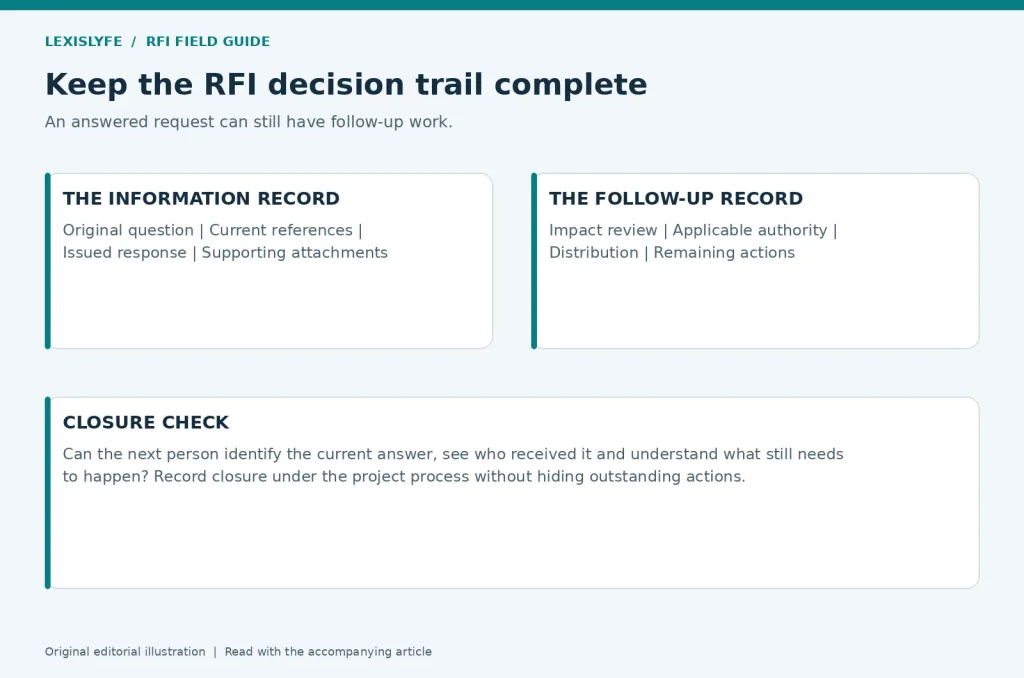
Close the information gap and keep any remaining actions visible.
What common RFI mistakes should you avoid?
Common RFI mistakes include asking vague questions, confusing research with approval, using outdated references and closing records before follow-up is complete. The corrective action is to make the requested decision explicit, supply relevant evidence and assign responsibility for the next step. Extra documentation only helps when it reduces uncertainty.
The following checks address problems on both sides of the exchange:
- A vague subject: Replace drawing issue with a location and specific conflict.
- Too many unrelated questions: Separate issues that need different respondents or closure decisions.
- An oversized procurement questionnaire: Ask only what can change the next research decision.
- Unsupported timing rules: Use the actual deadline or agreed process.
- Treating silence as approval: Check the governing procedure instead of inventing a default.
- Unclear pricing assumptions: Distinguish planning information from a quote or agreement.
- Unreviewed reused answers: Verify that the cited capability and evidence remain current.
- Missing distribution: Confirm affected participants receive the issued information.
Construction teams should also avoid using RFIs to accumulate accusations. A factual question, a precise reference and a documented impact are more useful than argumentative wording.
Measure decision quality, not just document volume. A high RFI count can reflect unclear documentation, detailed coordination or other project conditions. The count alone does not establish fault or entitlement.
Useful measures include:
- Response time, with the clock and calendar defined.
- Age of unresolved requests affecting a planned activity.
- Requests returned for missing information.
- Follow-up required because an answer did not resolve the issue.
Compare like with like. If one team measures calendar days and another measures working days, their averages do not support a fair comparison. If one system closes a request when it sends a response, report that definition alongside the result.
Frequently asked questions
An RFI’s meaning becomes clearer when you separate its purpose from the documents that may follow it. These answers address common questions about format, pricing, responsibility and approval. For a particular purchase or project, the issued instructions and governing documents take priority over a general explanation or example.
Conclusion
An RFI turns a missing piece of information into a documented question and response. Use procurement RFIs to research suppliers and construction RFIs to clarify project requirements. Define the decision, request useful evidence and record the next action. Before buying, building or changing a contract, confirm the applicable authority.