Who Owns Cracker Barrel? Ownership Explained
Ownership and leadership checked: October 18, 2026.
Cracker Barrel belongs to its shareholders through the publicly traded company Cracker Barrel Old Country Store, Inc., listed on Nasdaq as CBRL. There isn’t one individual who owns the entire restaurant chain. The founder, the chief executive, the largest investment manager, and the owner of a restaurant building can all be different people or organizations.
That distinction matters because older articles can give you a confident answer with yesterday’s names. David Deno replaced Julie Masino as CEO in August 2026, and the company exited Maple Street Biscuit Company earlier that summer. Meanwhile, the 2025 logo controversy continues to appear in searches about who controls the business.
This guide explains the ownership structure, the largest shareholders disclosed in the latest company proxy, the founder’s role, and the difference between owning shares and running restaurants. It also separates the restaurant chain from the Cracker Barrel cheese brand familiar to Canadian shoppers, then shows you how to check an ownership claim yourself.
Who owns Cracker Barrel today?
Cracker Barrel is owned by the shareholders of Cracker Barrel Old Country Store, Inc. Its common stock trades on Nasdaq under CBRL. Shareholders hold equity in the public company; the board oversees management, and executives run the business. Calling one executive the “Cracker Barrel owner” leaves out that structure.
The company’s 2026 annual report identifies the listed corporation and its subsidiaries. An individual can own a small investment in that corporation without owning a particular dining room, gift shop, or parcel of land.
Think of a hypothetical shareholder who buys ten shares. That person has an investment in the company alongside other shareholders. Buying those shares doesn’t grant permission to change the menu, direct employees, or occupy a restaurant building. Those decisions and rights belong to other parts of the business structure.
The most useful first question is therefore, what kind of ownership are we discussing? A news story about a shareholder vote answers a different question from a property record naming the owner of a restaurant site.
| Question | Where the answer belongs | What it establishes |
|---|---|---|
| Who owns equity in the restaurant company? | Shareholder disclosures | An investment interest |
| Who oversees the business? | Board information and governance documents | Oversight and accountability |
| Who runs the company? | Management biographies and appointment notices | Executive responsibility |
| Who owns a restaurant’s land or building? | Property records and lease disclosures | Real estate ownership |
| Who owns a similarly named grocery brand? | That brand’s corporate information | A separate commercial identity |
This guide uses those distinctions throughout. A large shareholding, a familiar name, or a prominent job title shouldn’t be asked to prove more than it actually proves.
Who are the largest disclosed shareholders?
BlackRock is the largest holder in the more-than-5% ownership table in Cracker Barrel’s 2026 proxy statement. D. E. Shaw and Vanguard Capital Management also appear. These are disclosed positions with specified source dates. They should be read as a documented snapshot, rather than a live record of every trade.
The 2026 proxy statement, ownership section provides these figures:
| Beneficial owner named in the proxy | Shares reported | Percentage of class | Underlying filing cited by the company |
|---|---|---|---|
| BlackRock, Inc. | 3,317,812 | 14.8% | Schedule 13G/A, April 30, 2025 |
| D. E. Shaw & Co., L.P. | 1,631,772 | 7.3% | Schedule 13G amendment, July 13, 2026 |
| Vanguard Capital Management | 1,141,327 | 5.1% | Schedule 13G, April 29, 2026 |
The table covers holders known to the company as of September 28, 2026. Percentages use approximately 22,352,430 shares outstanding on that date. The footnotes matter: a recently published proxy can rely on an older underlying ownership filing.
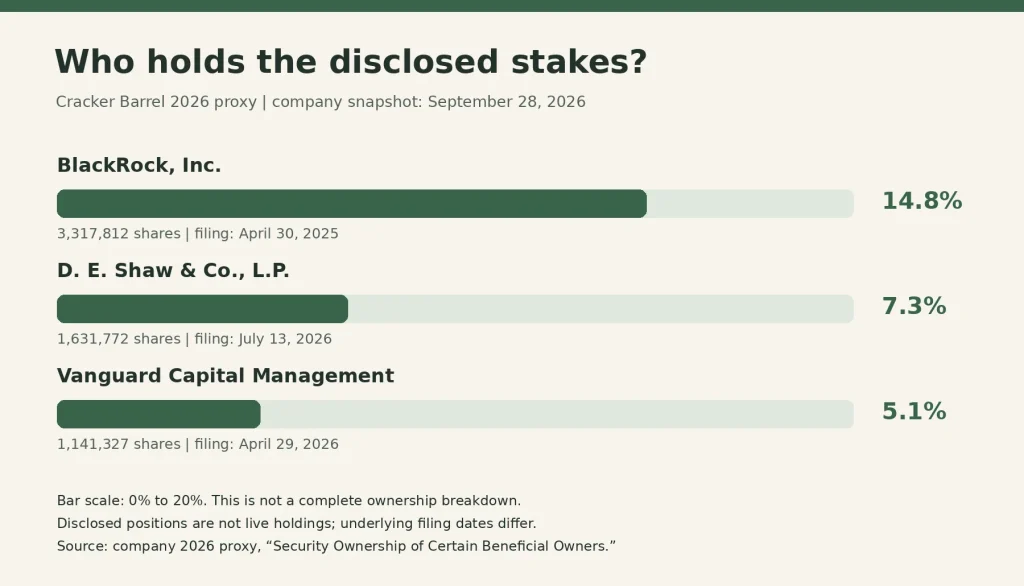
The chart reproduces the proxy’s disclosed positions. It does not represent live holdings or a complete ownership breakdown.
Does the largest shareholder own the whole chain?
A largest holder is simply the largest holder within the comparison being made. It doesn’t follow that the holder has a majority, can approve every proposal alone, or personally directs the restaurants. A minority stake and complete ownership are different claims.
The name of an investment manager also needs care. Investment managers can report positions connected with funds, affiliates, or client accounts. Reading the filing’s explanation is more informative than treating the manager’s name as if it identified a single private proprietor.
Why can two ownership websites show different percentages?
Before deciding that either source is wrong, compare the reporting dates, reporting entities, and number of shares used in the calculation. One table might quote an annual proxy, while another uses a later institutional filing. A parent manager and an affiliated fund can also appear as separate rows.
For a hypothetical example, 1,000,000 shares divided by 20,000,000 shares outstanding equals 5%. The same holding divided by 22,000,000 equals about 4.55%. A percentage can change when the denominator changes, even if the holding stays constant.
Don’t add a manager’s position to an affiliated fund’s position without checking for overlap. That can make the apparent ownership total larger than the actual set of distinct shares being described.
What does beneficial ownership mean?
Beneficial ownership is a reporting concept involving voting power or investment power, including the power to sell a security. The SEC’s Schedules 13D and 13G explanation describes that distinction. It helps explain why the name shown in a disclosure can be an investment organization rather than the person who ultimately supplied money to a fund.
For a hypothetical example, imagine a retirement investor who holds units in a fund, and that fund holds restaurant-company shares. The investor’s interest in the fund, the fund’s portfolio position, and a manager’s reported authority are connected relationships. They aren’t three separate restaurant shareholdings to add together.
This is why an ownership table needs footnotes. A row may describe sole or shared voting power, investment power, or a group of related reporting entities. The heading alone rarely carries all that information. If a source supplies a detailed definition, preserve it rather than replacing it with a more sweeping claim.
There is also a difference between identifying a major disclosed holder and reconstructing every shareholder. A table focused on a reporting threshold has a defined purpose. Absence from that table alone doesn’t establish that a person or organization has no shares. It may simply mean the table isn’t designed to list that particular interest.
Who is the Cracker Barrel CEO in 2026?
David Deno is Cracker Barrel’s president and chief executive officer as of October 18, 2026. His appointment took effect on August 10, 2026. Julie Masino stepped down as CEO and a director on that date, with an advisory transition scheduled through October 9. The leadership change didn’t make Deno the company’s sole owner.
Cracker Barrel announced the succession on July 27, 2026, in its official leadership announcement. The company’s management directory also identifies Deno in the current role.
Deno previously led Bloomin’ Brands from 2019 to 2024. His experience at another restaurant group is relevant to his background, but a shared executive doesn’t establish shared ownership between the businesses. A biography records where someone worked; an acquisition announcement records a corporate transaction.
Why do older articles still name Julie Masino?
A page published before the transition may have been accurate when written. Problems arise when an undated summary presents that earlier information as current. For leadership questions, check the effective date of an appointment alongside the date of the announcement.
An announcement can describe someone as the next CEO before the person takes office. After the effective date, the same person may be the current CEO. Keeping those dates separate prevents a simple tense error from becoming an inaccurate leadership claim.
The CEO’s compensation is another separate question. Salary, stock awards, and an equity holding describe different aspects of the executive’s relationship with the company. A compensation headline doesn’t tell you who owns the whole business.
Who founded Cracker Barrel, and when did it become public?
Dan Evins founded Cracker Barrel, and the first location opened in Lebanon, Tennessee, on September 19, 1969. The company became publicly traded in 1981. Its country-store origins explain the brand’s character, while its public-company structure explains how ownership is distributed today. Those are related parts of the story with different meanings.
The company’s founder history describes Evins working in the family gasoline business and developing a stop where travelers could eat and shop. Early locations also sold gasoline. The familiar restaurant-and-store combination grew from that roadside idea.
Cracker Barrel’s 50th-anniversary company history identifies the 1981 public-company milestone. Becoming public opened ownership to shareholders beyond the original investors.
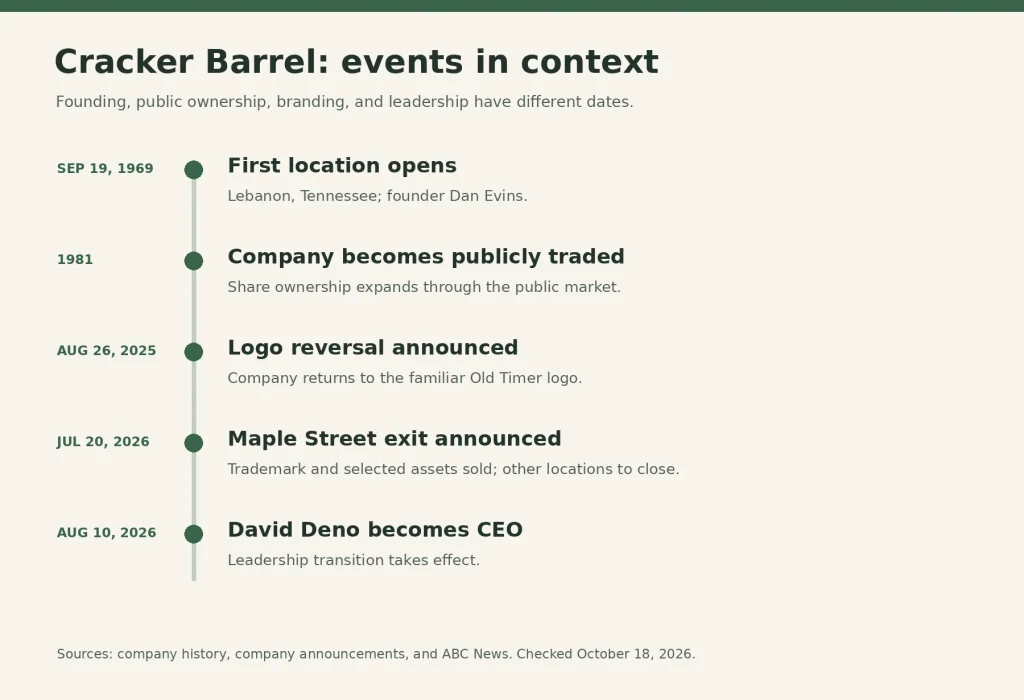
The timeline separates the company’s founding from later ownership, branding, and leadership events.
Does the founder’s history establish current family ownership?
A founder’s influence can remain visible in a brand long after the ownership structure changes. Family stories, recipes, traditions, and names help explain how a business developed. They don’t establish a present controlling stake without current ownership evidence.
For that reason, a search about the founder should lead to historical records, while a search about today’s largest investors should lead to current securities disclosures. Combining the two into one unsupported family-ownership claim loses the distinction readers need.
The 1969 opening remains part of the answer to “where did this business come from?” The shareholder records answer “who has an equity interest now?” Both questions deserve clear answers, without treating one as a substitute for the other.
Who controls decisions at Cracker Barrel?
Cracker Barrel’s governance separates shareholders, directors, and executives. Shareholders vote on matters put before them, directors oversee the business, and management handles operations. The company’s board directory identifies Carl Berquist as independent chairman. The best way to understand a decision is to identify the relevant role and supporting record.
The official board directory distinguishes the chairman and other directors from the management team. Board oversight and executive leadership can overlap through individual appointments, but the roles still have different purposes.
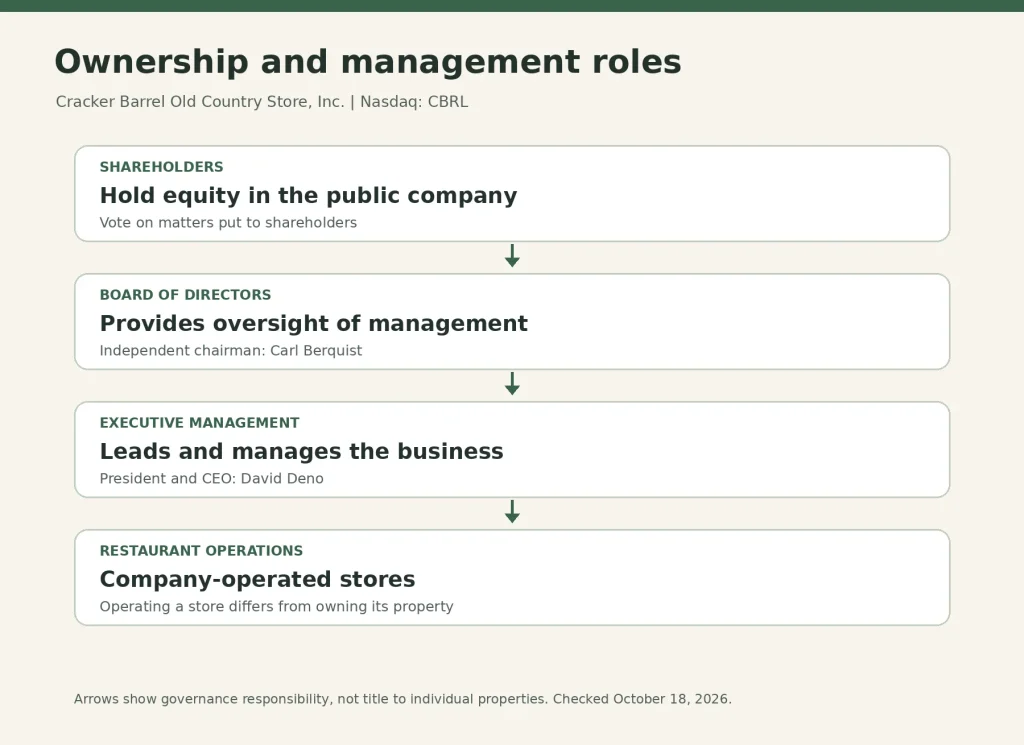
This diagram describes governance roles. The arrows show accountability and responsibility, rather than ownership of individual restaurant properties.
A practical example of the difference
Suppose customers object to a proposed dining-room change. A store manager may receive the complaints, executives may review the proposal, directors may question the strategy, and shareholders may consider leadership performance when voting. Each participant can affect the outcome through a different route.
None of those actions, by itself, identifies a single person who owns the chain. Customer pressure is commercial influence. A shareholder vote is a governance action. An executive instruction is a management action. Keeping the categories clear makes reporting easier to follow.
Where do activist investors fit?
Cracker Barrel has faced shareholder activism involving Sardar Biglari. In November 2025, Reuters reported on Biglari’s campaign and proxy-adviser responses.
An activist can press for board or strategy changes without owning the entire company. A campaign is evidence of a dispute or proposal, rather than proof that the campaigner has already gained control. The campaign’s result needs its own evidence.
When a headline names the owner of another restaurant business in a Cracker Barrel dispute, read the relationship carefully. The person might be a shareholder pressing for change. That doesn’t automatically make the person’s other business Cracker Barrel’s parent company.
Are Cracker Barrel restaurants franchises, and who owns their buildings?
Cracker Barrel says its restaurants are company-owned and operated, with no franchised stores. Building ownership is a separate matter: the company owns some restaurant properties and leases others. A landlord can own a site while Cracker Barrel operates the restaurant there. A property transaction therefore doesn’t automatically mean the chain has changed owners.
The company’s about page and franchise FAQ directly address the operating model. “Company-owned” in this context describes the restaurant business, rather than promising ownership of every building it occupies.
The 2026 annual report states that, as of September 11, 2026, Cracker Barrel had 655 stores across 43 states. It owned the land and buildings for 330 stores; the remaining 325 involved ground leases or ground-and-building leases. These are dated operational figures, rather than a live location count.
How a sale-leaseback works
A sale-leaseback separates a property transaction from the continued use of that property. A business sells real estate and leases it back. The location can keep serving customers while its status changes from owned property to leased property.
Cracker Barrel’s July 20, 2026 strategic-actions announcement reported a sale-leaseback involving 26 stores, generating approximately $77 million in net proceeds. That announcement described a real estate transaction, alongside a separate business divestiture.
For a reader, the useful questions are:
- Did the transaction involve shares in the public company?
- Did it involve the restaurant business or selected assets?
- Did it involve the land and buildings?
Those questions help interpret the word “sale” without assuming every sale has the same effect. An article that says only “Cracker Barrel sold stores” can leave the central issue unresolved.
Does a lender become an owner?
Debt and equity represent different financial relationships. A lender’s contractual rights differ from a shareholder’s equity interest. For a broader explanation of how companies combine those funding sources, Lexis Lyfe’s WACC formula and worked example separates the cost of debt from the cost of equity.
That financing distinction is useful here because property ownership, borrowing, and share ownership can appear in the same corporate announcement. Read each part according to the transaction it describes.
What other restaurant brands does Cracker Barrel own?
Current ownership requires checking later sales as well as original acquisitions. Cracker Barrel acquired Maple Street Biscuit Company in 2019, then exited the business in 2026. It also sold Logan’s Roadhouse years earlier. Listing either as a current restaurant subsidiary without checking those transactions gives readers an outdated corporate picture.
Cracker Barrel’s 2019 acquisition announcement reported the Maple Street purchase for $36 million. The July 2026 strategic-actions release then reported the sale of its trademark and assets used in 35 locations to Biscuit Belly, LLC, with the remaining 16 locations to close.
The 2026 annual report confirms that Cracker Barrel no longer operated Maple Street locations at July 31, 2026. The older acquisition remains a historical fact, but it no longer supports a statement of current ownership.
| Brand | Historical relationship | What the later record establishes |
|---|---|---|
| Cracker Barrel Old Country Store | Core restaurant-and-retail concept | Current operating business |
| Maple Street Biscuit Company | Acquired in 2019 | Business exited in 2026 |
| Logan’s Roadhouse | Former subsidiary | Sale completed in December 2006 |
The official Logan’s sale-completion announcement records the December 6, 2006 closing. A company’s acquisition history and its present portfolio should be kept in separate columns.
To check any similar claim, look for an event sequence:
- Find the original acquisition announcement.
- Search for later sales, closures, or restructurings.
- Read the latest annual report’s description of the business.
- State the relationship with a date.
This method is especially helpful when an old article still ranks well. Search visibility doesn’t update a transaction’s legal or commercial status.
What happened to the Cracker Barrel new logo?
Cracker Barrel introduced a simplified logo in August 2025 and announced a return to its familiar Old Timer logo on August 26 after a backlash. That branding episode concerned the company’s identity and strategy. It didn’t, by itself, establish an acquisition, a new parent company, or a change in share ownership.
ABC News’s August 26, 2025 report documents the reversal. Cracker Barrel also acknowledged the return to the Old Timer logo in its fiscal 2025 results announcement.
Why does the logo appear in ownership searches?
Brand changes prompt readers to ask who made the decision and whether someone bought the business. Those are understandable questions, but they require different evidence. A logo announcement can explain the design decision. An appointment notice identifies leadership. A transaction filing would establish an acquisition.
The company’s December 2025 organizational announcement separately addressed leadership responsibilities and the end of its engagement with Prophet, the consultancy involved in the earlier refresh. A consultancy’s involvement identifies an adviser, rather than an owner.
Was the CEO change caused solely by the logo backlash?
The logo reversal and the later leadership transition are documented events. Establishing that one was the sole cause of the other would require stronger evidence than their order on a timeline. The succession announcement describes a search and transition process.
Avoid turning a plausible interpretation into a confirmed explanation. Reporting can say that the CEO transition followed the controversy. A claim about the complete private reasoning behind that decision needs evidence of its own.
What does a falling share price establish?
A share-price move changes the market value attached to equity at that moment. It doesn’t establish that the company lost the same amount of cash from restaurant sales, or that ownership transferred to a new parent.
Lexis Lyfe’s guide to Amazon’s revenue versus profit illustrates why financial labels matter. Revenue, profit, and market capitalization measure different things. A dramatic figure needs its correct label before it becomes useful evidence.
How does ownership differ from a company’s market value?
Ownership describes a relationship to the company’s equity; market value describes what that equity is worth at quoted prices. Revenue and profit describe business performance over a period. These measures can appear together in a news story, but they answer different questions. Confusing them can make an ownership explanation sound more dramatic than the evidence supports.
A hypothetical example using simple numbers
Imagine a company with 1,000 shares outstanding, trading at $20 each. Multiplying the share count by the price gives an equity market value of $20,000. An investor holding 100 shares owns 10% of those shares, with a quoted holding value of $2,000.
Now suppose the price falls to $15 while both share counts stay unchanged. The company’s equity market value becomes $15,000, and the investor’s holding is valued at $1,500. The investor still holds 10%. The change in price hasn’t created a different ownership percentage.
These are illustrative numbers, not Cracker Barrel’s trading figures. Their purpose is to separate three statements that can otherwise sound similar:
- The investor’s holding became less valuable at the quoted price.
- The investor’s percentage interest stayed the same in this example.
- The calculation says nothing about the company’s revenue for that day.
A claim about reduced market value therefore needs a different explanation from a claim that someone sold a controlling interest. The first requires price and share-count context. The second requires evidence of a transaction and the rights involved.
Why the label on a financial figure matters
Consider a hypothetical restaurant that takes $10,000 in customer payments over a period. That figure doesn’t tell you what remains after food, wages, rent, and other costs. It also doesn’t tell you the price investors would pay for shares in the business.
The same discipline applies when reading a headline about a public restaurant chain. Before connecting a number to an ownership claim, ask what was measured, over which period, and using which source. A movement in a company’s share price can be relevant context without answering who currently holds its shares.
An ownership article also shouldn’t turn into an investment recommendation merely because it mentions shareholders. Establishing that a company is publicly traded identifies the structure. Deciding whether its shares suit an investor would require a separate assessment of valuation, financial performance, and that investor’s circumstances.
Read the transaction verb closely
“Bought,” “sold,” “appointed,” and “proposed” describe different events. Even the word “bought” needs an object: shares, selected assets, a trademark, or an entire business. A sentence that leaves out that object can create more confusion than it resolves.
For Cracker Barrel, the useful habit is to keep the relevant noun beside the verb. An executive was appointed. Certain property assets were sold and leased back. A former restaurant brand was divested. Each statement describes its own relationship and should be checked against the record for that event.
Is Cracker Barrel cheese owned by the restaurant chain?
The Cracker Barrel cheese brand familiar to Canadian shoppers belongs to a different business from the US restaurant chain. Lactalis Canada includes Cracker Barrel in its brand portfolio. A shared name doesn’t establish a shared parent, management team, or shareholder base. Start by identifying the country and product before answering the ownership question.
Lactalis Canada’s company history describes its acquisition of Kraft Heinz’s Canadian natural-cheese business. A July 2026 Lactalis Canada announcement also identifies Cracker Barrel among its brands.
| What you’re looking at | Relevant ownership question | Starting source |
|---|---|---|
| A Cracker Barrel Old Country Store restaurant | Who owns the listed restaurant company? | Company investor relations and SEC filings |
| Cracker Barrel cheese in Canada | Which dairy company owns the Canadian brand? | Lactalis Canada |
| A grocery product in another country | Which company holds the rights for that product and territory? | Local packaging and the relevant brand owner |
Territory matters in consumer brands. An answer about Canadian cheese shouldn’t be applied automatically to US grocery products, and neither answer should be used to identify the restaurant company’s shareholders.
The same applies to the compressed search spelling crackerbarrel. It helps you find results, but it doesn’t resolve which business the search result describes. Read the legal company name or product information before drawing an ownership conclusion.
Which ownership terms are easiest to confuse?
Founder, CEO, shareholder, parent company, and landlord describe different relationships. Confusing those terms can turn a true biographical detail into a false ownership claim. Use the term supported by the evidence, and add a date when the relationship can change. This makes short answers more accurate without making them harder to read. FounderThe person associated with starting the business. The title describes its origin. ShareholderA holder of company shares. The size and rights of the holding need their own evidence. Chief executive officerThe executive responsible for leading the company, subject to its governance arrangements. Parent companyA company with an ownership relationship to another business. A shared executive or adviser alone doesn’t establish that relationship. LandlordThe property owner or lessor in a lease relationship. That status doesn’t automatically confer ownership of the tenant’s business.
Common claims to check before repeating
- “The CEO owns Cracker Barrel.” Check for a documented equity holding and avoid confusing leadership with sole ownership.
- “A former employer owns the chain.” Look for a corporate transaction, rather than relying on an executive biography.
- “A brand redesign proves a takeover.” Find an acquisition record before making that connection.
- “A former subsidiary is still owned.” Search for the later disposal, alongside the original purchase.
Another mistake is presenting a historical number without its reporting date. Ownership figures have a time dimension. Removing that date makes a measured disclosure look more current and certain than the source allows.
The safest concise answer identifies the entity, the relationship, and the date. “A disclosed shareholder in the 2026 proxy” is a more precise description than an unqualified statement that an institution “owns Cracker Barrel.”
How can you verify an ownership claim yourself?
Begin with Cracker Barrel’s official investor information, then match the document to the question. The proxy helps identify disclosed shareholders and governance arrangements; the annual report describes the business; appointment notices establish leadership transitions. Read the underlying dates and footnotes before turning a disclosure into a statement about current ownership.
This is a practical research method, rather than a claim that every document answers every question. An annual report can be thorough about operations while directing ownership questions to the proxy. A press release can accurately report an appointment without listing all shareholders.
Match the question to the document
| What you want to verify | Most useful starting document | What to check |
|---|---|---|
| Major disclosed owners | Annual proxy and ownership filings | Entity, shares, percentage, reporting date |
| Current CEO | Appointment announcement and management directory | Effective date and current title |
| Present restaurant portfolio | Latest annual report and disposal announcements | Whether a former brand was sold or closed |
| A real estate sale | Transaction announcement and property records | Assets sold and lease arrangements |
| Whether another company bought the chain | Acquisition disclosures and completion notices | Buyer, scope, closing status |
The SEC’s beneficial-ownership explanation describes the role of Schedules 13D and 13G. Its Form 13F guidance explains institutional reporting. These are distinct reporting systems, so their figures shouldn’t be combined without understanding the scope of each filing.
Use the entity, role, date, and event check
Before repeating a claim, work through this short sequence:
- Entity: Is this the restaurant company, a property owner, an investment manager, or a cheese brand?
- Role: Does the source describe a shareholder, director, executive, adviser, or landlord?
- Date: When was the information measured, published, and made effective?
- Event: Does the document show a purchase, appointment, proposal, sale, or completed transaction?
For example, a July appointment announcement with an August effective date is evidence of a leadership transition. A July property-sale announcement is evidence of an asset transaction. Neither should be rewritten as a purchase of the whole restaurant chain without additional evidence.
Keep publication and measurement dates separate
Publication dateWhen the article or company document became available. Measurement dateWhen a holding, store count, or other reported figure was measured. Effective dateWhen an appointment or other announced change takes effect.
Those dates can differ within one source. The ownership table earlier in this guide makes that visible by showing both the proxy’s snapshot date and its underlying filing dates. That context is part of the answer, rather than a technical detail to discard.
Be cautious with search snippets and social posts
Search snippets can help locate a document, but the full page may contain qualifications the snippet omits. Social posts can reveal what customers are asking. They don’t replace corporate evidence for a claim about an acquisition or a controlling shareholding.
Useful checks include:
- Open the source, rather than relying on a screenshot of its headline.
- Follow a reported transaction to an announcement or filing.
- Check for a later update, reversal, or closing notice.
- Preserve the source’s qualifications when summarizing it.
This approach also helps explain conflicting search results. One page can describe a past CEO, another the current CEO, and another a shareholder campaign. Identifying the question each page actually answers resolves more confusion than choosing the most confident headline.
Frequently asked questions
These answers address the recurring distinctions behind searches about Cracker Barrel’s owner. They separate equity ownership, executive leadership, restaurant operations, and similarly named products. For details that change, use the dated evidence above and follow the linked company documents. A short answer is most useful when its scope is clear.
Conclusion
Cracker Barrel’s ownership is best understood through its public-company records: shareholders hold equity, directors provide oversight, and executives lead operations. Keep property transactions and similarly named products separate. When checking a future update, identify the entity and relationship first, then confirm the reporting date and whether the announced event actually took effect.