What Does Employer Name Mean? Examples for Forms
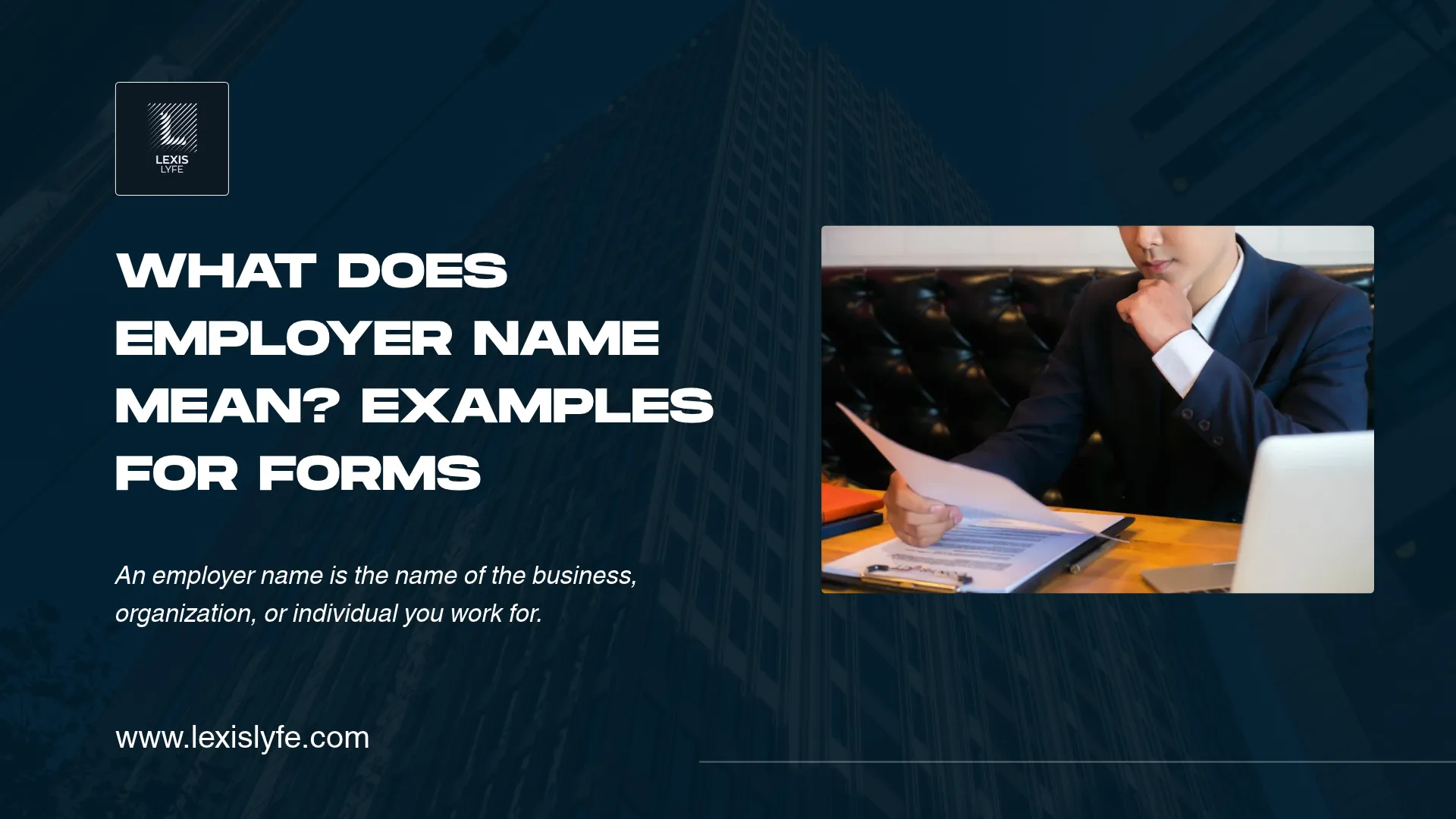
An employer name is the name of the business, organization, or individual you work for. If a form asks about a previous job, enter the organization that employed you during that job. Your job title and your supervisor’s name belong in their own fields.
The confusing part is deciding which business to name when the sign above the door, your employment agreement, and your pay statement use different wording. The answer also changes when you’re self-employed, applying for your first job, working through an agency, or filling out a form that specifically requests a legal business name.
This guide explains the differences, with fictional examples you can adapt to your own records. You’ll learn how to identify the right organization, separate current work from past employment, check US and Canadian documents, and handle fields that don’t fit your situation. Start with the form’s instructions, then match your answer to the actual working relationship.
What does employer name mean on a form?
The employer name meaning is the identity of the organization or person employing you in the job the form asks about. On an employment-history form, this could be a current or former business. Read the section heading to determine which job to describe before choosing the name to enter.
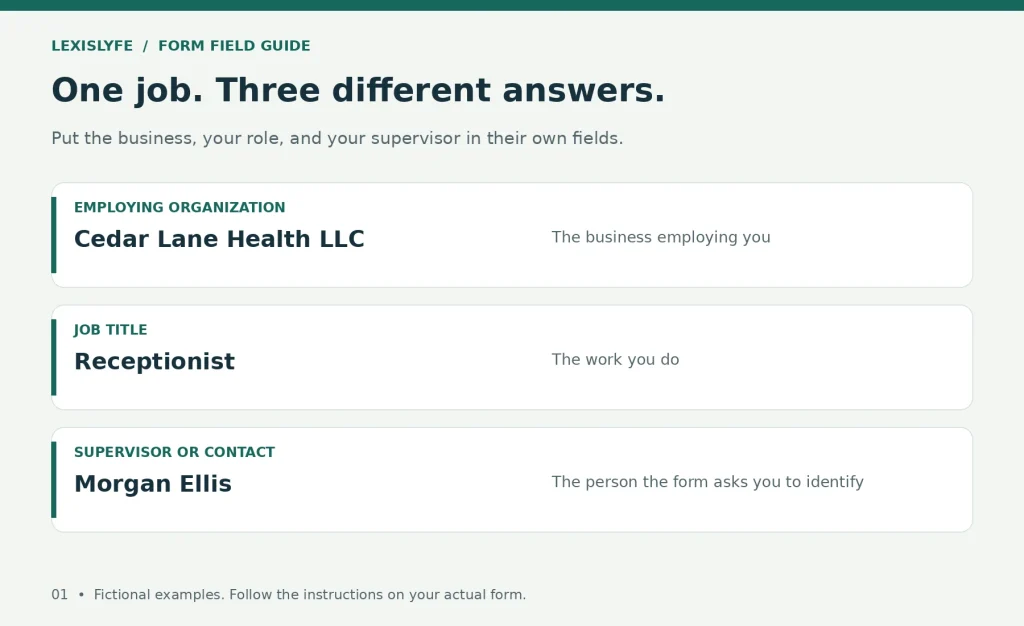
For example, suppose you work as a receptionist at a fictional clinic called Cedar Lane Health LLC. The clinic is the employing business. Receptionist is your position, and the person supervising reception is your supervisor. Those answers describe different parts of the same job.
Merriam-Webster’s definition of employer includes a person or company that provides paid work. That matters because an employer doesn’t have to be a large corporation. A household employing a nanny or a person running a business can also be the relevant hiring party.
Company, employee, supervisor, and job title
Use the following distinctions when several similar boxes appear together: EmployerThe organization or individual employing you in the role being reported. EmployeeThe person doing the work as an employee. In your own application, this is you. Supervisor or contactThe named person who manages you or can answer employment questions. Job title or occupationThe work you do, such as receptionist, electrician, or accounts assistant.
An employer contact field may request someone in human resources rather than your direct manager. Read its help text before choosing a person. A general company phone number and an individual’s direct number may also belong in separate boxes.
The phrase “name of employer” means the same thing, with the words reversed. Forms may also use “employer’s name,” “employing organization,” or “company.” An “organization” field can be broader if the section covers education, volunteering, or professional memberships.
Example only: the business, your position, and your supervisor are separate answers.
Examples: what should you write in the box?
Write the name that accurately identifies the hiring organization for the specific job and period requested. Use a legal name when the instructions require it, and add a recognizable trading name in an explanation field if helpful. The fictional examples below show how different working arrangements affect the answer.
| Your situation | Possible entry on a general work-history form | Separate detail to provide |
|---|---|---|
| Employed by a clinic | Cedar Lane Health LLC | Job title: Receptionist |
| Employed by a Canadian retailer | North Cedar Retail Ltd. | Store location: Toronto, Ontario |
| Working for a staffing agency at a client site | Harbor Staffing LLC | Assignment at Pine Works Manufacturing |
| Freelancing without a business name | Self-employed: Jordan Lee | Occupation: Freelance illustrator |
| Running your own business | Willow Desk Services Ltd. | Position: Owner and administrator |
| No employment history | No previous employment, if the form accepts this | Put education in the education section |
| Former employer changed its name | Maple Street Design Inc., now trading as Maple Studio | Preserve your actual employment dates |
| Household employee | The employing individual’s name, as supported by your records | Position: Nanny or household assistant |
These are examples of wording, not instructions to copy the invented business names. Your answer should come from your own work history. A form with a dropdown, a restricted format, or a request for a registered entity may need a different entry.
A complete fictional work-history entry
Suppose you worked for North Cedar Retail Ltd. as a sales associate between September 2023 and June 2025. A simple record could contain:
- Employing organization: North Cedar Retail Ltd.
- Position: Sales associate.
- Dates: September 2023 to June 2025.
- Work location: Toronto, Ontario.
If the next box asks for a supervisor, enter the appropriate person’s name there. Don’t combine an address, salary, contact person, and position inside the business-name box just because you have that information available. Separate fields help the reviewer identify each detail correctly.
Check the employment period as carefully as the spelling. A correct organization with an incorrect “Present” end date can misrepresent your work history. Someone reviewing the application should be able to tell who employed you, what you did, and when the job ended without guessing.
Current employer, previous employer, and most recent employer
A current employer is an organization employing you now. A previous employer employed you in the past. Your most recent employer is the latest one in your work history, which could be current or former. If you’re unemployed, don’t describe a completed job as current simply to fill a required box.
If you still have the job
Use the employing organization for the job you hold when completing the form. If you’re serving notice but remain employed, report the actual status and dates. An application asking about your work situation today is different from one asking where you expect to work next month.
For someone holding two jobs, the form may allow separate entries or specify a main occupation. Follow that instruction. If it permits only one answer and gives no way to explain concurrent work, ask the organization collecting the information which job it needs.
When checking the timeline:
- Use “Present” only for work that is still ongoing.
- Give a real end date for a completed position.
- Keep concurrent jobs as separate records when the form allows them.
If you’ve left your latest job
For a current-work section, choose “Not employed,” “Unemployed,” or the relevant option provided. If the same form later requests your last employer, enter that business with the correct end date. Current status and previous experience answer different questions.
For instance, someone who left Cedar Lane Health LLC in June 2025 and hasn’t taken another job should report no current employment. The clinic still belongs in a section requesting past work. There’s no need to erase that experience or extend its dates.
If the question asks about prior employment with this company
“Have you worked here before?” concerns the company receiving the application. “Have you been employed before?” may concern your entire history. Look for wording such as “with us,” “with this organization,” or a reference to a specific subsidiary before answering.
If the wording remains ambiguous, a short clarification is better than assuming every company uses the same question. A returning employee and an applicant with experience elsewhere can both have work history while answering the company-specific question differently.
Legal business name or trading name: which is right?
Use the legal business name when a form specifically asks for the legal entity, or when matching an employment record that identifies that entity. A recognizable brand can help on a general application, but it should still identify the organization that actually employed you. Explain differences when space allows.
A shop sign might say Maple Studio while employment documents identify Maple Street Design Inc. Both names may describe the same operation, but they serve different purposes. The brand helps readers recognize the workplace; the legal entity identifies the contracting business.
Brand, subsidiary, and parent company
A large corporate group can contain several employing entities. The best-known parent isn’t automatically the answer for every worker in the group. Check which organization appears in your employment agreement and ask HR if the relationship isn’t clear.
Useful distinctions to preserve are:
- Brand: the name customers recognize.
- Employing entity: the organization identified in your employment relationship.
- Parent company: the business that owns or controls another entity.
On a general work-history form, “Maple Street Design Inc. (Maple Studio)” can connect the legal and familiar names. If there is room for only the legal name, enter that name and explain the brand relationship elsewhere. Don’t remove a legal suffix when the form asks for an exact match.
Abbreviations and short character limits
Keep the wording recognizable and accurate. If space is limited, look for a notes field or ask how the issuer handles long business names. Don’t choose a different entity because its name fits the box more easily.
For an ordinary resume, a familiar abbreviation may help readers. For a verification request, exact wording can matter more. The form’s purpose should guide the level of detail; there is no single rule requiring every informal reference to reproduce an entire registered name.
A person can be the employer
An individual may employ someone directly, particularly in household work or a sole proprietorship. In that situation, a person’s name can be appropriate. The distinction is whether the person is the employing party, rather than simply a manager working for a separate organization.
Don’t replace the employing party with your supervisor merely because that person hired or managed you. If your contract names a business and your manager signed on its behalf, ask for clarification before treating the manager as your individual employer.
What should self-employed people and freelancers enter?
For a general job application, self-employed people can identify their own business or describe themselves as self-employed under their own name. Use the option the form provides and explain the work accurately. A client, marketplace, or payment service should be identified according to its actual relationship with you.
Operating under a business name
If your business is called Willow Desk Services Ltd., use that name where the form requests your business identity. In the position field, describe your actual role, such as owner and administrator. A business name alone doesn’t explain what skills you used or what work you performed.
Keep the entry specific:
- Identify your business or professional name accurately.
- Mark the work as self-employment when the form asks for status.
- Describe your occupation and work dates in their own fields.
For readers comparing ways to work independently, Lexislyfe’s guide to earning $100 a day online discusses potential work methods. When reporting any work you actually do, describe the relationship supported by your records rather than assuming every income source is employment.
Freelancing under your own name
“Self-employed: Jordan Lee” can make the situation clearer than entering only “Jordan Lee.” Put “Freelance illustrator” or another accurate occupation in the role field. You don’t need to invent a registered company to give legitimate independent work a place in your history.
If the form offers a self-employed option, selecting it may change the fields you need to complete. Read those questions before trying to force a freelance business into an employee-only layout. Business duration, client references, and project information may be requested separately.
Reporting clients and platforms
A customer purchasing a design isn’t automatically the designer’s employer. Likewise, receiving payments through a service doesn’t by itself establish that the service employs you. A form asking for client history can require client names, while a business-identity field may require your own professional identity.
For independent projects:
- Identify the work as freelance or contract work when appropriate.
- Name clients in a client or assignment section if requested.
- Follow confidentiality obligations when describing private projects.
A form entry doesn’t determine your legal employment classification. Where that classification is disputed, a label such as “freelancer” cannot settle it. Canada’s guidance on employer–employee relationships illustrates why the actual relationship needs examination.
What if you’re unemployed, a student, or applying for your first job?
If you have no current job, report your current status truthfully and provide past work only where requested. First-time applicants should use a no-experience option or another response permitted by the form. A school, family member, or invented business shouldn’t be entered as an employer simply to satisfy validation.
Students with no paid work history
A student isn’t automatically employed by their school. If the question says “employer or school,” the school’s name may be appropriate. If it asks only for work history, use the form’s no-experience route and complete the education section separately.
Where optional fields allow it:
- Leave an inapplicable work-history section blank if instructed.
- Use a provided “No previous employment” option.
- Describe relevant school projects in an education or experience section.
Writing “N/A” is suitable only if the form accepts it for that field. Some online forms require a selection before the relevant boxes disappear. Others expect you to contact support. A technical requirement doesn’t justify inventing a job or claiming that a school employed you.
Unemployed applicants with earlier experience
List former jobs with their actual dates in the employment-history section. For a current-work question, use the appropriate unemployed status or the issuer’s instructions. If the field accepts a note, “Not currently employed; previous role ended June 2025” may explain the situation clearly.
Before submitting, check:
- The latest completed job has an end date.
- The current-status selection reflects your situation now.
- An automatically populated employer hasn’t been left marked as current.
Being unemployed doesn’t make previous experience invalid. The goal is an accurate timeline, not a timeline without gaps. A job application may ask you to explain a gap separately; answer that question where it appears instead of changing company names or dates.
Internships, volunteering, and family businesses
Use the organization hosting an internship when the form asks for that experience, and label the role as an internship. Put volunteering in its own section when available. If a general experience section allows unpaid work, identify it as volunteer work instead of implying paid employment.
For work in a family business, name the actual business and describe the arrangement honestly. Regular paid work, occasional unpaid assistance, and informal independent services can require different descriptions. A relative’s business shouldn’t be used as a substitute for work you didn’t perform.
Agency workers, contractors, franchises, and outsourced payroll
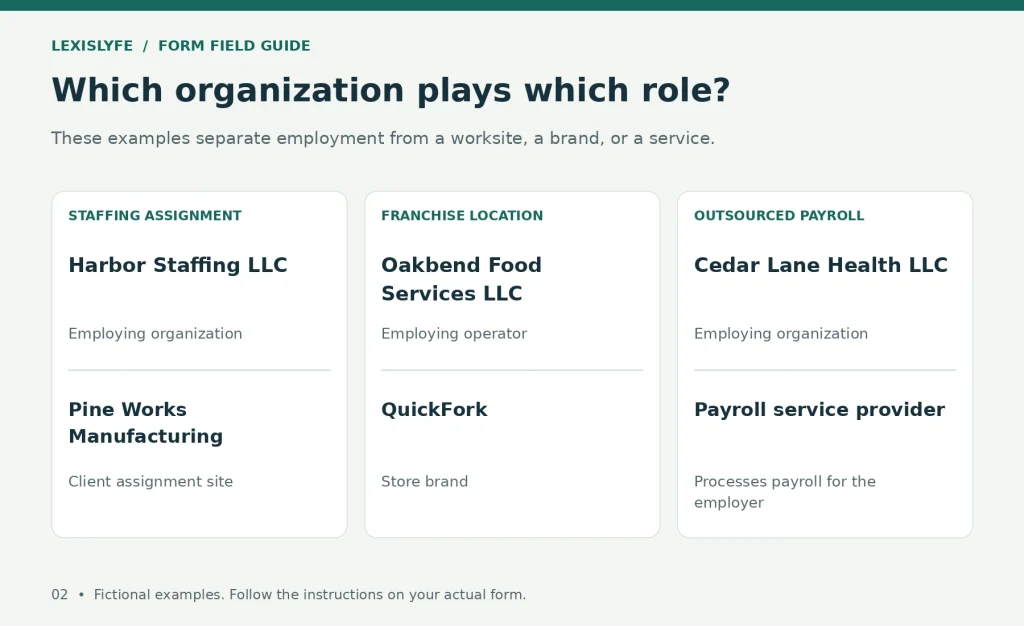
Identify the employing party in your actual arrangement, then describe the client site or brand separately when needed. A staffing agency, franchise operator, client business, and payroll processor can play different roles. Your work location and the name on a payment screen aren’t enough, by themselves, to establish the answer.
Staffing agencies and client assignments
Suppose Harbor Staffing LLC employs you and assigns you to Pine Works Manufacturing. On a general employment-history form, identify Harbor Staffing LLC as the employing organization and explain the assignment at Pine Works. If the form asks specifically for worksite history, provide the client location there.
Keep the relationship clear:
- Employing organization: Harbor Staffing LLC.
- Assignment location: Pine Works Manufacturing.
- Position: Production assistant on a temporary assignment.
An agency recruiter may instead have introduced you to a business that hired you directly. In that case, the recruiter isn’t automatically the employer. Check your agreement rather than assuming every job found through an agency has the same structure.
Independent contracts and fixed-term employment
The word “contractor” can be used loosely. Someone may have a fixed-term employment contract, work independently for clients, or be employed by an agency on an assignment. Those situations shouldn’t be merged into one answer just because each involves a contract.
Look at the agreement and ask who can confirm the relationship. If you’re an independent contractor, identify that status as the form requests. If an organization employs you for a fixed period, list that employing organization and preserve the actual start and end dates.
Franchise locations
A franchise location may trade under a familiar brand while a separate operator employs its staff. Use the business supported by your employment records when identifying the legal employer. Add the store brand or location in an explanation field if it helps the reviewer understand the connection.
For a fictional example, “Oakbend Food Services LLC, operating a QuickFork location” provides more useful detail than selecting the national brand without checking. It also avoids treating the shift manager as the employing party. The specific wording should match your own documents.
Payroll services and employers of record
A payroll provider may process wages for another business. The IRS describes a payroll service provider as a third party helping an employer administer payroll and employment-tax obligations. That service role should not be confused with an employment relationship.
If payroll branding causes uncertainty:
- Check the employer information on the employment agreement.
- Compare the employer identification section of your pay statement or tax slip.
- Ask HR to explain any agency, professional employer organization, or employer-of-record arrangement.
Don’t choose a name solely because its logo appears beside your salary payment. In more complicated arrangements, ask which entity the specific form needs. An organization responsible for one reporting obligation may not be the right answer to every question about your workplace.
Identify the employing party first, then explain the assignment, trading brand, or service relationship.
How to find the right name in US and Canadian records
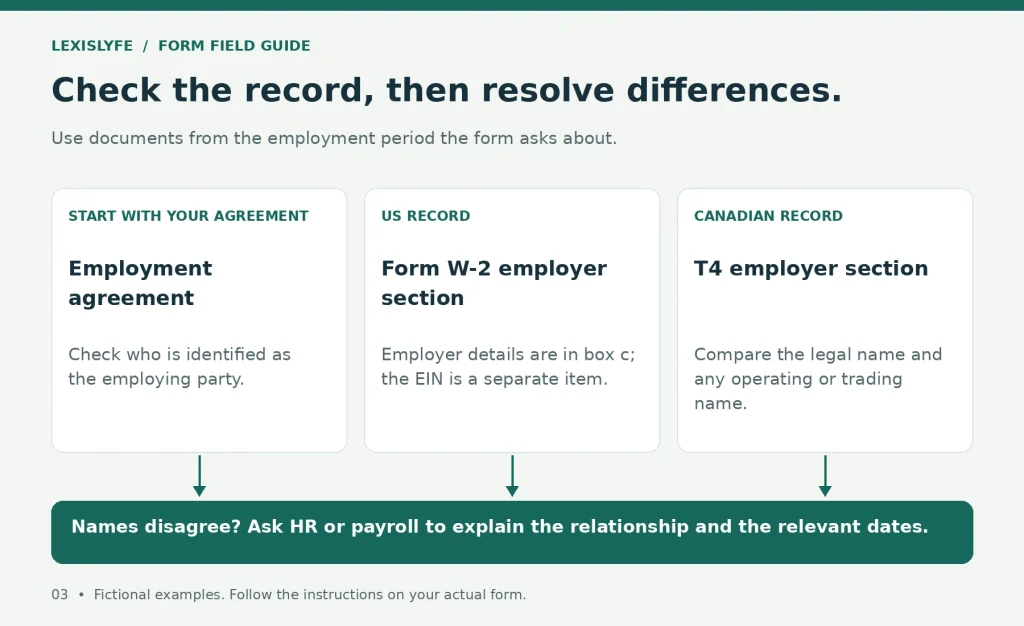
Check the employment agreement, employer details on pay statements, and relevant tax documents, then resolve differences with HR or payroll. US workers can inspect Form W-2, while Canadian workers can inspect a T4 slip. These are useful records, but the form’s instructions still determine which identity it requests.
US records: Form W-2 and employment documents
The IRS instructions for Forms W-2 and W-3 identify box c as the employer’s name, address, and ZIP code. Box b contains the employer identification number, or EIN. Those are different pieces of information; a business name shouldn’t be replaced with its identification number.
For an ordinary employee, checking the employer section can help you confirm spelling. If it differs from the brand you know, compare your agreement or ask payroll to explain. Third-party reporting arrangements need extra care, so treat the record as evidence rather than a shortcut that resolves every possible relationship.
Documents worth comparing include:
- Your employment agreement or offer letter.
- A pay statement showing employer details.
- The employer section of the relevant W-2, if you received one.
You may be applying for a job before receiving a year-end tax form. In that case, start with current employment documents and contact HR if needed. There is no reason to delay an ordinary application simply to wait for a W-2 when another reliable record answers the question.
Canadian records: the T4 slip
The Canada Revenue Agency’s T4 instructions tell employers to enter their legal name, operating or trading name if different, and address. A T4 can therefore help connect a business’s legal identity with the name you recognize at work.
Read the employer area rather than copying an account number from another part of the slip. If a new job hasn’t yet produced a T4, use current employment records and ask payroll to confirm the wording. A former year’s slip also needs context if ownership or the employing entity has changed.
When reviewing Canadian documents:
- Compare the legal and operating names when both are shown.
- Match the document to the employment period you’re reporting.
- Ask payroll about a difference you can’t explain from your records.
What to do when records disagree
An old offer letter and a recent pay statement may differ because of a name change, ownership transfer, or a different reporting arrangement. Establish when the difference began before changing your application. The record for an earlier job should describe the organization and period actually involved.
Use this checking process:
- Compare the names and dates on the documents you have.
- Identify whether the difference concerns a brand, an entity, or a reporting service.
- Ask HR which organization employed you during the period requested.
- Keep the explanation with your own application records.
Avoid sending an entire tax document just to confirm a business name. Such documents contain unrelated personal information. If evidence is requested, use the recipient’s secure process and clarify which information it needs before sharing a copy.
Use documents from the correct period and resolve conflicting names before submitting.
How to complete the employment section step by step
Read the section heading, identify the requested job, check the business identity against your records, and enter each detail in its own field. Review any imported information before submitting. If the form cannot represent your situation accurately, use its help route instead of entering invented details to pass validation.
Use the field, relationship, and record check
A practical way to decide is to check three things: what the field asks, what your working relationship was, and which record supports the answer. This is an editing method for completing a form, not a legal test of employment status.
For a staffing assignment, the field may ask for your employing organization, the relationship may be employment through an agency, and the agreement may name that agency. Those details point to the agency entry. A separate question about the assignment location can then name the client business.
Work through the form in this order:
- Read the section title, help text, and any requested time period.
- Decide which current job, former job, or business activity belongs there.
- Check the organization’s identity using a relevant record.
- Enter the business, role, dates, address, and contact in their separate fields.
- Review the completed record against your resume and supporting documents.
- Save a copy or confirmation of what you submitted, where permitted.
This order prevents a familiar brand name from becoming the default answer before you’ve understood the question. It also catches the common situation where a form imports your latest employer correctly but assigns the wrong role or employment dates.
Required fields, dropdowns, and imported resumes
An employer dropdown may not contain a small business, a former trading name, or a self-employed option. Look for a manual-entry choice such as “Other.” If there isn’t one, ask support how to report your actual situation. Selecting an unrelated company creates an inaccurate record.
For automatic resume imports:
- Check that a job title hasn’t been placed in the company box.
- Confirm the correct organization appears beside each role.
- Inspect the dates and any current-employment checkbox.
Don’t assume an application is accurate because the resume uploaded successfully. Parsing software can join separate jobs, lose a location, or read a client as the employer. The final form is the information the recipient receives, so inspect that version directly.
A label such as “name under which employed” needs extra care. In a personal-identity section, it may ask for your own name during an earlier job, such as a former surname. Check the surrounding fields or ask the issuer instead of assuming this label always requests a business identity.
For example, the City of Maumelle’s employment application distinguishes an employer entry from the applicant’s name during employment if different from their current name. The surrounding wording changes what the box is asking you to provide.
Corrections after submission
If you entered a supervisor’s name or chose the wrong business, correct it through the portal if editing is available. Otherwise, contact the recruiter or support team with a short factual explanation. Keep the correction focused on the inaccurate field rather than resubmitting unrelated personal documents.
A useful correction process is:
- Identify the application and the field containing the mistake.
- State the correct organization and explain the relationship briefly.
- Ask how the recipient wants the record updated.
For example: “My employment entry should identify Cedar Lane Health LLC as the employing organization. Morgan Ellis was my supervisor.” That gives the reviewer enough information to understand the change without suggesting that your work dates or responsibilities also changed.
Job applications, bank forms, and government paperwork
The basic meaning stays similar across forms, but the requested detail can change. A job application may describe work history, a bank form may request current employment information, and government paperwork may specify an exact entity or reporting period. Follow the particular form instead of copying an answer without checking.
Employment history and references
A hiring team can use organization names to understand where you worked and to organize verification. Names alone don’t establish your responsibilities or qualifications. Give an accurate position and describe relevant work in the sections requesting that information.
Where references are requested:
- Use the appropriate contact person or HR route requested by the form.
- Check that contact details are current before submitting them.
- Ask permission before naming an individual as a personal reference.
“May we contact your current employer?” is a separate question. Answer it explicitly, and explain any request about timing to the recruiter. Entering a business name and choosing when a potential employer may contact someone are different decisions.
Banking, rental, and payment-service forms
Check whether the question asks about employment, your business, or the source of funds. Those are related topics, but they aren’t interchangeable. A self-employed person may need to provide business details through a self-employed option rather than name a client as an employer.
Where a combined label says “Employer/Business,” read the help text and your selected status. Don’t assume that instructions for one payment app apply to another service or country. If a form rejects a truthful answer, its issuer should explain how to handle the field.
Before copying a saved answer:
- Check whether the form requests current work or employment history.
- Confirm whether it asks for a legal identity, trading name, or work location.
- Use the issuer’s guidance for unemployment or self-employment.
Immigration and other government forms
Use the issuing agency’s instructions and the exact period or relationship it requests. A field that combines employment and education isn’t identical to an employment-only field. Avoid carrying a generic “N/A” rule from a job application into official paperwork.
For example, the US Department of State maintains DS-160 frequently asked questions, including guidance on required responses. Check the current agency instructions for the form you’re completing rather than relying on an example intended for a general work-history application.
Background checks and privacy
In the United States, the Federal Trade Commission explains background-check rights, including written permission before an employer obtains a report from a background reporting company. That rule concerns a particular screening process; it shouldn’t be generalized to every reference conversation or every Canadian application.
Treat requests for supporting documents separately from the business-name question:
- Confirm that the recipient and application process are legitimate.
- Use the designated secure channel for documents the recipient actually needs.
- Avoid placing tax identifiers or banking information inside a company-name box.
An organization asking for its former employee’s work dates doesn’t need those dates hidden in a large collection of unrelated records. Provide the requested information clearly, and ask about a suitable alternative if a document contains details unnecessary for the task.
Resumes, promotions, company closures, and name changes
Keep each entry connected to the organization and time period that actually employed you. On a resume, you can add a familiar brand or explain a promotion for readability. On a verification form, follow the requested structure and clarify changes without rewriting historical employment as if it occurred somewhere else.
Several positions with one organization
Use the same employing organization for several roles if the entity stayed the same. A promotion changes your position, not necessarily your employer. A resume can group the roles under one business, while a form may require a separate record for each position.
For a fictional promotion:
- Business: North Cedar Retail Ltd.
- First role: Sales associate, September 2023 to December 2024.
- Later role: Shift supervisor, January 2025 to June 2025.
Keep the overall employment period and the individual role dates consistent. Don’t extend the supervisor title across the earlier months just because it was your final position. If a transfer involved a different employing entity, preserve that distinction even if the public brand stayed the same.
Renamed or acquired businesses
Use the name appropriate to your employment period, adding a verified current name where it helps identification. “Maple Street Design Inc., now Maple Studio Inc.” can explain a confirmed change. An acquisition by itself doesn’t establish that you worked for the acquiring company.
Before adding a new name:
- Confirm that the successor or new name relates to your actual former business.
- Keep the dates when you worked there unchanged.
- Use a note to explain the change instead of silently substituting an entity.
Two businesses with similar names may be unrelated. Don’t use a search result as proof of a merger. Ask a known contact or consult reliable company records if a background-check form requires you to identify a successor organization.
Employers that closed
A closed business can still be a valid entry in your work history. Name the organization you worked for and state that it closed if the form asks for verification information you can’t provide. A current phone number belonging to another business is not a suitable replacement.
Possible supporting records include:
- An old employment agreement or dated employment letter.
- Pay statements from the relevant period.
- An appropriate tax record, shared only through the required secure process.
If a former supervisor is available, ask the screening team whether that person is an acceptable alternative contact. Don’t assume a closed business means the job must be removed. The recipient can explain what evidence it accepts when standard verification isn’t possible.
Common mistakes and how to fix them
The most common errors mix up the employing organization, a contact person, and the applicant’s occupation. Other mistakes involve reporting an old job as current or choosing a familiar brand without checking the legal relationship. Fix the specific field, preserve accurate dates, and explain any naming difference the reviewer needs to understand.
| Mistake | Better approach | Why it helps |
|---|---|---|
| Writing the manager’s name for a corporate employer | Enter the business; identify the manager separately | Distinguishes the organization from its contact |
| Entering “cashier” as the company | Move cashier to the role field | Separates who employed you from what you did |
| Reporting a finished job as current | Give the real end date and current status | Preserves the work-history timeline |
| Naming the payroll app automatically | Check the agreement and employer details | Avoids confusing a service with an employing party |
| Calling a freelance client your employer without explanation | Identify the independent relationship | Makes the work arrangement clear |
| Replacing a former company with its acquirer | Explain the verified change and relevant dates | Avoids rewriting historical employment |
| Inventing a business to satisfy a required box | Use the form’s no-experience route or contact support | Keeps the submitted information truthful |
Organization details versus employment details
The same business can employ people in different cities, departments, and occupations. Its identity doesn’t replace those details. Use the workplace address when the form asks for your work location; use a registered office or other address when that is explicitly requested.
Compare the field labels:
- Business identity: which organization employed you.
- Work location: where you performed the work or were assigned.
- Position: your role within that arrangement.
A remote employee’s home address isn’t automatically the requested employer address. Read the instructions for remote work and ask the issuer if it doesn’t distinguish the employing office from the worksite. An accurate company name can’t resolve an ambiguous address question on its own.
A final review before you send the form
Read the completed section as someone who has never seen your resume. Is the organization identifiable? Are role titles in their own boxes? Can the reviewer tell which jobs are ongoing? A quick review at this stage is easier than explaining contradictory records later.
Use this final check:
- The organization matches the relevant job and period.
- The role and supervisor appear in the appropriate fields.
- Legal and trading names are explained where needed.
- Current-status and end-date selections are accurate.
- No unsupported experience or unrelated business has been added.
If a detail is uncertain, resolve that detail directly. There’s no benefit in replacing a verifiable record with a guess that happens to look more familiar. A short explanation is more useful than making the reviewer work out why two documents use different names.
Frequently asked questions
These questions address the remaining choices people face when a form uses unfamiliar wording. The same approach applies throughout: read the requested period, identify the actual working relationship, and check a relevant record. If a form’s instructions differ from a general example, use those instructions and ask its issuer about unresolved details.
Conclusion
An employer name identifies the organization or person employing you for the job the form asks about. Start with the field’s wording, check your actual relationship, and confirm the identity against a relevant record. If a brand, agency, client, or payroll service complicates the answer, explain the connection rather than guessing.
Keep job titles, contacts, and employment dates in their own fields. When there is no current employment or no work history, use the truthful option the form provides. The best entry is one a reviewer can connect to your records without having to infer who employed you.