WYFF and WYF Meaning in Text: Uses, Context and Examples
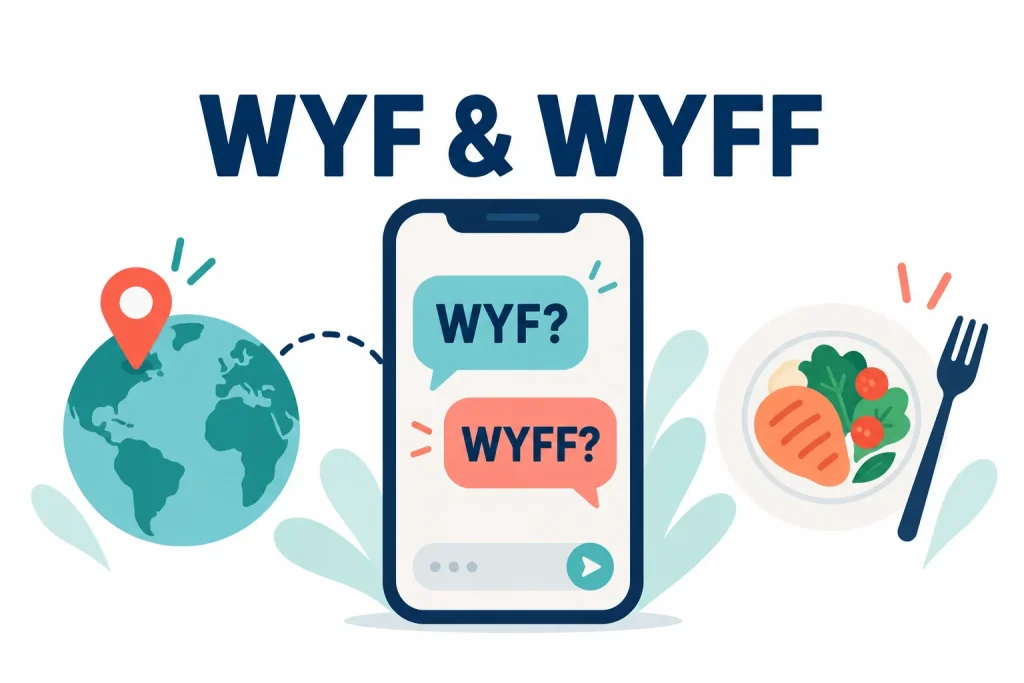
Someone sends “WYF?” after saying hello. You could answer with your hometown, ask what they mean, or keep your location private. All three can be reasonable responses. The useful starting point is that WYF generally means “Where you from?”, while WYFF needs more context and has a documented food-related interpretation.
This guide explains the WYF meaning in text, the evidence behind different WYFF definitions, and the clues that help you choose a sensible reply. You’ll find examples for Instagram, Snapchat, TikTok, WhatsApp, dating conversations, and gaming chats. It also separates hometown questions from requests for your current location, explains when an exchange might feel flirty or intrusive, and compares similar abbreviations such as WYA and WYD.
The aim is simple: understand the question before answering it. You don’t need to memorize every expansion on a slang website, and you never need to share more personal information than you want to.
What does WYF meaning in text?
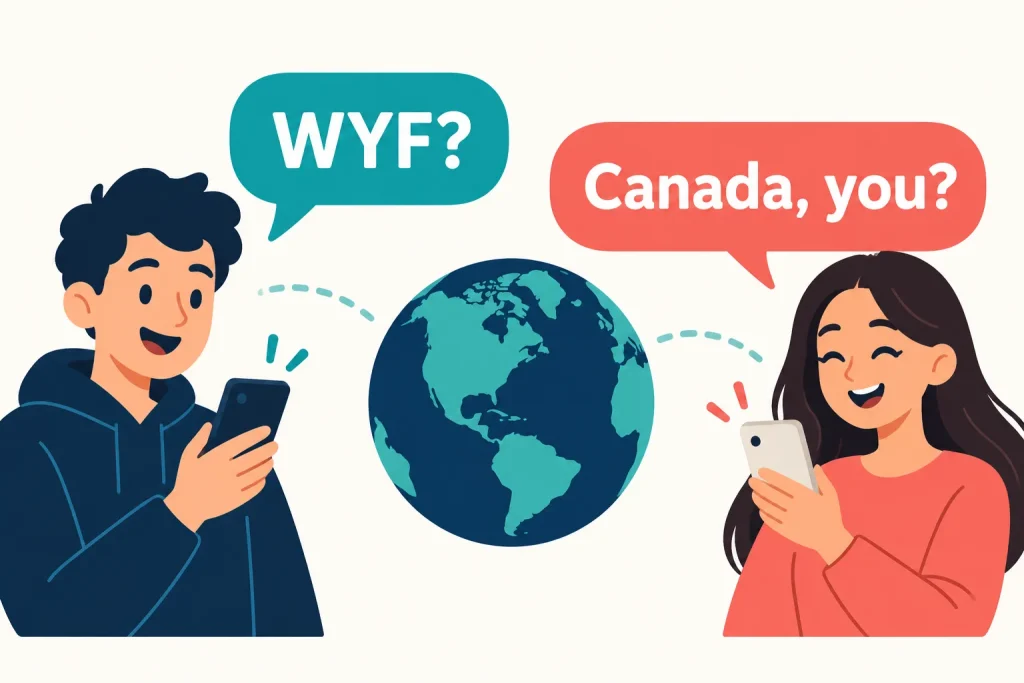
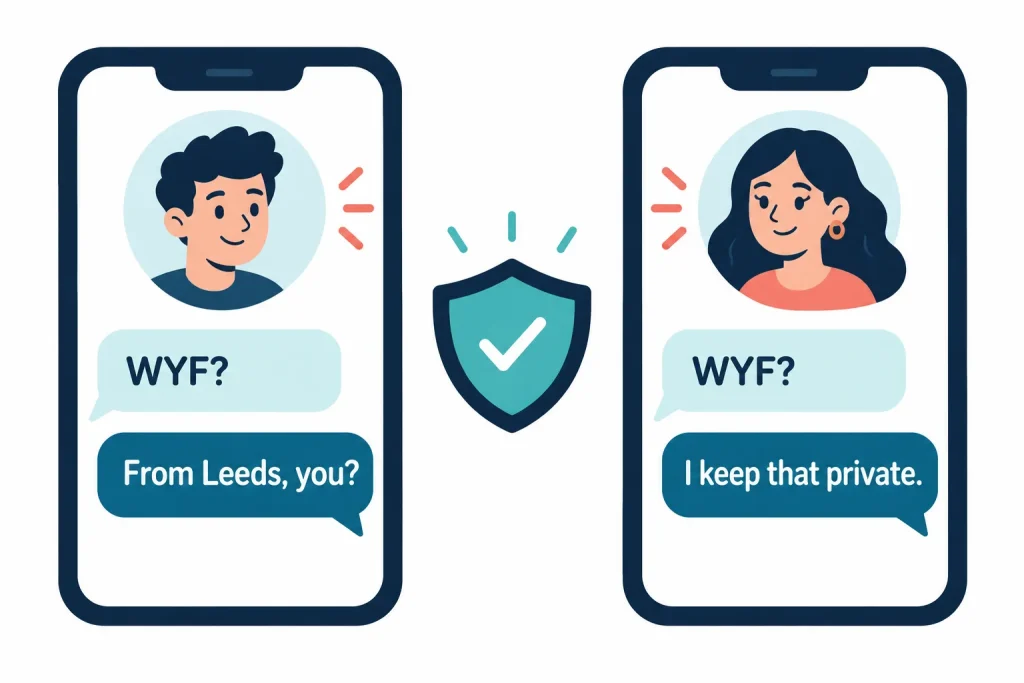
WYF stands for “Where you from?” in its usual introductory-chat use. The full standard-English question is “Where are you from?” Someone may be asking about your hometown, country, or general background. A short reply such as “I’m from Canada. You?” answers the question without requiring your exact location.
Hushed’s texting explanation supports this location-related reading and also recognizes favorite-related alternatives. The important distinction is between a useful default and a meaning that fits every possible message. WYF has a default, but context can override it.
The letters follow the shortened phrase:
- W represents where.
- Y represents you.
- F represents from.
“Where you from?” leaves out “are,” as casual shorthand can do. Use “Where are you from?” when you want standard written English. You can describe WYF as a texting abbreviation without needing to settle terminology about acronyms and initialisms.
Here’s an original example:
Alex: Hey, nice playing with you. WYF?
Sam: Canada, you?
Alex: Australia. That explains the time difference!
Sam’s answer identifies a country. It doesn’t share a street, school, workplace, or live location. The same principle applies if you choose a state or broad region instead.
| Message | Sensible first interpretation | Example reply |
|---|---|---|
| “Hey, WYF?” | Where are you from? | “Canada, you?” |
| “WYF originally?” | Where did you grow up or come from? | “Originally from Bristol.” |
| “WYF song on this album?” | What’s your favorite song? | “The opening track.” |
| “WYFF?” in a food conversation | Possibly “What’s your favorite food?” | “Pasta. Is that what you meant?” |
| “WYFF?” without context | Ambiguous | “What do you mean by WYFF?” |
Lowercase “wyf” carries the same possible meanings. A question mark makes the question easier to recognize, but its absence doesn’t establish a different definition. Read “wyf,” “WYF,” and “WYF?” against the same conversation.
What does WYFF mean, and how is it different from WYF?
WYFF can mean “What’s your favorite food?”, an interpretation documented in a user-submitted Urban Dictionary entry dated November 22, 2022. That establishes a recorded use, not a universal definition. Other online guides offer conflicting expansions, so an unexplained WYFF message deserves clarification rather than an automatic location-based answer.
The Urban Dictionary WYFF entry is useful evidence because you can see both its wording and submission date. It remains crowdsourced evidence, and it doesn’t tell us what proportion of texters use that meaning.

In a conversation about meals, the food interpretation fits naturally:
Mia: We keep talking about restaurants, but I’ve never asked. WYFF?
Noah: Pasta. Especially anything with mushrooms.
That exchange is an illustrative example, not a quotation from the dictionary or a real private conversation.
You may encounter guides expanding WYFF as “Where you from, friend?”, “Where you from, fam?”, or “What you finna do?” Those claims aren’t equally established by the evidence reviewed here. Repetition across blogs doesn’t establish how widely an expansion is used.
Keep three possibilities in mind:
- A food question: especially when meals or restaurants are already the topic.
- Personal shorthand: a meaning the sender or their group has adopted.
- A typo or extra letter: possible, but something to confirm rather than assume.
A useful response is “Do you mean my favorite food, or something else?” If they meant “Where are you from?”, they can say so. You avoid answering an entirely different question and keep the exchange relaxed.
WYFF also identifies WYFF 4, a US news broadcaster. In a headline, weather update, or local-news account name, it may be a station name rather than chat slang. That is a separate context, not another definition to insert into every conversation.
How can you tell which meaning the sender intends?
Read the surrounding words before choosing an expansion. A topic such as hometowns supports the location meaning; a named category such as “song” supports a favorite question. When two interpretations remain plausible, ask one short clarifying question. The app alone cannot resolve an ambiguous message for you.
Use this guide’s Read, Fit, Reply method. It’s a practical editorial framework, not a scientific test or a rule every speaker follows.
- Read the previous message and any words after the abbreviation.
- Fit the possible expansion into the complete question.
- Reply to the meaning that makes sense, or ask if the fit is weak.
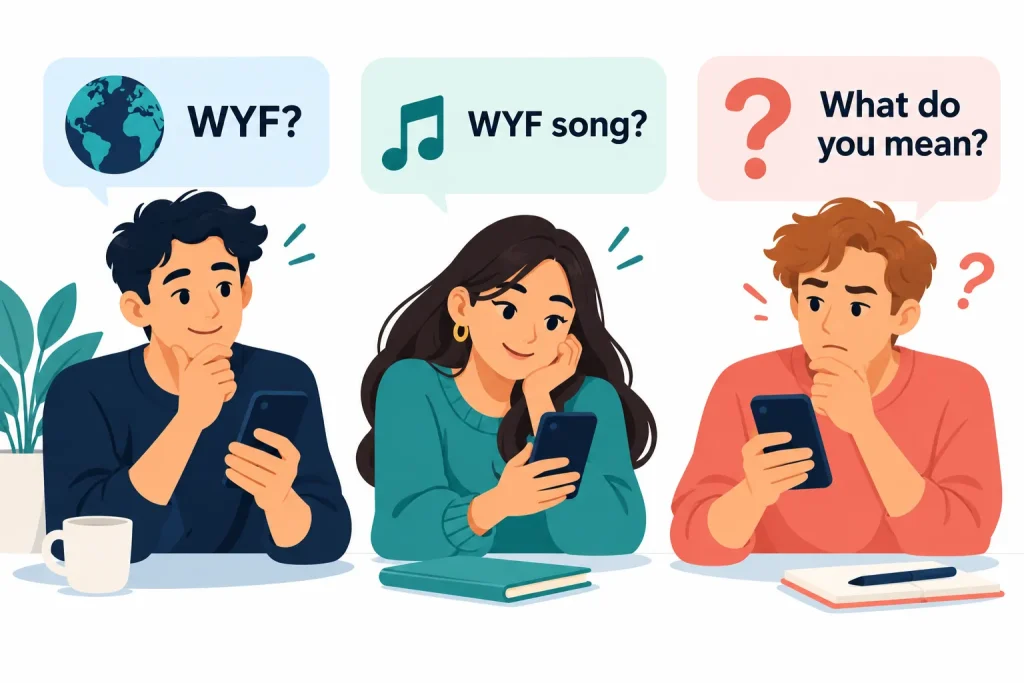
For example, “WYF singer?” becomes “Where you from singer?” under the location interpretation. That doesn’t fit the sentence. “Who’s your favorite singer?” does. The added category is more useful than a generic list of definitions.
By contrast, “Hey, I’m new to this group. WYF?” is consistent with a location question. You still decide whether you want to answer, especially when the group is public or unfamiliar.
Useful clues include:
- Topic words: city, country, album, meal, or design.
- Earlier questions: a discussion about moving differs from a discussion about music.
- Shared habits: a friend may use shorthand you’ve already clarified together.
- Conversation setting: a poll supplies context that a bare direct message lacks.
Avoid treating a clue as proof. A heart emoji can add warmth, but it doesn’t tell you which words an abbreviation represents. A profile location may also be outdated or intentionally broad.
For a quick clarification, try “Do you mean where I’m from?” With WYFF, “What does WYFF mean here?” is clearer than guessing between several incompatible blog definitions. Asking is a normal part of understanding unfamiliar language.
What else can WYF stand for?
“What’s your favorite?” is a documented alternative to WYF’s location meaning, particularly when a category follows it. Other interpretations appear in explanatory guides, including questions about preferences, feelings, findings, feedback, or finishing times. Treat these as context-dependent possibilities, not meanings that every reader will recognize without explanation.
Urban Dictionary’s WYF page includes a favorite-related entry dated December 23, 2008. It also contains later location-related entries. These dates establish recorded submissions, not the invention date of either usage.
The table below separates an established alternative from readings you should clarify:
| Possible expansion | Clue that could make it fit | Clearer wording |
|---|---|---|
| What’s your favorite? | A category follows, such as “movie” | “What’s your favorite movie?” |
| Who’s your favorite? | The category consists of people or characters | “Who’s your favorite singer?” |
| What you fancy? | You’re choosing an activity or meal | “What would you like?” |
| What you feeling? | Feelings or preferences are already being discussed | “How are you feeling?” or “What do you feel like?” |
| What you found? | You’re comparing search or shopping results | “What did you find?” |
| What’s your feedback? | Someone has shared work for review | “What do you think of this draft?” |
| When you finish? | You’re arranging a time after an activity | “What time do you finish?” |
Parade’s explanation lists several of these alternatives. That supports describing them as reported interpretations, but it doesn’t supply measured usage rates or show that an unfamiliar coworker will understand them.
A favorite question needs a recognizable category
“WYF movie?” gives the reader something concrete to answer. Bare “WYF?” after a greeting provides much less support for the favorite interpretation. If you’re writing the message, adding the category reduces unnecessary guessing.
Useful preference prompts could ask about:
- A favorite film or television series.
- A favorite song on a named album.
- A favorite restaurant in a specific area.
Writing the full question is still the clearer choice for a public survey. The abbreviation saves space only if the audience understands it.
Preference and feelings are different questions
“What do you feel like eating?” asks about a current preference. “How are you feeling?” asks about someone’s emotional or physical state. An unexplained WYF can blur those two questions, so give your friend enough wording to understand the kind of answer you want.
The expression “What do you fancy?” can serve as a preference question, but that doesn’t make every WYF message a British-English preference question. A sender’s country cannot replace the actual sentence as evidence.
What does WYF mean on Snapchat, Instagram, TikTok, and WhatsApp?
WYF’s interpretation depends on the conversation across these platforms. In an introductory message, “Where you from?” is a sensible default. A caption asking “WYF song?” points toward favorites instead. Public comments, private messages, Stories, and group chats change the audience and privacy considerations, but they don’t impose separate official definitions.
Snapchat and Instagram messages
A new contact might write, “Hey, WYF?” after a short introduction. “I’m from Wales” is a complete answer if you’re comfortable giving that information. You don’t need to add your current whereabouts just because a conversation happens on an app with location-related features.
In an Instagram Story reply, distinguish between the person and the place shown. Under a beach photograph, “WYF?” is less precise than “Where was this taken?” If you’re the one asking about the photograph, use the second question.
TikTok comments and public polls
A creator asking “WYF track from this album?” has supplied a music category. A reader can reasonably understand that as a favorite question. Don’t generalize from that example to every TikTok comment or assume that platform automatically changes WYF’s default meaning.
Before answering publicly, consider:
- Who can read the reply, including people outside the immediate conversation.
- How specific it needs to be, such as country rather than neighborhood.
- Whether answering helps, or simply discloses information you’d rather keep private.
You can engage with a video without replying to a location question. An invitation to comment isn’t an obligation to disclose.
WhatsApp, gaming chats, and dating conversations
In a WhatsApp group or game lobby, someone may be asking which country or region you’re from. You can name a broad area or ask whether they mean your time zone. That is useful when the real purpose is arranging a game rather than learning personal background.
On a dating app, WYF can be part of getting acquainted. It doesn’t establish romantic intent by itself. A location question may help people discuss distance, but the recipient still chooses the level of detail to share.
If the chat shifts toward arranging plans, a different abbreviation may appear. LexisLyfe’s guide to WTW meaning in text explains how that expression can ask what’s happening or what the plans are.
How should you reply to WYF or WYFF?
Answer the question you understand at a level of detail you choose. For a location-based WYF, a country, region, or hometown can be enough. For a favorite question, name the relevant preference. If the meaning is unclear or the question feels intrusive, clarify it or decline politely.
| Your situation | Reply you could send | What the reply does |
|---|---|---|
| You’re happy to share a country | “I’m from India. You?” | Answers broadly and returns the question |
| You want to distinguish past from present | “Grew up in Winnipeg, now in Toronto.” | Separates hometown from current city |
| You prefer to keep it general | “From the north of England.” | Gives a region without a town |
| You don’t want to share | “I keep my location private.” | Sets a direct boundary |
| You’re unsure about WYF | “Do you mean where I’m from?” | Checks the intended meaning |
| WYFF appears during a food discussion | “Pasta! Are you asking my favorite food?” | Gives a possible answer and confirms it |
| WYF follows an album discussion | “The last track is my favorite.” | Answers the category already supplied |
Short, friendly replies
A short answer doesn’t need to sound cold. Add a return question if you want the conversation to continue, or mention a shared interest instead of adding more personal details.
Try one of these:
- “From Auckland. What about you?”
- “The Midlands. Are you from the UK too?”
- “Canada. Did you want to compare time zones for the game?”
- “Do you mean my hometown or where I live now?”
The last question is useful when both interpretations could matter. You can also answer only the part you’re comfortable sharing. A message doesn’t need a complete life history to be friendly.
Replies that keep a boundary
“I’d rather not say, but happy to talk about the game” redirects the conversation without creating a false answer. If someone keeps pressing, a firmer “I’m not sharing that” is enough.
You don’t need to apologize for declining. Likewise, if someone declines your question, accept their answer and move to another topic. A respectful exchange gives both people room to choose what they share.
If you’re ending the conversation after a brief introduction, LexisLyfe’s guide to ways to say “have a great day” offers wording for a friendly sign-off.
Is WYF flirty, rude, or sexual?
WYF isn’t inherently flirty, rude, or sexual. Its ordinary introductory meaning is a question about where someone is from. The surrounding messages and the sender’s behavior establish tone. A compliment may make the exchange feel flirty; repeated demands for personal information may make it intrusive.
Compare these original examples:
- Friendly: “Good game! WYF? We seem to play at the same time.”
- Potentially flirty: “You seem fun. WYF?”
- Intrusive: “WYF? Tell me the exact street. Why won’t you answer?”
In the third example, the problem is the pressure for detail, not the letters themselves. You can stop replying or use the platform’s controls if the interaction becomes unwelcome.
A WYF message from a girl, boy, or anyone else doesn’t acquire a fixed gender-specific meaning. Interpret the content and your relationship with the person. An abbreviation alone cannot tell you whether someone likes you.
Some user-submitted slang entries attach explicit expansions to WYF. Their presence in a dictionary database doesn’t make them the default reading. There’s no need to interpret an ordinary greeting sexually without contextual evidence, or to continue a conversation that makes you uncomfortable.
How much location information should you share?
Share only the information you’re comfortable making available to that audience. A general country or region can answer WYF without revealing where you are right now. You can also decline entirely. Understanding what a question means never creates an obligation to answer it, privately or publicly.
You can answer without sharing your exact location. “I’m from Australia” is a valid response even if the sender hoped for a city. “I don’t share that online” is equally valid when you prefer not to answer.
It helps to distinguish several kinds of location information: Hometown or place of origin A place you grew up in or identify as being from. It may differ from where you live now.Current home city The city where you currently live. Sharing it is a separate choice from naming your hometown.Live location Your whereabouts at a particular moment. A general WYF question does not require this information.Nationality or cultural background These may relate to someone’s identity, but neither should be assumed from a hometown, name, photograph, or accent.
With someone unfamiliar, you may prefer to keep these details private:
- Your street address or building.
- Your school or workplace.
- Your daily route or schedule.
- Your live location or the fact that you’re home alone.
These are choices about disclosure, not instructions to distrust every friendly question. A trustworthy conversation allows a broad answer without pushing for more.
Avoid “Where are you really from?” after someone has already answered. If you wanted to discuss a language or shared background, explain that interest respectfully and let the other person decide whether to discuss it.
WYF vs. WYA, WYD, WBU, and other similar abbreviations
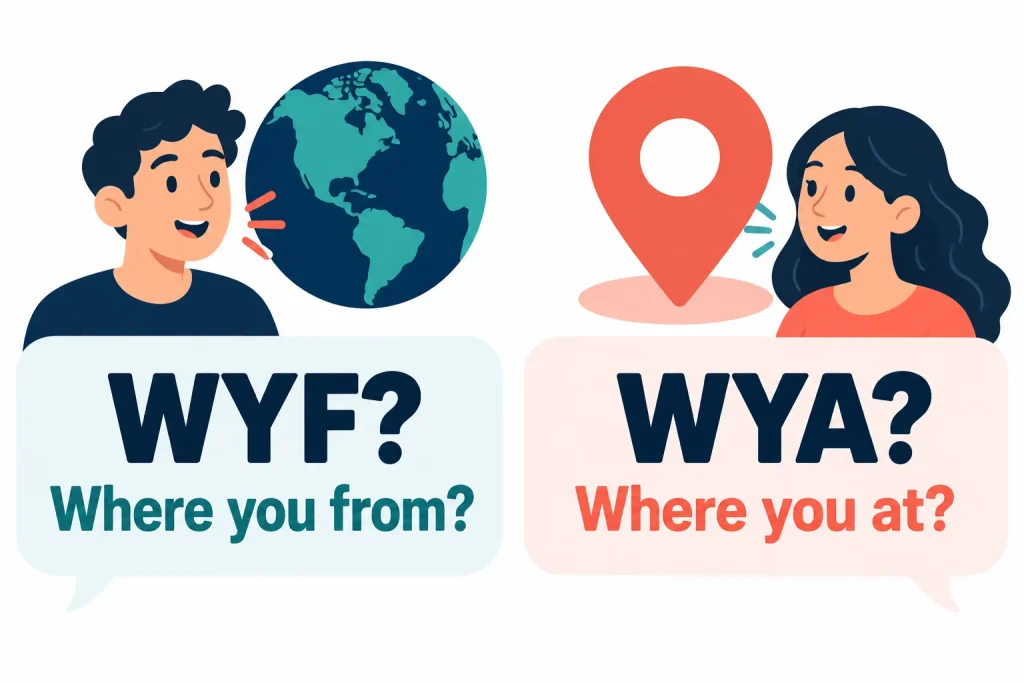
WYF asks about origin or background; WYA generally asks about current whereabouts. WYD asks about activity, while WBU and HBU return a question to the other person. Similar spelling can cause mix-ups, but these abbreviations serve different conversational purposes. Match the question to the kind of answer it requests.
| Abbreviation | Common expansion in this context | Question or purpose | Example answer |
|---|---|---|---|
| WYF | Where you from? | Origin or general background | “From Cardiff.” |
| WYA | Where you at? | Current whereabouts | “At the station.” |
| WYD | What you doing? | Current activity | “Making dinner.” |
| WBU | What about you? | Return a question | “I’m from Ottawa.” |
| HBU | How about you? | Return a question | “Same, I’m free later.” |
| WYM | What you mean? | Ask for clarification | “I meant your hometown.” |
| HMU | Hit me up | Invite later contact | “Sure, I’ll message you.” |
| WTW | What’s the word? | Ask what’s happening or about plans | “We’re meeting at seven.” |
| WTF | What the fuck? | Express surprise, disbelief, or frustration | Depends on the situation |
The most useful memory aids are:
- From points backward toward origin or background.
- At points to whereabouts, which may mean right now.
- Doing points to an activity, not a hometown.
That distinction matters when arranging a meetup. “WYF?” might produce “Scotland,” which doesn’t help you find a friend outside a cinema. Ask “Where are you right now?” when that is what you mean.
WYF and WTF also differ by one letter, but WYF is not simply a polite version of WTF. If a message looks like a typo, check the whole exchange or ask. Don’t silently replace an unfamiliar abbreviation with a more familiar one.
How do you use WYF politely and clearly?
Use WYF with people who understand the shorthand and can comfortably decline the question. Add context if you’re asking about someone’s origin, and spell it out when clarity matters. In public, professional, or unfamiliar settings, a complete question is easier to understand and gives you more control over tone.
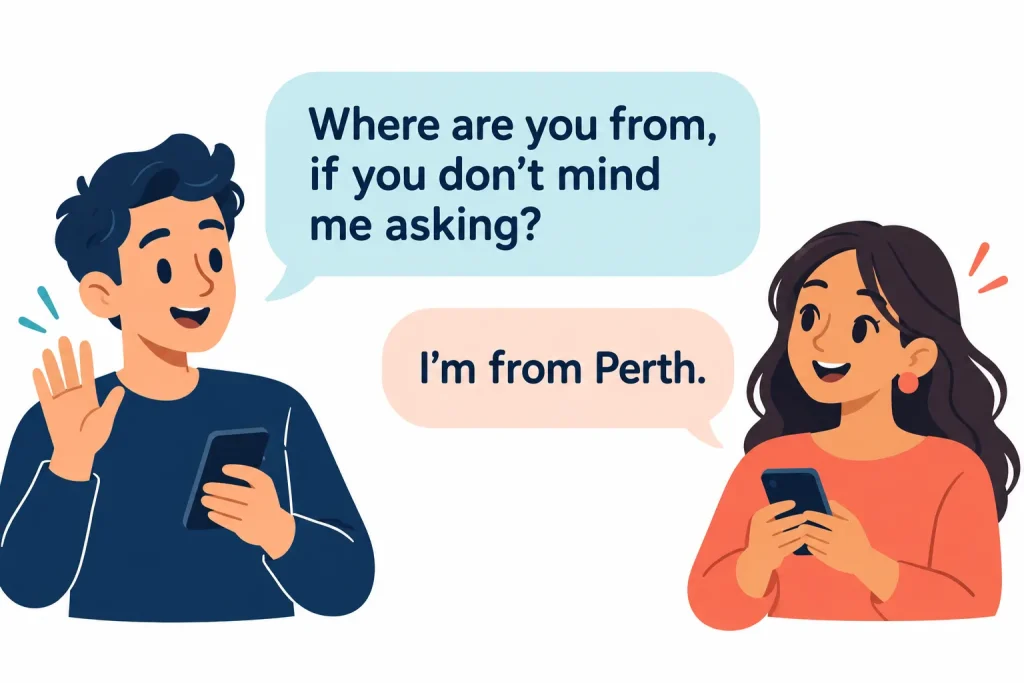
Before sending it, consider these choices:
- Explain the connection. “I noticed we follow the same local team.”
- Ask the actual question. “Are you from this area?”
- Allow a general answer. Don’t turn a region into a demand for a town.
- Respect a refusal. Change the topic without arguing.
You don’t need to add all four steps to every message. They describe an approach to a conversation, not a script to copy word for word.
Casual messages and English learners
For a friend who uses texting abbreviations, “WYF originally?” may be clear enough. With an English learner, “Where are you from?” avoids asking them to decode the letters before answering.
If someone says they don’t understand, define it plainly: “I meant, where are you from?” Making fun of someone for not knowing slang makes a simple exchange needlessly uncomfortable.
The same approach works across the US, Canada, India, the UK, and Australia. Use vocabulary your conversation partner understands instead of assuming their country determines which shorthand they know. The examples in this guide illustrate possible exchanges, not measured national usage patterns.
Professional messages and brand accounts
For a coworker, write “Could you share your feedback?” rather than relying on a less familiar WYF expansion. If you need to arrange a call, ask about their time zone or working hours directly.
A brand answering “WYF?” should distinguish between business location, shipping origin, and delivery coverage. “We’re based in Manchester” may answer the first question but leave the other two unresolved.
Clear business replies can include:
- “Our team is based in Manchester. Were you asking where orders ship from?”
- “Are you asking about our location or whether we deliver to your country?”
- “Which product are you interested in? I can check its shipping origin.”
These replies resolve the customer’s likely need without turning slang recognition into a sales pitch. A business also shouldn’t ask a customer to post a full delivery address in a public comment.
Common mistakes when interpreting WYF and WYFF
The main mistake is treating one expansion as correct in every conversation. Other errors include confusing origin with live location, reading romantic intent into a neutral question, and treating every dictionary submission as equally representative. A good interpretation fits the message, respects uncertainty, and leaves room for clarification.
Mistake: Every platform gives WYF a different definition. A favorite-related TikTok poll and a location-related Instagram message illustrate different contexts. They don’t establish platform-wide rules.
Mistake: WYFF is automatically WYF with an extra letter. It might be a typo, but a documented food-related interpretation also exists. Ask before substituting the location meaning.
Mistake: A dated entry proves who invented the expression. A submission date shows when that particular entry was posted. Earlier use may exist elsewhere, and the person submitting a definition need not have coined it.
Mistake: A direct question requires an exact answer. “Where are you from?” can be answered broadly, redirected, or declined. The recipient controls the disclosure.
Mistake: More possible meanings make every interpretation equally likely. A plausible expansion still needs contextual support. Don’t turn a long list into a reason to disregard an obvious hometown question.
Mistake: The sender’s gender establishes the meaning. The useful evidence is what the person actually wrote, the preceding conversation, and their behavior. A gender label doesn’t decode the abbreviation.
When an answer seems odd, repair the misunderstanding directly: “Sorry, I thought you meant my hometown. Did you mean my favorite film?” A short correction is more effective than arguing over which slang list is right.
Frequently asked questions
The best short answers preserve the distinction between a default meaning and an uncertain one. WYF generally points to origin in a new chat, while WYFF needs additional context. These questions address the practical situations that remain after you know the definitions, including capitalization, tone, replies, and privacy.
Conclusion
Start with “Where you from?” for WYF in an introductory chat, then check the surrounding words. For WYFF, recognize the documented favorite-food interpretation without treating it as universal. Reply briefly, clarify when needed, and choose your own privacy boundary. Understanding shorthand should make a conversation easier, not require guesswork or oversharing.
A message such as “WYF song?” supplies a category; a bare “WYFF?” may need a follow-up question. The most useful habit is to read the complete message. If it still isn’t clear, “What do you mean?” is a perfectly good reply.