FR Meaning in Text: Uses, Context and Examples
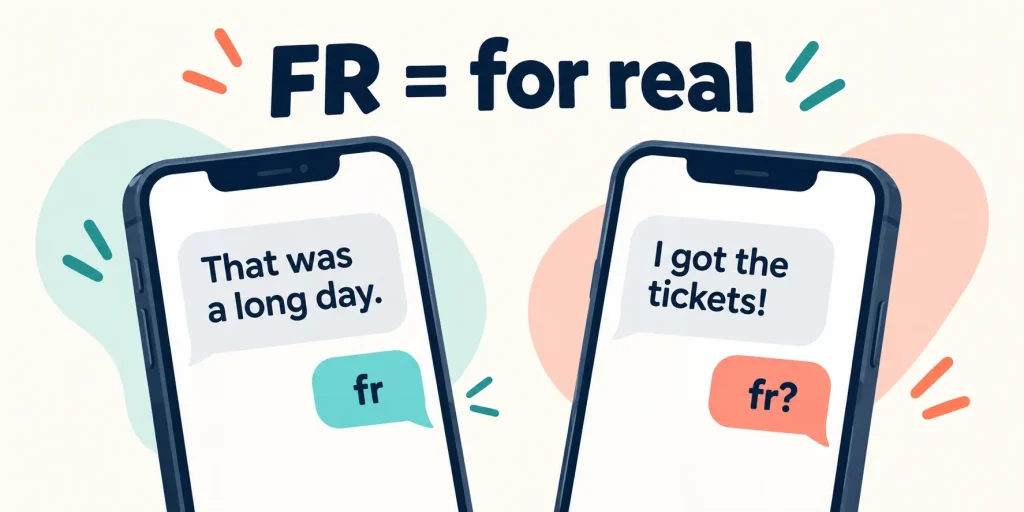
Someone replies “fr” to your message. Are they agreeing, asking a question, or telling you to get serious? Those two letters stand for “for real,” but the conversation determines what they do. “That was exhausting, fr” emphasizes a feeling. “Fr?” asks for confirmation. “Be so fr” challenges what somebody just said.
This guide explains the fr meaning in text, the difference between fr and frfr, and how punctuation, sarcasm, relationships, and the surrounding words affect the message. You’ll find natural chat examples, replies you can adapt, and plain-English alternatives for school or work. We’ll also separate the slang from French-language labels, France, a priest’s title, and other uses outside everyday conversation.
The goal is practical: understand the message, choose a reply that fits, and recognize when two letters don’t give you enough information. Every conversation below is an original illustration, rather than a transcript of someone’s private messages.
What does FR mean in text?
FR means “for real” in casual text messages and online chat. It can express agreement, emphasize sincerity, or ask whether something is true. A reply such as “fr” can mean “exactly,” while “fr?” can mean “seriously?” The words before it help you choose the right interpretation.
Merriam-Webster’s definition of “for real” includes being genuine, serious, or in earnest. The abbreviation carries those ideas into informal writing. Think of it as a small signal about how to read the sentence, rather than a separate topic.
FR as agreement
When someone replies to an opinion with fr, they’re backing it up. You can mentally replace the letters with “I agree” or “that’s true.”
- Friend: “The last episode needed another ten minutes.”
- You: “fr, that ending felt rushed.”
Here, the reply agrees with the criticism. It doesn’t ask for evidence or introduce a new meaning.
FR as sincerity or emphasis
Added to someone’s own statement, fr can underline how much they mean it. The closest everyday replacements are “seriously” and “I mean it.”
- Friend: “Thanks for checking on me, fr.”
- You: “Of course. I’m glad you told me what was happening.”
The abbreviation emphasizes the thanks. It doesn’t make the sentence more formal, and it doesn’t independently prove the speaker’s honesty.
FR as a question
With a question mark, fr can ask “really?” or “are you serious?” The reaction might be delighted, doubtful, or concerned.
- Friend: “I got accepted onto the course.”
- You: “fr? That’s brilliant!”
The full reply makes the excitement clear. A bare “fr?” would leave more room for uncertainty.
| Form | Plain-English reading | Original example |
|---|---|---|
| fr after an opinion | Seriously; I mean this | “That was worth the wait, fr.” |
| fr as a reply | Exactly; I agree | “The queue was ridiculous.” “fr.” |
| fr? | Really? Is that true? | “They moved the exam.” “fr?” |
| fr fr or frfr | For real, for real | “I need a quiet weekend, frfr.” |
| be so fr | Be serious; be realistic | “I’ll finish six assignments tonight.” “Be so fr.” |
The fr meaning in chat stays connected to “for real” across these examples. What changes is the speaker’s purpose: agreeing, emphasizing, questioning, or challenging.
What does FR FR mean, and how is FRFR different?
FR FR means “for real, for real.” FRFR is the same repeated phrase written without a space. Both add emphasis to agreement or sincerity. The repeated form can sound more insistent, but it doesn’t guarantee that the speaker is truthful, angry, or making a formal promise.
The fr fr meaning comes from repetition. English speakers repeat words to strengthen a message, as in “really, really tired.” Doubling this abbreviation performs a similar job in casual writing.
Compare these messages:
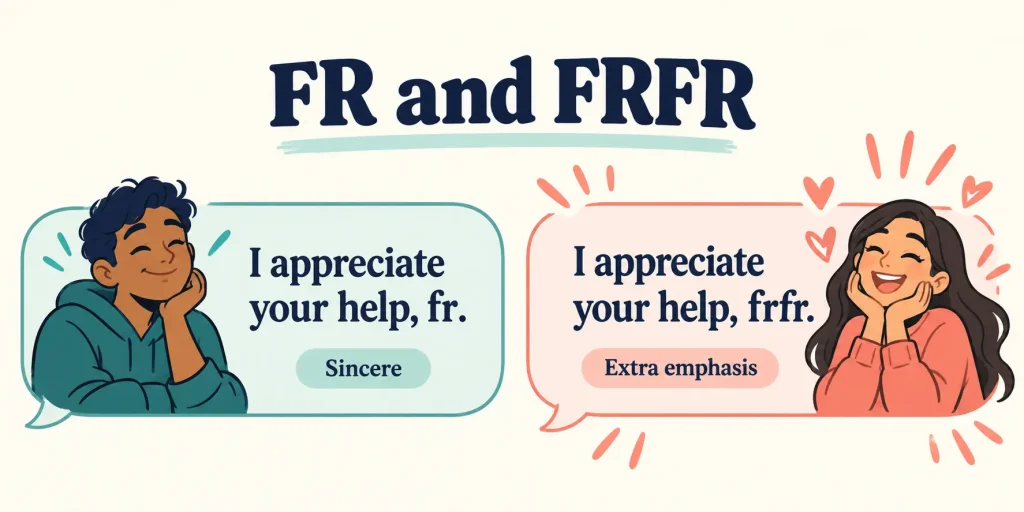
- “I appreciate your help, fr.” This emphasizes sincere appreciation.
- “I appreciate your help, frfr.” This adds another layer of emphasis.
- “frfr?” This can ask for stronger confirmation, especially after surprising news.
There’s no official scale that makes frfr exactly twice as sincere as fr. Repetition changes the conversational effect, not the amount of evidence behind a claim.
Spacing and capitalization are flexible. You may see fr fr, frfr, or FRFR. In an ordinary English-language conversation, these can represent the same expression. Uppercase may add energy, but some people simply type that way.
A useful editing test is to expand the phrase before sending it:
- Replace fr with “for real.”
- Read the sentence as if you were saying it aloud.
- Keep the abbreviation if that voice suits the recipient.
For example, “I’m taking this seriously, for real, for real” sounds emphatic. In a sensitive conversation, however, explaining what you’ll actually do can be more reassuring than repeating the phrase.
What does “be so fr” mean?
“Be so fr” means “be serious,” “be honest,” or “be realistic.” It’s a request or challenge directed at somebody else. A friend might use it as teasing disbelief; during an argument, the same phrase can sound dismissive. It generally questions a claim rather than simply agreeing with it.
The be so fr meaning becomes clearer when you expand it to “be so for real.” The wording is idiomatic slang, so a natural translation such as “come on, be realistic” is more useful than a word-for-word rewrite.

Consider two different situations:
- Playful: “I can study all of this in five minutes.” “Be so fr.” The reply challenges an unrealistic plan.
- Confrontational: “You’re upset over nothing.” “Be so fr.” The reply rejects the other person’s description of the situation.
Neither example is simple agreement. That distinction matters because copying the phrase into a supportive conversation could make you sound as though you’re brushing someone off.
“So fr” and “be so fr” aren’t interchangeable
“You’re so fr for saying that” can express agreement with somebody’s honest or relatable observation. “Be so fr” tells the other person to reconsider what they said. Look for the verb be, who is being addressed, and what prompted the reaction.
Related expressions include:
- “Be fr.” A shorter request to be serious or realistic.
- “Are you fr?” A question about seriousness or truth.
- “BFFR.” Commonly an expansion of “be fucking for real,” which adds profanity and can sound sharper.
Axis’s slang guide groups BFFR, BFR, and “be so fr” as expressions of disbelief. That family resemblance doesn’t make them equally polite. If you want a gentler response, try “Do you mean that?” or “Is that realistic?”
How do you read FR using context, punctuation, and tone?
Read fr by checking the topic, its position in the message, and the speaker’s relationship to you. A question mark suggests a request for confirmation; a reply to an opinion suggests agreement. These are useful clues, but no punctuation mark can establish the sender’s exact mood by itself.
Here’s an original Topic, Function, Tone check you can use when the meaning feels uncertain. It’s a reading aid, not a standardized linguistic test.
- Topic: Is this a conversation, a language selector, a clothing label, or a technical document?
- Function: Is the sender making a statement, agreeing with yours, asking a question, or challenging you?
- Tone: Do the surrounding words support excitement, warmth, frustration, teasing, or doubt?
- Clarification: If the distinction affects your answer, ask what the sender means.
For instance, a friend writes “fr” after “I can’t keep taking extra shifts.” Agreement is a reasonable first reading. “Are you saying you feel the same?” gives them room to confirm without forcing an emotional interpretation onto the message.
Punctuation adds clues, not certainty
A period can make a short reply look final. Exclamation marks can add energy. Repeated question marks can make surprise or disbelief more noticeable. None of those effects operates like a fixed grammar rule for everyone.
- “fr?” may ask for confirmation.
- “FR!!” may express enthusiastic agreement.
- “fr…” may suggest hesitation, but the sender’s habits still matter.
Some people use almost no punctuation in messages. A bare fr can therefore still be a question in context, especially after unexpected news. Read the conversational turn instead of relying on one symbol.
Sarcasm depends on the whole message
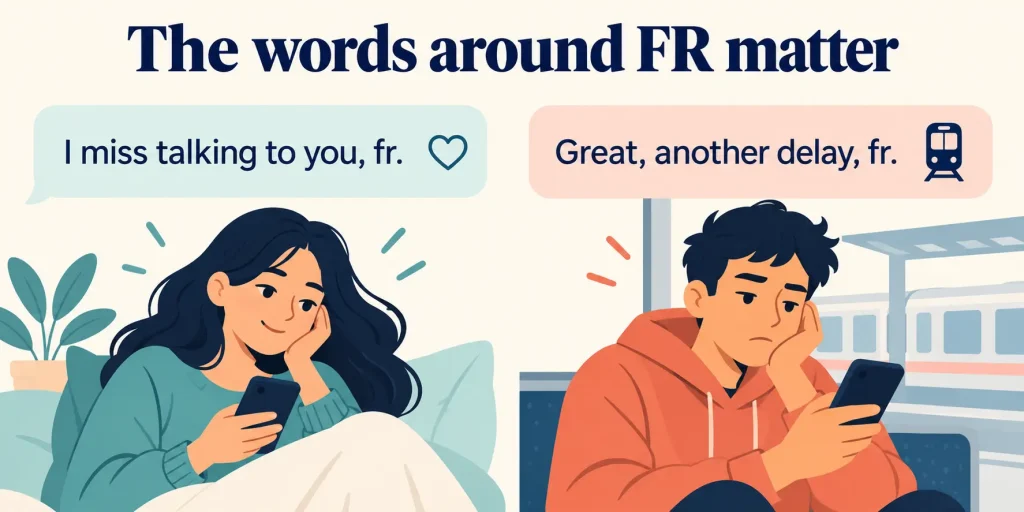
“Great, another delay, fr” could be a sarcastic complaint. The positive word “great” clashes with an unwelcome situation. The abbreviation adds emphasis without making the sentence literally positive.
By comparison, “I miss talking to you, fr” emphasizes a personal feeling. The abbreviation is the same, but the sentence gives you a different starting point. You don’t need to assign a hidden meaning to the letters.
The same caution applies when decoding WTW meaning in text: identify the conversation’s purpose before choosing a reply. A shorthand expression is easier to interpret when you know what the person is responding to.
Does FR mean something different on Snapchat, TikTok, or WhatsApp?
In ordinary English-language messages on Snapchat, TikTok, Instagram, WhatsApp, and other chat services, fr can still mean “for real.” The platform provides context, but it doesn’t automatically change the expansion. A public comment, private message, caption, and gaming reply can use the same abbreviation for different conversational purposes.
SocialBee’s glossary describes fr as shorthand for seriousness or sincerity and gives questioning and emphatic uses. Those functions are more useful to recognize than a separate definition for every app.
| Setting | Illustrative message | Likely function |
|---|---|---|
| TikTok comment | “This happens every Monday fr.” | Agreement with a relatable post |
| Instagram caption | “Needed this break fr.” | Emphasis on a personal feeling |
| Snapchat chat | “You’re moving next week? fr?” | Request for confirmation |
| WhatsApp group | “We need to decide today, fr.” | Emphasis on urgency |
| Discord or game chat | “That comeback was wild, fr.” | Emphasis on a reaction |
| Facebook discussion | “fr, the second option makes sense.” | Agreement with another comment |
These are context examples, not rules imposed by the services. The same sentence could appear on another platform and retain its meaning.
Can FR mean “friend request”?
It can if a person or community uses those letters as shorthand for “friend request.” A message such as “accept my FR” supplies a request-related clue. That’s different from treating FR as an official notification label across social apps.
Check the action being discussed:
- “That ending was excellent fr” points toward “for real.”
- “I sent an FR, can you accept it?” points toward a friend request.
- “FR pending” needs the interface or conversation around it.
Don’t expand an unfamiliar MFR automatically from what you know about fr. Added letters can create a different abbreviation, and a private group may use its own shorthand. Ask the writer or check the relevant service’s terminology.
How should you reply when someone says FR?
Reply to the purpose of the message. Confirm the news if somebody asks “fr?”, acknowledge agreement if they reply “fr,” and respond to the feeling if they use it sincerely. You don’t have to answer with slang. A short, clear sentence can fit just as well.
When they want confirmation
After surprising news, give a direct answer before adding detail. This prevents a string of reactions from leaving the original question unresolved.
- Them: “You got the job? fr?” You: “Yes! I start next Monday.”
- Them: “The event is cancelled fr?” You: “Yes, the organizer confirmed it.”
- Them: “You’re coming this time, fr?” You: “Yes. I’ve booked the train.”
Notice that the reply provides information. It doesn’t simply repeat the same abbreviation and leave the person guessing.
When they agree with you
A standalone fr may already complete the exchange. You can acknowledge it, add a related thought, or move the conversation forward.
- Them: “fr.” You: “Exactly. Let’s choose a different time.”
- Them: “frfr, that was exhausting.” You: “Same. I’m heading home early.”
There’s no requirement to send another message just because they used slang. If nothing needs an answer, the conversation can pause naturally.
When they’re sharing a feeling
Address the substance instead of focusing on the abbreviation. “I’m worried about tomorrow, fr” calls for a different response from a joke about a television show.
- Supportive: “What part is worrying you most?”
- Warm: “I appreciate you telling me.”
- Clarifying: “Do you mean you’re serious about changing the plan?”
If somebody says “be so fr” and you can’t tell whether they’re teasing, ask “Are you joking, or do you disagree?” That question identifies the ambiguity without escalating it.
For a more upbeat conversation ending, these ways to say have a great day offer alternatives you can adapt to the relationship. A reply should sound like something you’d actually say, not a collection of fashionable abbreviations.
What does FR mean from a girl, a guy, or someone you’re dating?
FR doesn’t acquire a different dictionary meaning because of the sender’s gender. In personal messages, it can emphasize agreement, attraction, appreciation, frustration, or another feeling already expressed in the sentence. The surrounding words and the person’s behavior give you more information than the abbreviation alone can provide.
“I like spending time with you, fr” sounds more personal than “That song is good, fr.” The personal content is in “I like spending time with you.” The final letters emphasize it without establishing a relationship or an exclusive intention.
Distinguish these possibilities:
- Affection: “I miss you, fr.” Respond to the feeling if you want to.
- Doubt: “You like me fr?” Answer the question directly.
- Frustration: “You never listen, fr.” Ask about the specific concern.
Avoid treating a short message as a promise. If the person says “I’m serious about us, frfr,” a useful next question is “What does that mean for you?” Their answer can clarify expectations more effectively than analyzing the repetition.
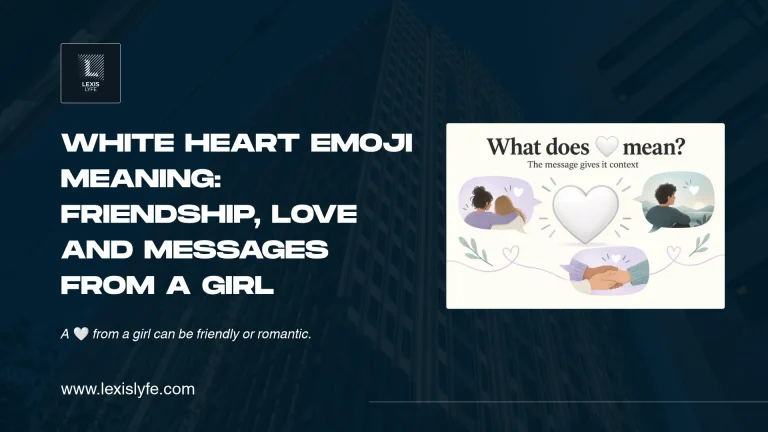
Emoji can add another layer of ambiguity. Our guide to white heart meaning in messages explores why affection, friendship, and romance can overlap in a symbol. Neither a heart nor fr can replace a conversation about intentions.
Does the meaning change across countries or languages?
In an English-language chat, start with “for real” whether the participants are in the United States, Canada, the United Kingdom, Australia, India, or France. Location alone doesn’t establish a separate slang expansion. In multilingual conversations, however, the surrounding language and the type of text become especially useful clues.
That’s a reading recommendation, not a claim that every country or age group uses the abbreviation equally. No country-by-country usage survey is needed to explain an individual message, and this guide doesn’t assign invented popularity percentages.
An English sentence such as “That was close fr” can be understood through the English phrase. A menu showing “EN | FR” points toward language options instead. Those contexts do different jobs even when the letters look similar.
For international readers, check three things:
- Language: Which language supplies the sentence’s grammar and vocabulary?
- Setting: Are you reading a chat, a product specification, or an interface?
- Local use: Has the group already explained its preferred shorthand?
The Library of Congress language-code table lists fr for French. That code identifies a language, whereas the chat abbreviation represents an English phrase.
Other short forms can require the same care. LexisLyfe’s BTA meaning across different contexts illustrates why the surrounding language and community can matter. When you’re unsure, ask what the writer intended instead of assuming a nationality determines their vocabulary.
What can FR mean outside texting?
Outside casual chat, FR, fr, and Fr. can represent different things. A language label may refer to French, a country code to France, a priest’s title to Father, and a clothing description to flame-resistant material. Identify the subject first; capitalization and punctuation provide supporting clues rather than a complete answer.
Merriam-Webster’s FR entry lists several non-slang senses, including Father, French, Friday, and the element symbol Fr. The breadth of that entry explains why a general search can return results unrelated to texting.
| Context clue | Possible interpretation | How to check |
|---|---|---|
| Language selector or language metadata | French | Look for other language names or codes |
| Country field or country-code list | France | Read the field label and coding system |
| “Fr.” before a priest’s name | Father | Look at the title and religious context |
| “Fr” on a periodic table | Francium | Check the element entry |
| FR workwear or fabric description | Flame-resistant | Read the product’s technical description |
| Older price or currency reference | Franc | Identify the currency and historical setting |
| Calendar or schedule abbreviation | Friday | Check the calendar’s abbreviation key |
| “Accept my FR” in a social exchange | Friend request | Confirm the action or local shorthand |
Cambridge’s entry for Fr. specifically explains its use as a priest’s title. Meanwhile, MCR Safety’s FR article uses the letters in a protective-clothing context. Neither page should be read as a complete definition of texting slang.
In academic writing, an unexplained “fr.” may need the author’s abbreviation list, citation conventions, or original source. Don’t assume it means “for reference” simply because that phrase would fit the letters. A plausible guess still needs verification.
How does FR compare with TBH, NGL, no cap, and FFS?
FR overlaps with expressions about honesty and agreement, but they aren’t interchangeable in every sentence. TBH and NGL introduce an honest admission; “no cap” rejects exaggeration or lying. FFS expresses frustration and contains profanity. Choose the expression according to the message you want to communicate, not just its informality.
| Expression | Expansion or plain meaning | Main conversational job |
|---|---|---|
| FR | For real | Agreement, emphasis, or a question about seriousness |
| FRFR | For real, for real | Stronger emphasis |
| TBH | To be honest | Introduces a candid opinion or admission |
| NGL | Not gonna lie | Introduces a candid reaction or admission |
| No cap | No lie; no exaggeration | Stresses truthfulness |
| Facts | That’s true | Agreement |
| FFS | For fuck’s sake | Frustration, impatience, or disbelief |
Compare “TBH, I preferred the first version” with “I preferred the first version, fr.” The first introduces a candid opinion. The second emphasizes the opinion after stating it. Their meanings overlap, but their placement and conversational effect differ.
Use these quick substitutions when learning the distinctions:
- Replace fr after a statement with “seriously.”
- Replace a confirming reply with “exactly.”
- Replace fr? with “is that true?”
- Replace be so fr with “be realistic.”
LexisLyfe’s FFS meaning and tone explains the profanity behind that abbreviation. FR itself doesn’t contain a swear word, so substituting FFS can make a message much harsher than intended.
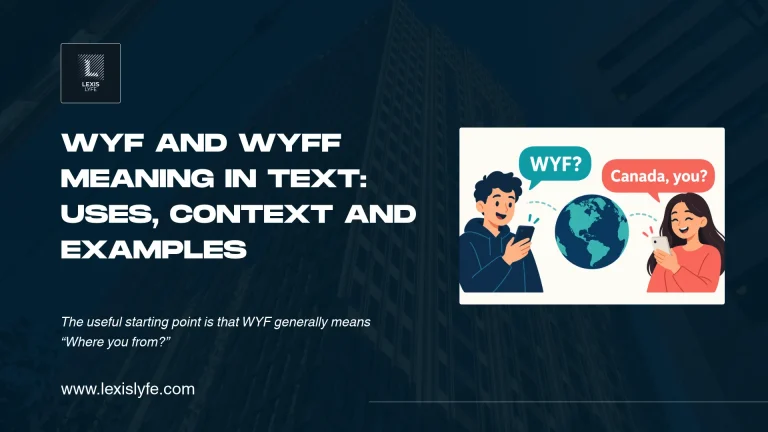
A similar caution applies to WYF and WYFF meaning in text: an extra letter can change the interpretation or create uncertainty. Learn the whole expression instead of assuming related-looking strings are synonyms.
When should you spell out “for real” or use a clearer alternative?
Spell it out or choose a clearer sentence when the recipient may not recognize fr, when the setting is formal, or when your message needs precision. Familiar friends may understand the shorthand immediately. A client, teacher, new colleague, or international contact may benefit from a direct confirmation or explanation instead.
Informal doesn’t mean incorrect in every setting. A casual message between friends serves a different purpose from an application, report, or customer email. The practical question is whether your recipient will understand your meaning and tone.
| Casual wording | Clearer alternative | Why it helps |
|---|---|---|
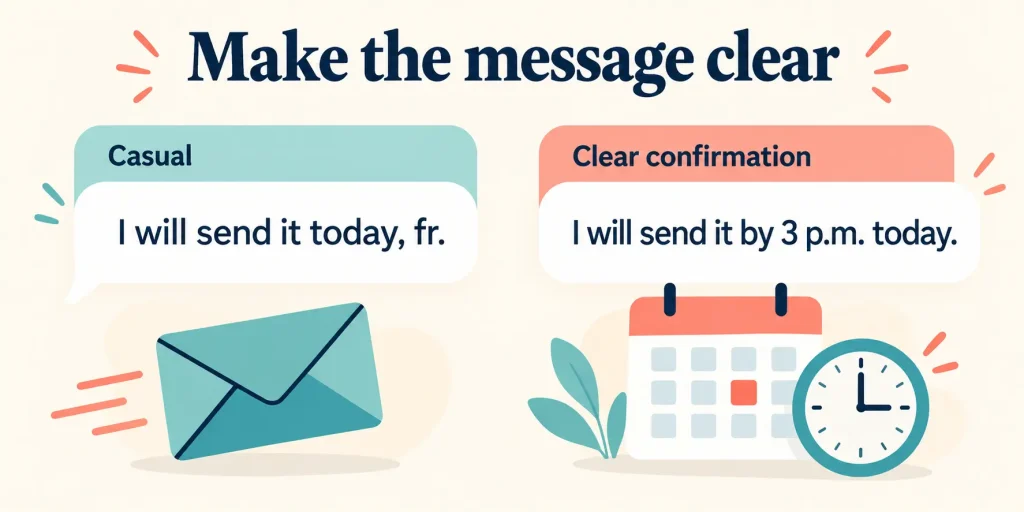
| “I’ll send it today, fr.” | “I’ll send it by 3 p.m. today.” | Adds a specific commitment |
| “That’s the right file fr.” | “Yes, that’s the final file.” | Confirms the version clearly |
| “fr?” | “Can you confirm that?” | States the request explicitly |
| “Be so fr.” | “I don’t think that timeline is realistic.” | Explains the disagreement |
Before using the abbreviation at school or work, consider:
- Audience: Do you already share an informal messaging style?
- Purpose: Is this social conversation or a decision people will act on?
- Clarity: Would spelling it out resolve a misunderstanding?
Precision matters most when somebody needs a time, action, or answer. “I’ll help, fr” expresses willingness. “I can review the first two pages tonight” tells the recipient what help to expect.
Where did FR come from, and is it only Gen Z slang?
FR shortens the spoken phrase “for real,” which predates social media. Texting and online conversations provide a setting for using its initials, but the sources reviewed here don’t establish one inventor or a definitive first use of the abbreviation. Association with younger internet users doesn’t make it exclusive to one generation.
Merriam-Webster records 1950 as its first known use of the phrase “for real” in one listed sense. That is a dictionary’s documented date for the phrase, not the invention date of fr or frfr.
Keep these claims separate:
- A phrase’s history: Evidence that people used the full expression.
- An abbreviation’s history: Evidence that people wrote the initials with that meaning.
- A platform’s influence: Evidence that a particular service helped spread a usage.
SocialBee links the expression’s internet-slang context to African American Vernacular English. That cultural attribution should not be stretched into an unsupported claim that a named app, celebrity, or generation invented the two-letter form on a particular day.
Recognizing the term is useful even if you never choose to type it. You can understand somebody’s informal writing without imitating their voice. Clear communication doesn’t require sounding like the youngest person in the group chat.
Common mistakes when interpreting FR
The biggest mistake is treating fr as a complete explanation of someone’s intentions. It signals how a statement is presented, but it doesn’t prove honesty, affection, anger, or commitment. Another mistake is assuming that every appearance of the letters online belongs to texting slang rather than a specialized context.
Avoid these seven shortcuts:
- Reading every fr as agreement. A question or challenge can perform a different function.
- Assuming frfr proves truthfulness. Repetition adds emphasis, not evidence.
- Deciding the meaning from gender. Read the sentence and relationship instead.
- Treating capitals as proof of anger. Typing habits vary.
- Giving every app a separate definition. The conversation can matter more than the platform.
- Assuming an added letter changes nothing. MFR and BFFR need their own interpretation.
- Ignoring the subject. A language selector or product label needs a different reading.
<u>A sincerity marker is not a truth test.</u> That principle is useful beyond this abbreviation. Someone can sincerely misunderstand a situation, joke while using emphatic language, or exaggerate a claim that contains “for real.”
If a friend says “I’m fine fr” but the conversation leaves you uncertain, a gentle follow-up is reasonable: “Okay. I’m here if you want to talk.” You can respect the answer without pretending the abbreviation settles everything about their mood.
Parents and learners can use the same approach. Ask what an expression means in that group, share the sentence you’re trying to understand, and listen to the explanation. Recognizing ordinary slang doesn’t require assuming that unfamiliar wording hides a problem.
Frequently Asked Questions
The most common questions about fr concern its expansion, repeated forms, politeness, and personal meaning. The answers below distinguish the words represented by the letters from what someone is doing with them. When a message remains ambiguous, the sentence and a direct clarification are more reliable than a universal slang rule.
Conclusion
FR means “for real” in casual texting, but its function changes with context. It can agree, emphasize sincerity, or ask for confirmation. FRFR adds emphasis, while “be so fr” challenges a claim. Read the topic and surrounding sentence before deciding how to reply, and ask directly when the meaning matters.
Remember the useful distinction: the letters suggest an expression; the conversation supplies the intent. A clear answer, a supportive question, or a specific commitment will do more for the exchange than guessing a hidden meaning from two letters.
Meta description: Learn the fr meaning in text, what frfr and be so fr mean, and how to read tone, reply naturally, and avoid common misunderstandings.