WTW Meaning in Text: Uses, Context and Examples
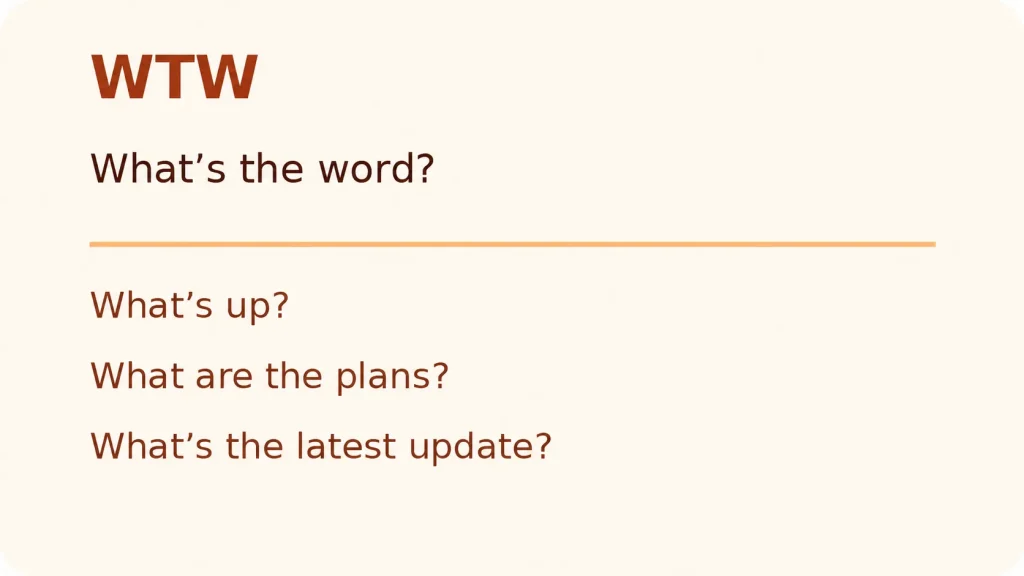
WTW usually means “what’s the word?” in a text. It is a casual way to ask “What’s up?”, “What’s happening?”, or “What are the plans?” A friend might send “WTW tonight?” because they want an update, want to make plans, or simply want to start a conversation.
The same three letters can also mean “what the what?” when someone is surprised or confused. Less often, WTW may stand for “what’s the wave?” or “when’s the wedding?” The right interpretation comes from the words around it, punctuation, earlier messages, and the kind of answer the sender seems to expect.
This guide explains the main WTW meaning in text, its common uses on social apps, how to read the context, and how to reply without sounding awkward. You will also see realistic examples, similar abbreviations, and situations where spelling out your message is the better choice.
What Does WTW Mean in Text?
In most text conversations, WTW means “what’s the word?” It works like “What’s up?” and invites the other person to share news, say what they are doing, or discuss plans. It is informal, so it appears most often between friends, relatives, classmates, dates, and other people who already speak casually.
The literal wording can sound as if the sender is asking for one particular word. That is rarely the point. In slang, “the word” means the latest information, the current situation, or whatever is happening next.
Common plain-English translations include:
- What’s up?
- What’s going on?
- What are you doing?
- What are the plans?
The broad definition is simple, but the sender’s purpose can vary. “WTW?” at noon may be a general check-in. “WTW tonight?” often tests whether you are free. “WTW with the tickets?” asks for a specific update.
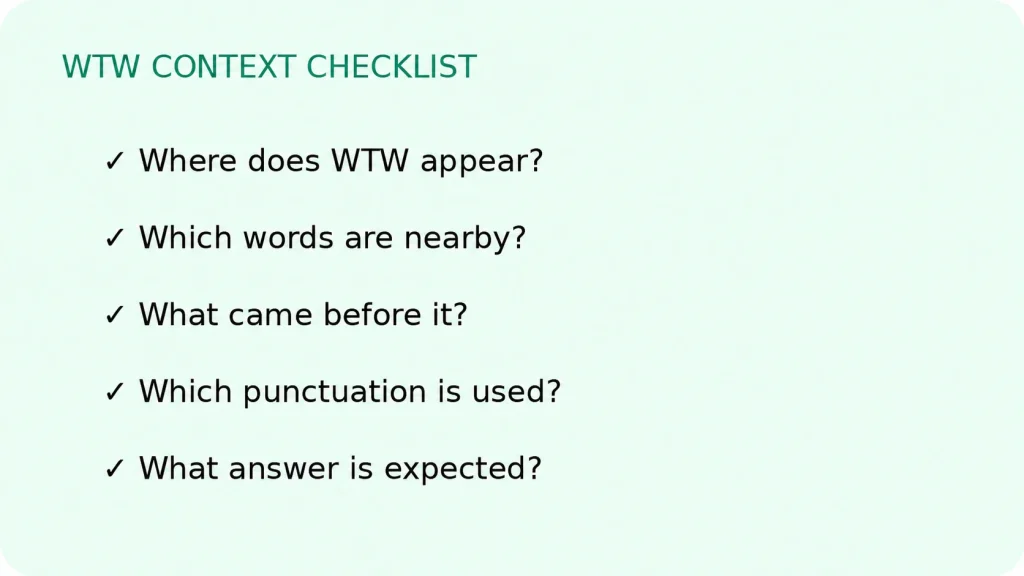
Use this quick sequence when the message feels unclear:
- Read the entire sentence, not only the acronym.
- Check the previous two or three messages.
- Notice any time, place, person, or plan mentioned.
- Look at the punctuation and emotional tone.
- Ask what type of answer would make sense next.
This context-first method is more reliable than choosing the first definition in a slang dictionary.
The Four Most Common Meanings of WTW
WTW has one dominant texting meaning and several alternatives. “What’s the word?” should be your starting assumption, but a reaction, wedding discussion, or regional phrase can change the answer.
| WTW expansion | What it communicates | Strong context clue | Example |
|---|---|---|---|
| What’s the word? | A greeting, check-in, plan request, or update request | A question mark, time reference, or conversational opener | “WTW after work?” |
| What the what? | Surprise, disbelief, or confusion | An exclamation mark or reply to strange news | “WTW! That actually happened?” |
| What’s the wave? | What is happening or where people are going | Party, event, or nightlife context | “It’s Saturday, WTW?” |
| When’s the wedding? | A playful or literal question about marriage | Engagement, couple, ring, or wedding discussion | “You two are engaged? WTW?” |
“What’s the word?” as a greeting or check-in
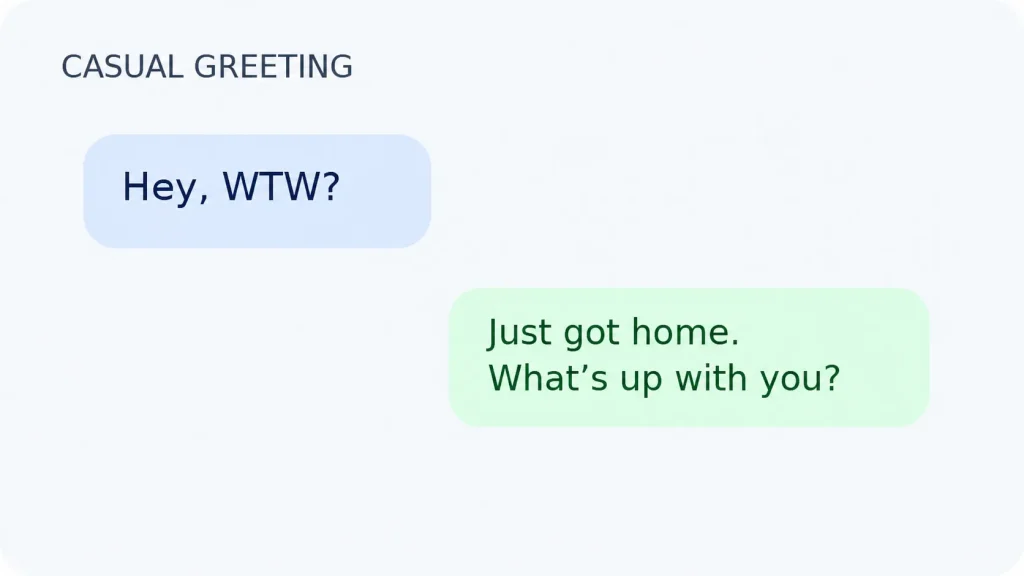
This is the standard WTW meaning in text. The sender opens a conversation without a specific subject, much like “Hey, what’s up?”
- “Yo, WTW?” means “Hey, what’s going on?”
- “Long time, WTW with you?” asks for a personal update.
- “WTW today?” may ask what you are doing.
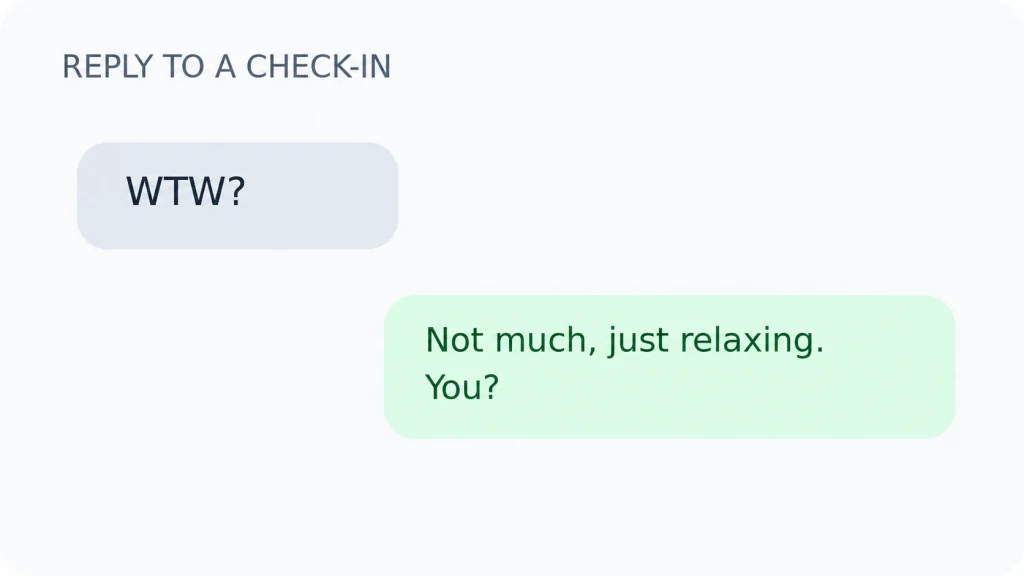
If the conversation begins with WTW, reply with a short update and return the question. “Not much, just finishing work. You?” is enough.
“What’s the word?” as a request for plans
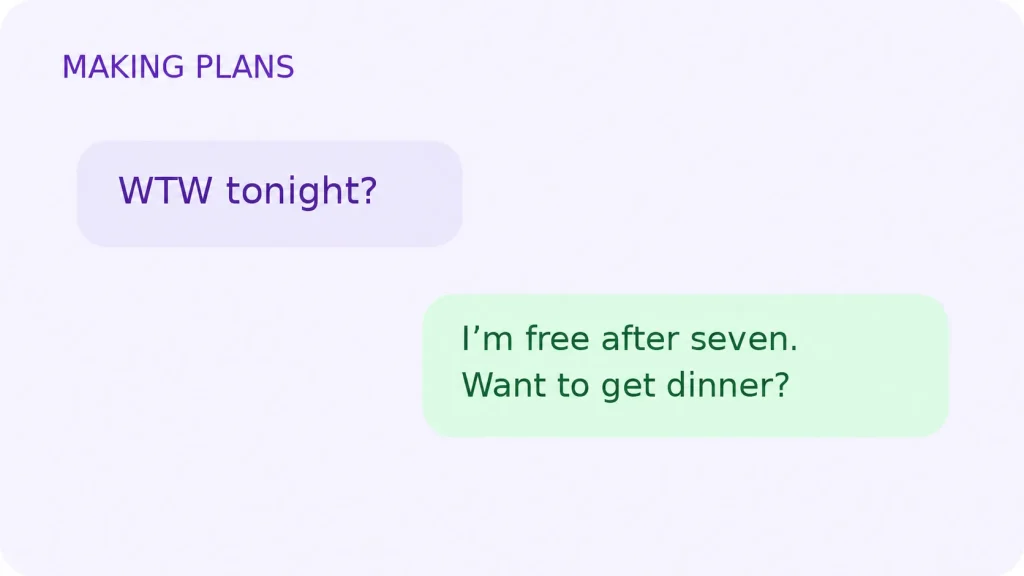
WTW often hides a practical question: <u>Are you free, and do you want to do something?</u> A time word such as “tonight,” “later,” or “this weekend” makes that reading more likely.
- Identify the time reference.
- Decide whether the sender may be checking your availability.
- State whether you are free.
- Ask for the proposed plan if none was given.
- “WTW tonight?” usually means “What are the plans tonight?”
- “WTW after class?” can mean “Are we doing anything after class?”
- “Friday WTW?” asks about Friday plans.
“What’s the word?” as an update request
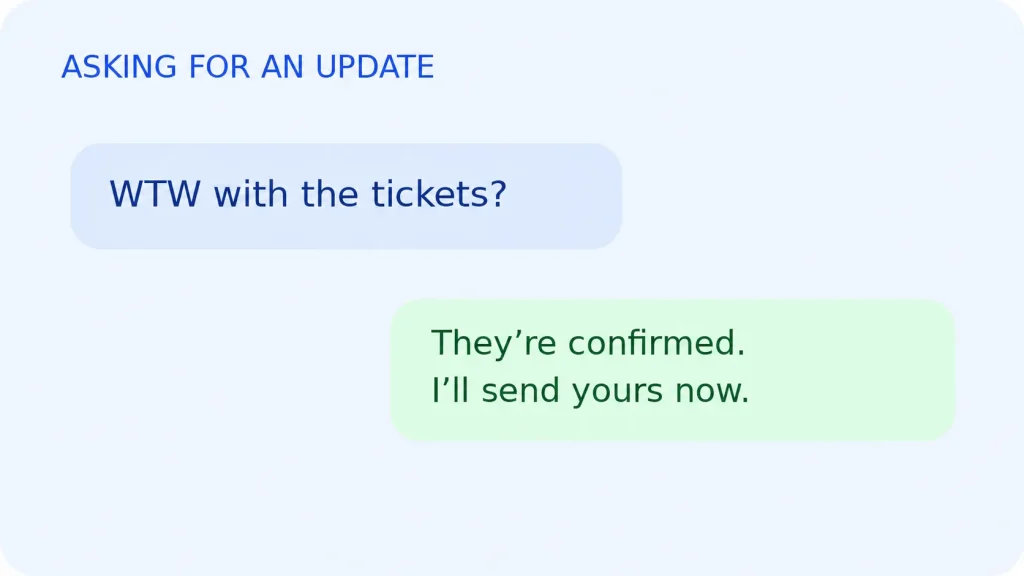
When WTW appears with “on,” “with,” or the name of a shared subject, it may mean “What is the latest information?” The sender expects a factual update rather than small talk.
- “WTW on the concert tickets?” asks whether the tickets were bought or confirmed.
- “WTW with your interview?” asks how it went or what happened next.
- “WTW on the group project?” asks about progress or decisions.
A useful response answers the subject first: “The tickets are confirmed. I’ll send yours now.”
“What the what?” as a reaction
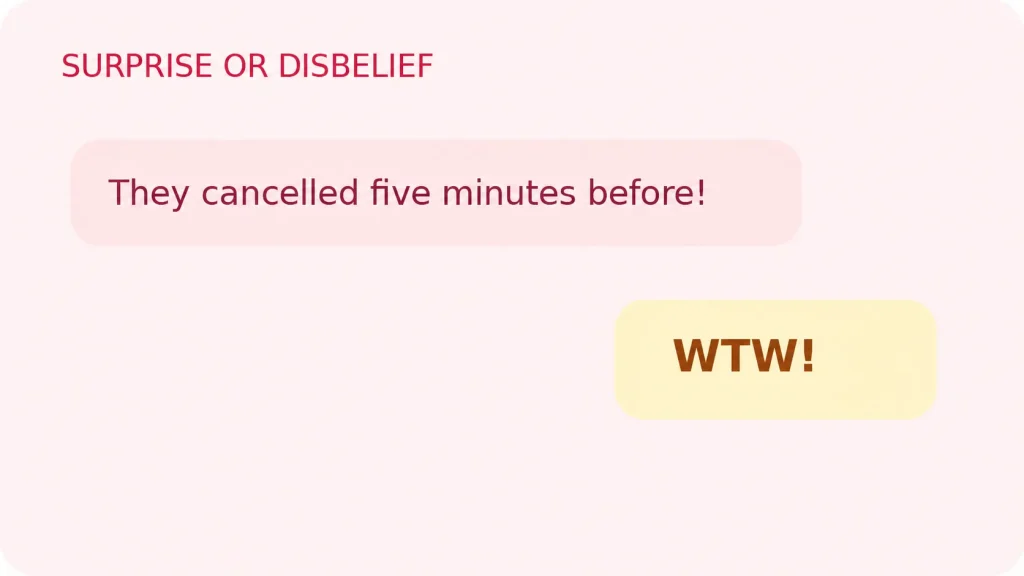
WTW can soften a stronger expression such as “What the heck?” It communicates surprise, confusion, or disbelief. This meaning usually appears after unexpected information, often with an exclamation mark.
- Look for surprising news immediately before WTW.
- Treat “WTW!” as a reaction rather than a greeting.
- Explain or confirm the surprising detail.
- Match the sender’s emotional tone without escalating it.
- “They cancelled the show five minutes before it started.” “WTW!”
- “My rent went up again.” “WTW? Didn’t it increase last month?”
- “The package went to another country.” “WTW is happening with that delivery?”
How Context Changes the Meaning of WTW
Context tells you more than capitalization does. Read WTW as part of a conversational move: the sender may be opening a chat, proposing plans, asking for an update, expressing concern, flirting, or reacting to surprising information.
The following five clues work together:
- Position: An opening “WTW?” usually starts a conversation.
- Nearby words: “Tonight,” “later,” and “weekend” point toward plans.
- Previous message: Unexpected news makes “what the what?” more likely.
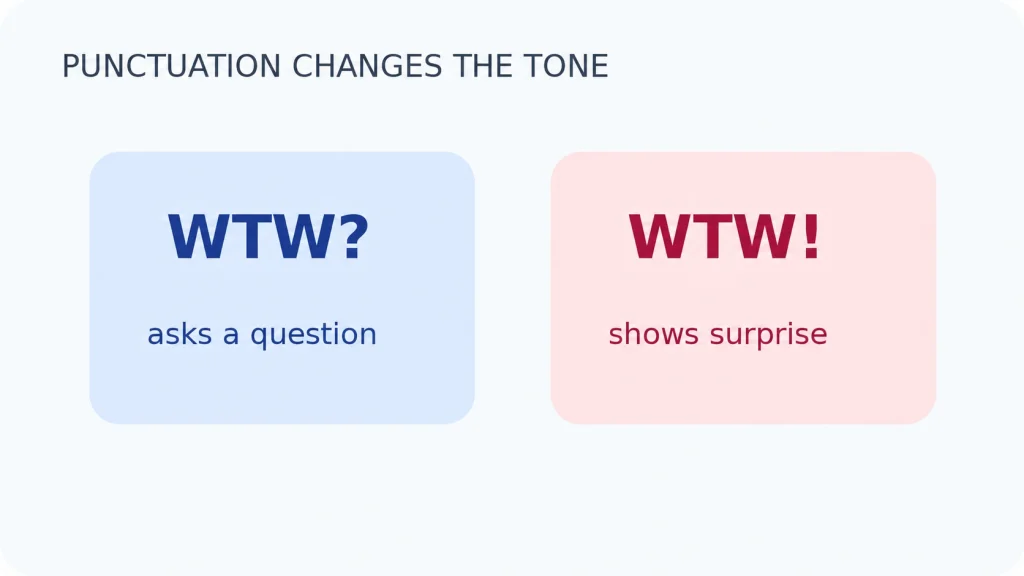
- Punctuation: A question mark requests an answer; an exclamation mark shows emotion.
- Relationship: Close friends use shorter, more relaxed wording than coworkers.
Greeting context
If WTW is the first message of the day and nothing specific precedes it, read it as a casual greeting.
- Give a brief update.
- Return the question.
Example: “WTW?” → “Just got home. What’s up with you?”
Planning context
If the text includes a time or follows a discussion about meeting, the sender probably wants availability or a decision.
- Message: “WTW after the game?”
- Likely intent: “Where are we going or what are we doing?”
- Natural reply: “I’m free. Food near the stadium?”
Concerned context
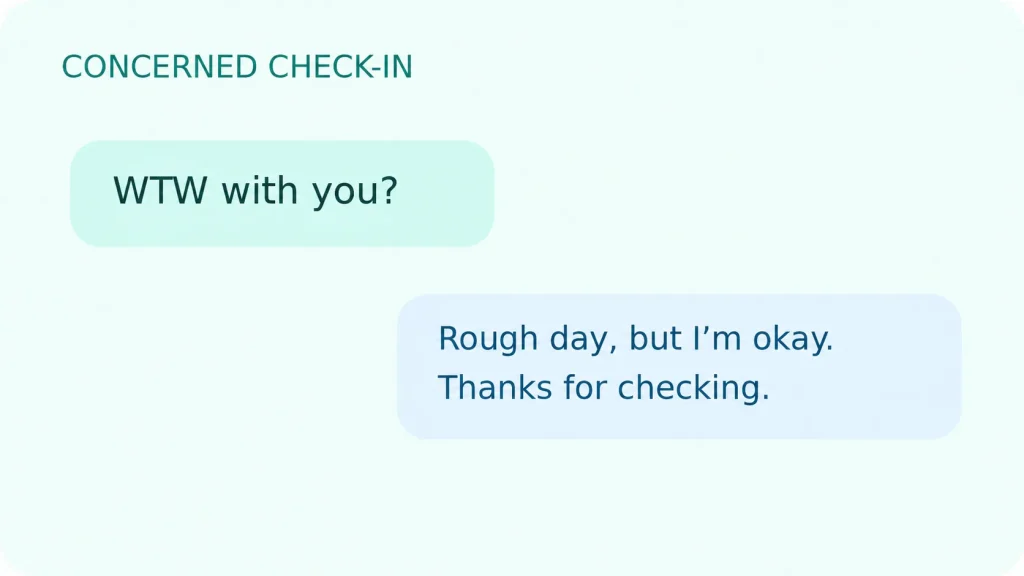
“WTW with you?” can sound more serious if you have been quiet, upset, or acting differently. The sender may mean “What is going on with you?” rather than “What are the plans?”
- A warm reply: “I’ve had a rough day, but I’m okay. Thanks for checking.”
- A private boundary: “I’m dealing with something. I’ll explain when I’m ready.”
- A reassuring reply: “All good. I’ve just been busy and slow to answer.”
Flirty context
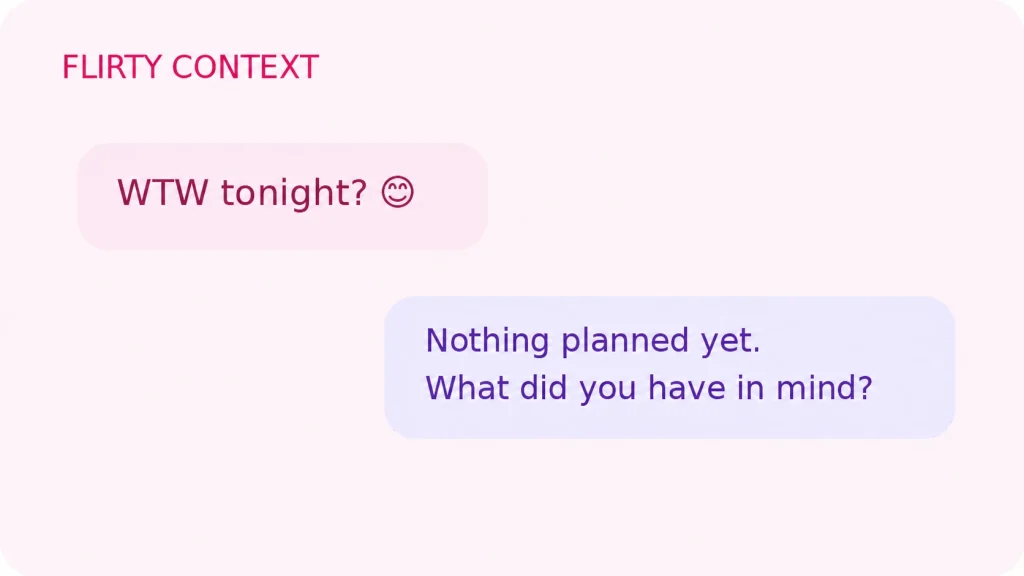
WTW can be a low-pressure way to test interest. A person may ask “WTW tonight?” before suggesting a date, call, or visit. The letters themselves are not automatically romantic; the relationship, timing, emojis, and follow-up create the flirtatious tone.
- Decide whether you want to encourage the conversation.
- Give a clear signal instead of making the other person guess.
- Suggest a simple next step if interested.
- Set a polite boundary if you are not interested.
- Interested: “Nothing planned yet 😊 What did you have in mind?”
- Friendly only: “Just having a quiet night. Hope yours is good!”
- Not available: “I’m booked tonight, but thanks for asking.”
What Does WTW Mean on Snapchat, TikTok, Instagram, and Other Apps?
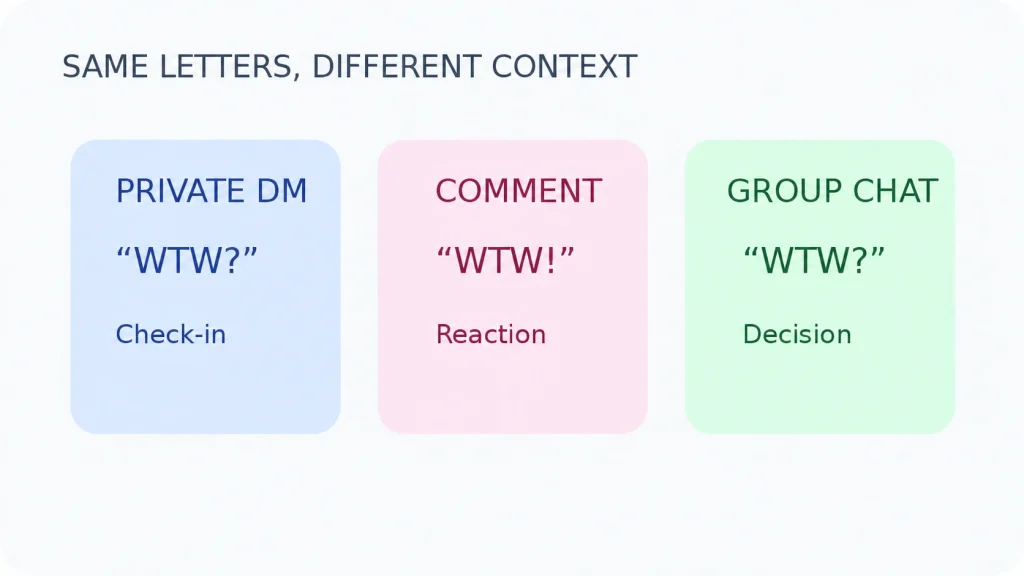
WTW generally keeps the same meanings across Snapchat, TikTok, Instagram, X, iMessage, WhatsApp, and ordinary SMS. The platform changes the surrounding clues, though. A private message may be a check-in, while a caption or comment may invite engagement or react to the attached content.
- Snapchat: A snap saying “WTW?” often asks what you are doing or whether you want to meet.
- TikTok: A comment may mean “what the what?” when reacting to a surprising clip.
- Instagram: A Story reply can ask for plans, while a caption may ask followers what is happening.
- Group chats: WTW may ask the group for a decision, location, or update.
Do not assume an app has its own fixed definition. The conversation remains the deciding factor.
- Identify whether the message is private, public, or in a group.
- Check the photo, video, post, or Story it responds to.
- Read any caption and the previous comments.
- Choose the meaning that produces a sensible next reply.
How to Respond When Someone Texts WTW
Respond to WTW by matching the likely intent. Give a brief personal update for a greeting, state your availability for a planning message, provide the requested information for an update, and explain surprising news when WTW is a reaction.
Here is a practical response process:
- Translate WTW using the surrounding message.
- Answer the likely question in one sentence.
- Return the question or suggest a next step.
- Ask for clarification if two meanings still fit.
Replies to a general check-in
- “Not much, just relaxing. You?”
- “Finishing some work. WTW with you?”
- “Doing well. What are you up to?”
These replies keep the exchange moving because they answer and invite a response.
Replies when the sender wants plans
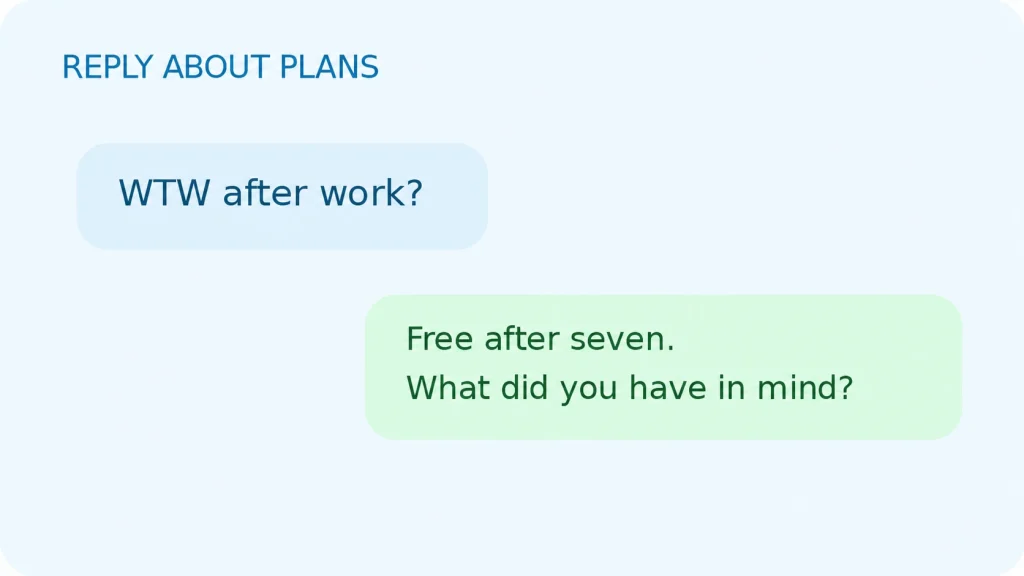
- “I’m free after seven. What did you have in mind?”
- “A few of us are getting food. Want to join?”
- “I can’t tonight, but I’m open Saturday.”
Be specific about availability. A vague “nothing” may sound uninterested even when you would like an invitation.
Replies when the sender wants an update
- “The reservation is confirmed for 8 p.m.”
- “No answer yet. I’ll message you when I hear back.”
- “We changed the meeting to Tuesday.”
Lead with the result, then add details. This is clearer than treating a specific question as casual small talk.
Replies to “what the what?”
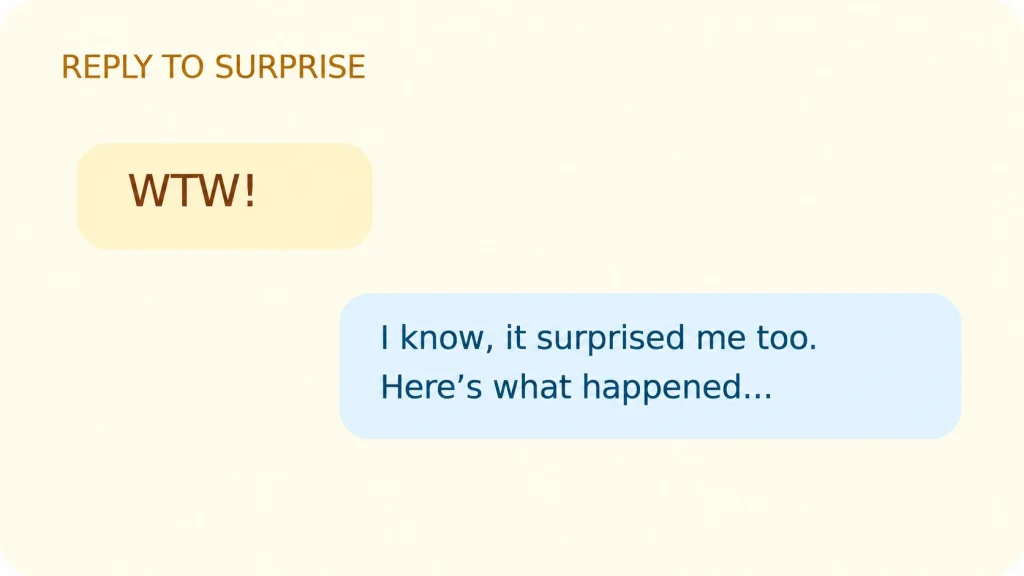
- “I know, it surprised me too. Here’s what happened.”
- “It sounds strange, but yes, that is the confirmed update.”
- “I may have explained that badly. Let me clarify.”
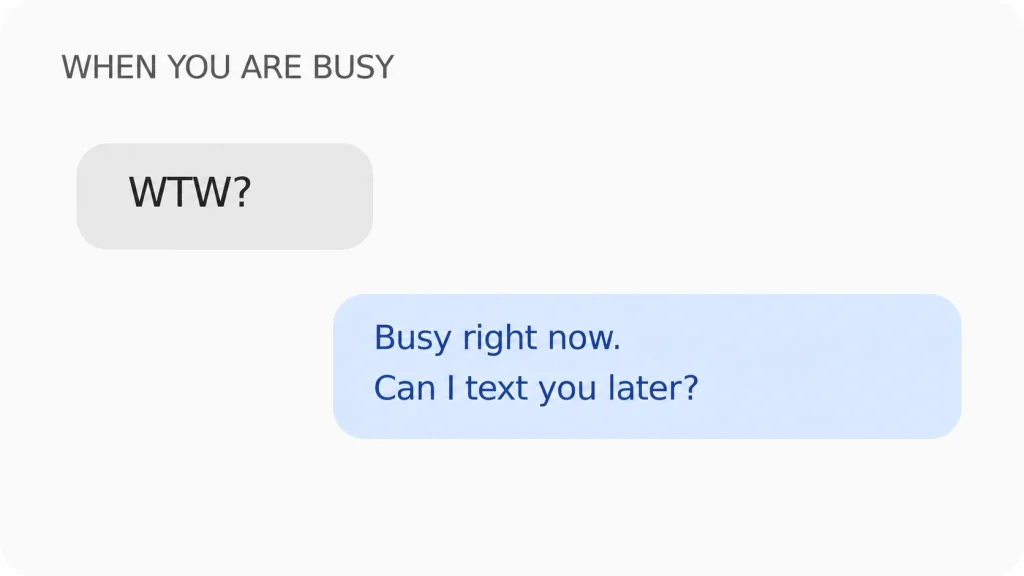
Replies when you are busy or do not want to chat
You do not have to begin a full conversation just because someone sends a casual opener.
- Acknowledge the message.
- State your availability honestly.
- Offer another time only if you want to continue.
- “Busy right now. Can I text you later?”
- “I’m heading into class, but I’ll reply tonight.”
- “Can’t talk at the moment. Hope everything’s okay.”
Clarification replies for ambiguous messages
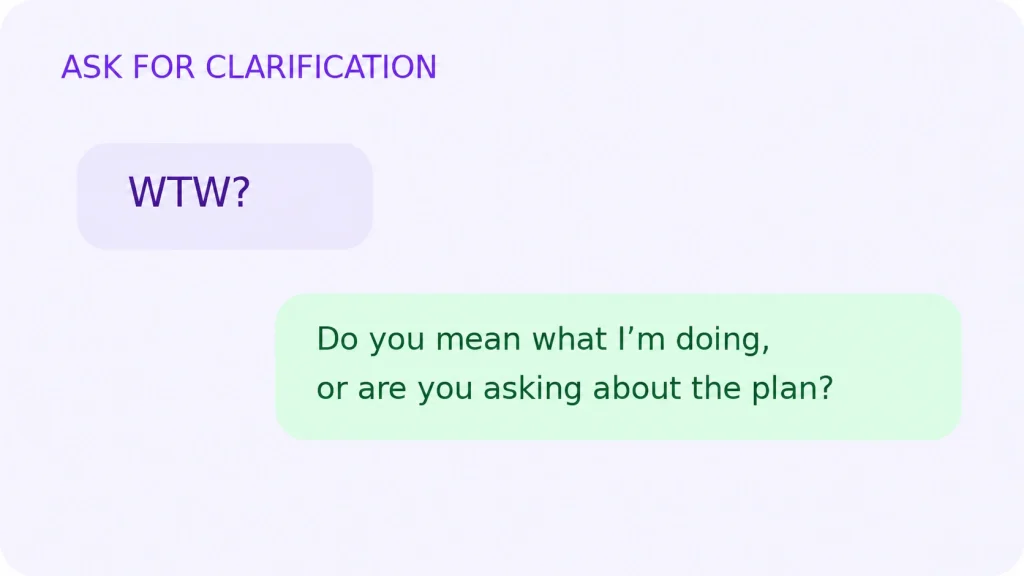
If the message could reasonably have two meanings, asking is better than pretending.
- “Do you mean what am I doing tonight?”
- “Are you asking for an update on the tickets?”
- “WTW as in ‘what’s up’ or ‘what happened’?”
Clarification is a normal conversational skill. It prevents a small abbreviation from turning into a confusing exchange.
How to Use WTW Naturally
Use WTW with people who understand casual English slang. Place it at the beginning for a general check-in, add a time reference for plans, or name the subject when asking for an update. Avoid it when clarity, formality, or accessibility matters more than brevity.
Good uses include:
- Opening: “WTW? Haven’t heard from you in a while.”
- Plans: “WTW this weekend?”
- Update: “WTW with the apartment application?”
- Reaction: “WTW! How did that happen?”
Follow these steps when writing it:
- Decide what you are actually asking.
- Add the missing subject if the reader might be unsure.
- Use a question mark for a request and an exclamation mark for surprise.
- Replace the acronym with full words if the recipient may not know it.
Capital letters and lowercase letters normally carry the same meaning. WTW, wtw, and Wtw differ more in visual tone than definition. Lowercase can feel especially casual; all caps may look more emphatic, particularly with an exclamation mark.
WTW vs. WYD, WYA, WSG, and SUP
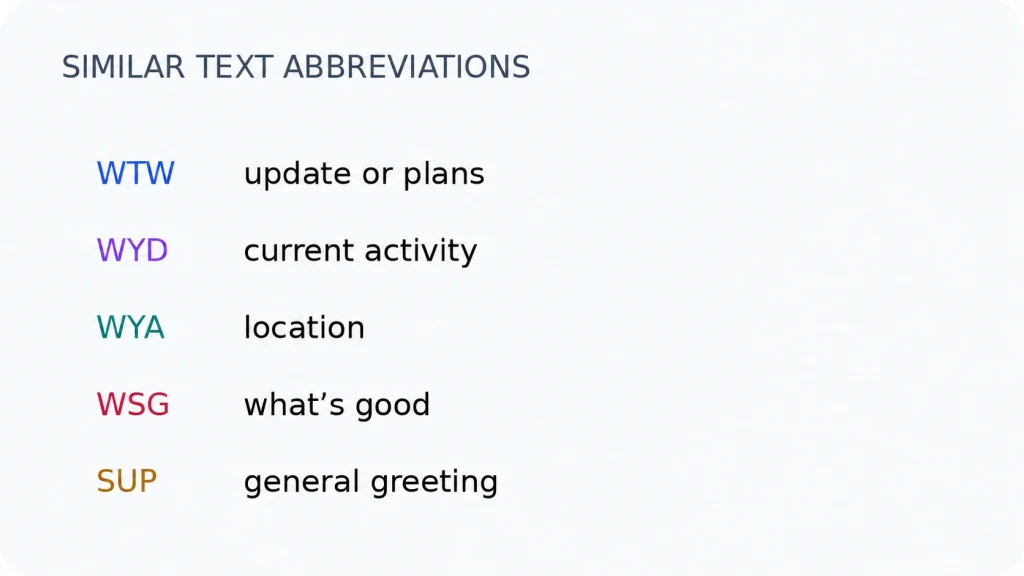
WTW overlaps with several casual abbreviations, but each asks for a slightly different kind of information. WTW is broad and context-sensitive; WYD asks about an activity, WYA asks for a location, WSG asks what is good or happening, and SUP is a general greeting.
| Abbreviation | Usual expansion | Main question | Example reply |
|---|---|---|---|
| WTW | What’s the word? | What is happening, what is the update, or what are the plans? | “I’m free later. You?” |
| WYD | What are you doing? | What activity are you doing now or soon? | “Studying at home.” |
| WYA | Where are you at? | Where are you? | “I’m outside the café.” |
| WSG | What’s good? | How are things or what is happening? | “All good here.” |
| SUP | What’s up? | General greeting or check-in | “Not much. You?” |
- Use WTW when you want a broad update or plans.
- Use WYD when the current activity matters.
- Use WYA only when you need the person’s location.
- Use WSG or SUP as a relaxed greeting.
For a wider guide to abbreviation meanings, LexisLyfe can build on its existing explanatory style, such as What Does Employer Name Mean? Examples for Forms, with a dedicated texting-slang hub.
Common Mistakes and Misconceptions
The biggest mistake is assuming that WTW always asks “What are you doing?” It can request plans, seek news, express concern, or react to surprise. Read the sentence and conversation before replying.
- Mistake: Treating every WTW as WYD. Fix: Look for a time, plan, or shared subject.
- Mistake: Assuming WTW is automatically flirty. Fix: Judge the relationship and follow-up message.
- Mistake: Reading all caps as anger. Fix: Consider punctuation and the sender’s normal style.
- Mistake: Using WTW in a formal email. Fix: Write the complete question.
Another misconception is that one online definition settles every use. Slang changes across communities, and user-submitted dictionaries can record rare, local, joking, or explicit meanings beside the common one. Treat them as evidence of usage, not a universal rule.
When You Should Avoid WTW
Avoid WTW when the recipient may not know English internet slang, when the subject is sensitive, or when the message must be clear without follow-up. Full wording works better in professional, academic, customer-service, emergency, and cross-cultural communication.
- In a work chat, write: “Do you have an update on the report?”
- With a customer, write: “How can I help you today?”
- For plans, write: “Are we still meeting at 7 p.m.?”
- When checking on someone, write: “You seemed upset earlier. Are you okay?”
Clear language is not less friendly. It simply removes the decoding step when misunderstanding would cost time or cause stress.
Frequently Asked Questions
Conclusion
WTW most often means “what’s the word?”, a casual way to ask what is happening, request an update, or find out about plans. It can also mean “what the what?” when someone reacts with surprise. “What’s the wave?” and “when’s the wedding?” occur in narrower contexts.
The best way to interpret WTW is to read beyond the three letters. Check the sentence position, nearby time or topic words, punctuation, previous messages, and the answer the sender appears to expect. Then reply to the real intent: share an update, state your availability, explain the surprising news, or ask for clarification.
Used between people who share the same casual style, WTW is quick and natural. When the audience or situation calls for precision, write the full question.